I was coming back from a completely ordinary shopping trip.
Nothing fateful. Nothing that was supposed to have any prior significance. Just a bag in my hand, my body on the way, my head still somewhat outside and yet already at home. That ordinary transition between the world and the room. Between the street and the armchair. Between what is happening outside and what one carries inside.
Hloubětín.
Domov.
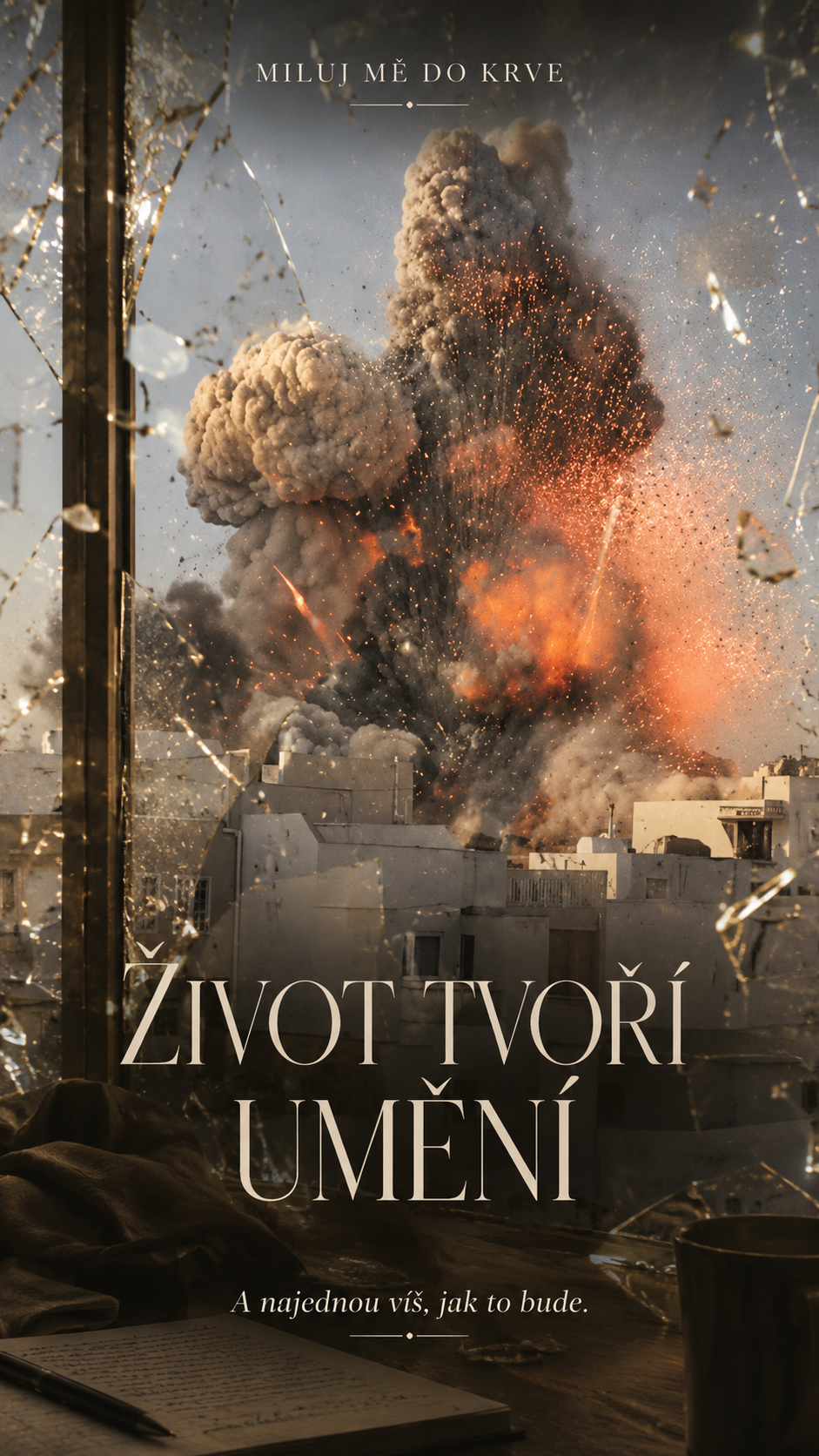
I sat down in the armchair and opened Instagram. And an explosion flew right into my eyes. Not a headline. Not a message one calmly reads and files away. Not a sentence one can keep at a distance. An image. A sharp, physical, almost indecently direct image. Someone was filming a fireworks factory explosion in Malta on a phone. An ordinary shot, without film, without direction, without prepared aesthetics. And perhaps precisely because of that, so powerful. In the distance, something opened up. Flame, smoke, pressure, a landscape torn out of its normal shape for a moment.
First the explosion.
Then the shockwave.
Then glass.
And only after that, sound.
That sequence burned itself into me. Because the sound didn't come first. First you see that the world has torn apart. Then something invisible approaches you. A force that has no face, but has an effect. It overcomes distance. It reaches the window. And then the glass shatters. That glass hit me the hardest. It wasn't just that it splintered. It was that it flew straight into the camera. And because it flew into the camera, it flew at me, too. At that moment, it stopped being just a news report from Malta. It stopped being somewhere out there. That image stepped beyond its own frame. It stepped beyond the display. It stepped beyond the safe distance that a person usually keeps between themselves and the world just to be able to function.
Suddenly I didn't feel like I was watching someone else's disaster. I felt like something right in front of me had broken. That the glass from Malta was flying into my room in Hloubětín and that the image landed inside me before I could even understand it. And only then did the sound come. Delayed, deep, almost an afterthought. As if reality struck the body first and only then added an explanation to it.
First the explosion.
Then the shockwave.
Then glass.
Then a sound.
And then a click.
Malta.
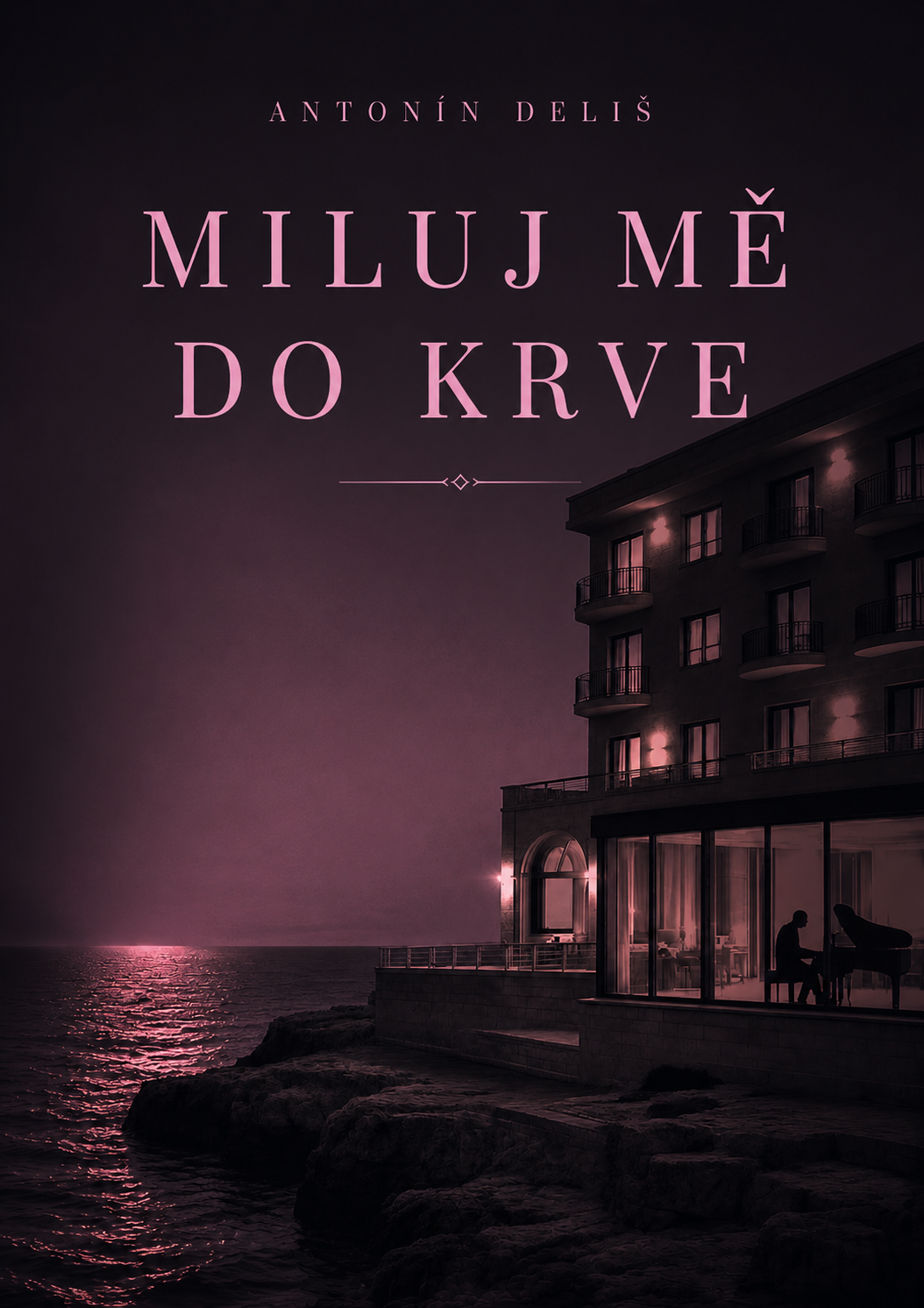
That word stopped me even more than the explosion itself. Because Malta is no longer just an island to me now. It's not just a place on a map, a holiday, the sun, stone, sea, and facades. Malta is a space in which my book is being written Miluj mě do krve. And from the very beginning, that book hasn't just been about Malta as a backdrop. It's not a postcard. It's not a summer decoration. It's a story about the disruption of space, relationships, and trust. And that is precisely what I suddenly saw in that video. A disruption of space. A window that stops protecting. Glass that, instead of being transparent, becomes a shard. A distance that ceases to apply. Safety that shatters outward toward the viewer.
And mixed into all of that is my book. A family in Malta, a hotel above the coast, a glass-walled lounge, a pianist playing not just the keys, but also the silence between the notes. Petr, sinking into the tones as if someone had lent him a spare life for a moment. Žaneta, fading away into shopping and mirrors. Markéta on the rocks, the evening in her palm, and a young Algerian who laughs with his eyes and the salt from the edge of the waves. This was already inside me. But it wasn't holding together yet. There were images, characters, a tone, the sea, the hotel, relationships, fatigue, indifference, the body of a holiday that isn't really supposed to be a holiday. There was love exhausted down to a habit. There was a family rift. There was the question of how much indifference a person can endure before a seam rips open.
Yet I was still waiting for the click. For that moment when it all comes together not as notes, but as an inner necessity. And that click didn't happen at the desk. It didn't happen when I tried to force it. It happened after grocery shopping. In the armchair. Through Instagram. Through glass flying into the camera.
And the first thing that came to my mind after the word Malta was Diana.
Diana Kassim.
My friend. A writer. A person whom I associate with Malta, writing, imagery, moving between cultures, between languages, between reality and what one compiles of it within. I knew I had her last trail stored precisely via Malta. And so, after the explosion, not just a news report opened up inside me. A name opened up. And a name is sometimes not just information.
A name is a door.
I started looking for her in the online world. Not because I knew that something had happened. I don't know that. And I don't want to make things up. Online silence is not proof. Online silence can just be silence. A pause. Privacy. Fatigue. Change. The right to disappear from visibility. The right not to be constantly findable. But at that specific moment, even that silence became part of the layer. The explosion in Malta. Glass into the camera. Diana. The silence of the online world. Hloubětín. The armchair. Miluj mě do krve. And I suddenly understood that this is not an appendix to the book. That it is not a random note on the side. That it is not a sensation I should glue onto the story to make it look more dramatic. It is the key to a feeling. To how that book is supposed to breathe.
Not as a detective story that gradually reveals the culprit. Rather as a space where something is disrupted and from that moment on nothing is separated as purely as before. The inside from the outside. Family from a stranger. Love from habit. Desire from danger. A vacation from escape. Glass from a shard. Image from body. Perhaps this is precisely what I needed to see. Not an explosion as an effect. Not a catastrophe as a plot device. But that moment when the boundary shatters.
Because Miluj mě do krve for me isn't about blood as an ornament. Blood is not decoration. Blood is proof that something has penetrated beneath the surface. That something has opened up. That the body can no longer pretend it doesn't concern it. And the glass flying into the camera is an image of the same kind. Something was transparent. Something was supposed to separate. Something was supposed to allow you to look and stay safe.
And then comes the blast wave.
And protection turns into an attack.
That is stronger than the explosion itself. Because the explosion is there. In the distance. In the world. In the landscape.
But the shards are here.
They are flying at you.
And at that moment you are no longer a spectator.
At that moment you are inside.
Perhaps writing works similarly. For a long time, you look through glass. At your own characters, your own themes, your own pain, your own material. You see them, but they haven't hit you yet. They are behind a transparent boundary. You can observe them. You can describe them. You can walk around them.
And then something comes.
Sometimes gently.
Sometimes like a shockwave.
And the glass shatters.
Suddenly you are no longer writing about a story from the outside. Suddenly you are in it. Suddenly you know that the cliffside hotel is not just a hotel. The glass-walled lounge is not just a pretty space. The pianist is not just playing music. Žaneta is not just losing herself in shopping. Petr is not just sinking into tones. Markéta is not standing on the rocks just so there would be a summer scene.
Everything is a boundary.
Everything is waiting for when it will crack.
And Diana entered into it not as a mystery to be solved, but as a human trace. As a name that appeared at the exact moment when the image of Malta ceased to be an image and became an impact. As a reminder that behind every place we use in literature, there are real people. Real cities. Real lives. Real silences. And that is precisely why I must handle this with care. I do not want to turn a real explosion into a book advertisement. I do not want to turn Diana into a character without her consent. I do not want to turn online silence into a dramatic ending. But at the same time, I cannot deny that something shifted inside me. That the image arrived right at the spot where the book was already waiting. That it was not an idea.
It was a collision.
And suddenly I knew how it would be. Not the whole thing. Not mechanically. Not like a list of chapters. But I knew what internal pressure that story possessed. I knew it was not just about relationships, but about disruption. Not just about family, but about the space between people. Not just about a vacation, but about the fatigue of love that perhaps only breathes anymore. Not just about Malta, but about an island where beauty and danger do not have to be mutually exclusive.
Life creates art.
But not always beautifully.
Sometimes it creates it through ordinary things. Through shopping. Through returning home. Through the moment when you expect nothing.
Sometimes through a person you begin to search for and find only silence.
Sometimes through an island you chose for a book, and it suddenly calls out from the real world.
Sometimes through the explosion.
Sometimes through the shockwave.
Sometimes through the glass flying right at you.
And sometimes through a single, precise, physical second when everything comes together:
First the image.
Then the pressure.
Then the shards.
Then a sound.
Then the name.
Then silence.
Then the story.