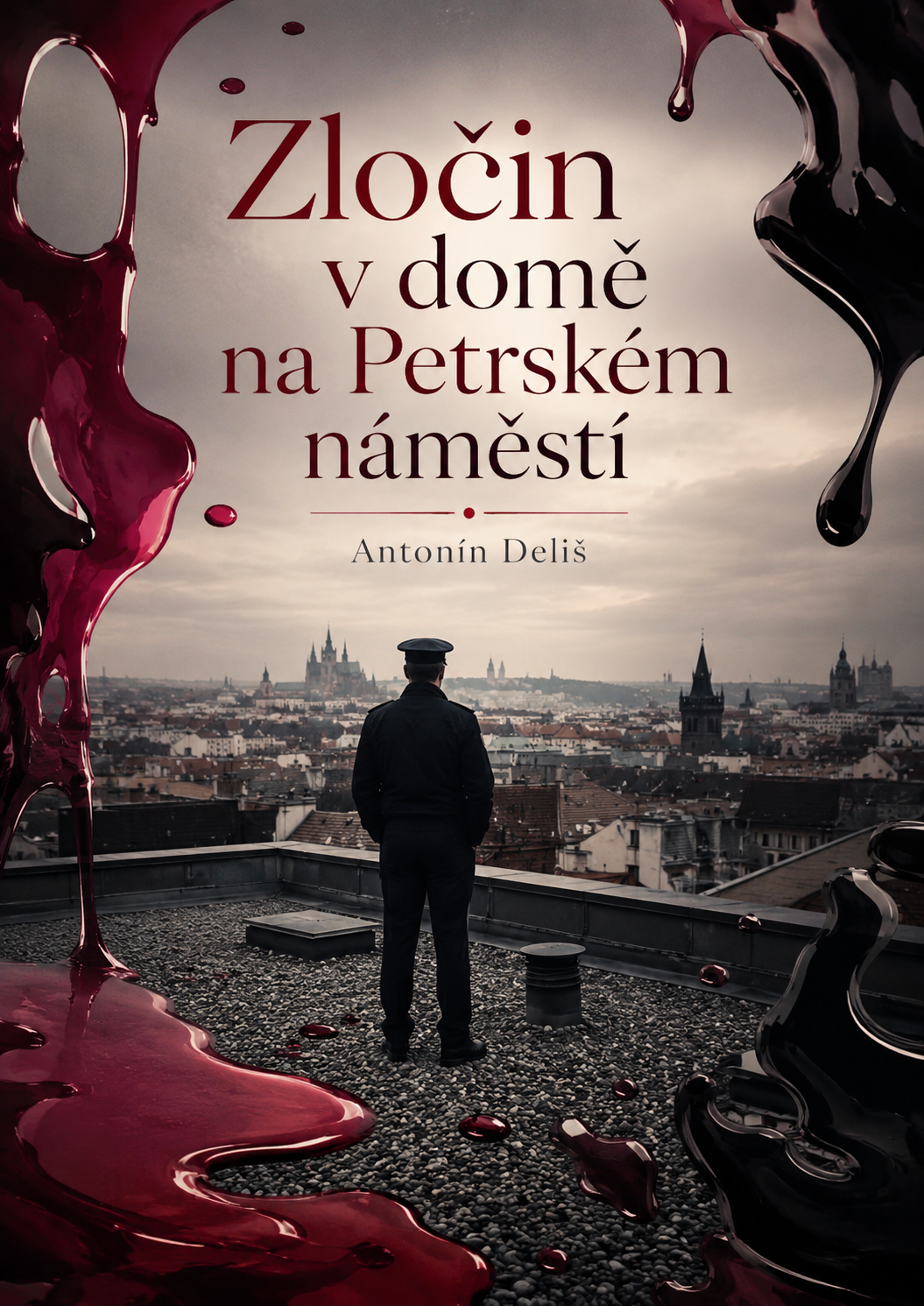
The first image of the book is not a crime. It is the reception. The reception desk, the turnstile, a non-functioning card, a person claiming to have an arranged entry, another one in a hurry, and someone upstairs who is not picking up the phone. And Marek Macura, who at that moment has to decide something that was actually never supposed to rest solely on him.
Crime in the House on Petrské náměstí does not begin with a corpse, a scream, or catching the perpetrator in the act. It begins with an ordinary work situation in which it immediately turns out that the rules of the house are not as firm as they look. Sometimes they apply precisely. Sometimes they bend. Sometimes they pretend not to exist. And every time, someone is standing right there who has to keep calm.
The house in this book is not just a building. It has entrances, exits, floors, transitions, screens, sounds, doors, elevators, corridors, and people who keep it running. The reception desk lets people in. The studio produces the image. The editing room guards the rhythm. The hallway carries fragments of sentences. The elevator mixes the floors for a moment. The corporate apartment promises privacy. And the roof reminds us that even a large building has its edge.
Yet outside its walls, Prague still exists. The city, the air, the water, different scales. But whoever stays inside for too long can easily start to perceive the building as the whole world.
The Corporate Phone
One of the important motifs of the book is the missing corporate phone. At first glance, a trivial thing. A device. Inventory. A technical matter. Something that should be easy to report, track down, log, and resolve.
Yet in this building, even a simple thing begins to linger strangely. Some questions remain hanging in the air. Some answers arrive too late. And the longer people tread carefully around the lost phone, the clearer it becomes that this is not just about a device.
It is about who is allowed to say what actually happened.
Nail Polish as a Surface
Nail polish in this book is neither blood nor a horror clue. It is a surface. Glossy, chemical, decorative, somewhat restless. Something that can seem like a minor detail until it starts reappearing in places where one would not expect it.
It belongs to the body, to the image, to the touch, to things left on the table or by the door. It can embellish a surface, but also leave a trace. And in a house where many things look more polished than they really are, even a small sheen can be suspiciously precise.
Marek as a Witness
Marek Macura is not someone who wants to change the world. He wants to make a shift change, check the door, let people in, avoid making trouble, and survive the day. Yet it is precisely people like Marek who sometimes notice the most, because they move between places that others keep separate.
The front desk does not know everything about the studio. The studio does not know everything about the corporate apartment. The hallway does not know everything about the office upstairs. But Marek passes through. He sees the keys, the glances, the records, the silences, the doors, and the phrases that pose as routine operation.
And one day, it begins to dawn on him that "faultless" does not necessarily mean "all right".
The witness in this book is not a person with definitive proof. He is a person who begins to notice that some fragments may not lie next to each other by accident.

 ForendorsČTENÍ · SLEDOVAT
 WattpadČTENÍ · SLEDOVAT
 SpotifySOUNDTRACK
 Databáze knihKARTA KNIHY
 VinylHUDEBNÍ VYDÁNÍ · ELASTICSTAGE
 E-knihaE-KNIHA · NEDOSTUPNÁ
 AudioknihaAUDIOKNIHA · PŘIPRAVUJE SE
 Kniha u partneraTIŠTĚNÁ KNIHA · PŘIPRAVUJE SE















