ENDRALON.SPACE · ČLÁNEK
9. 7. 2026
Author's Afterword
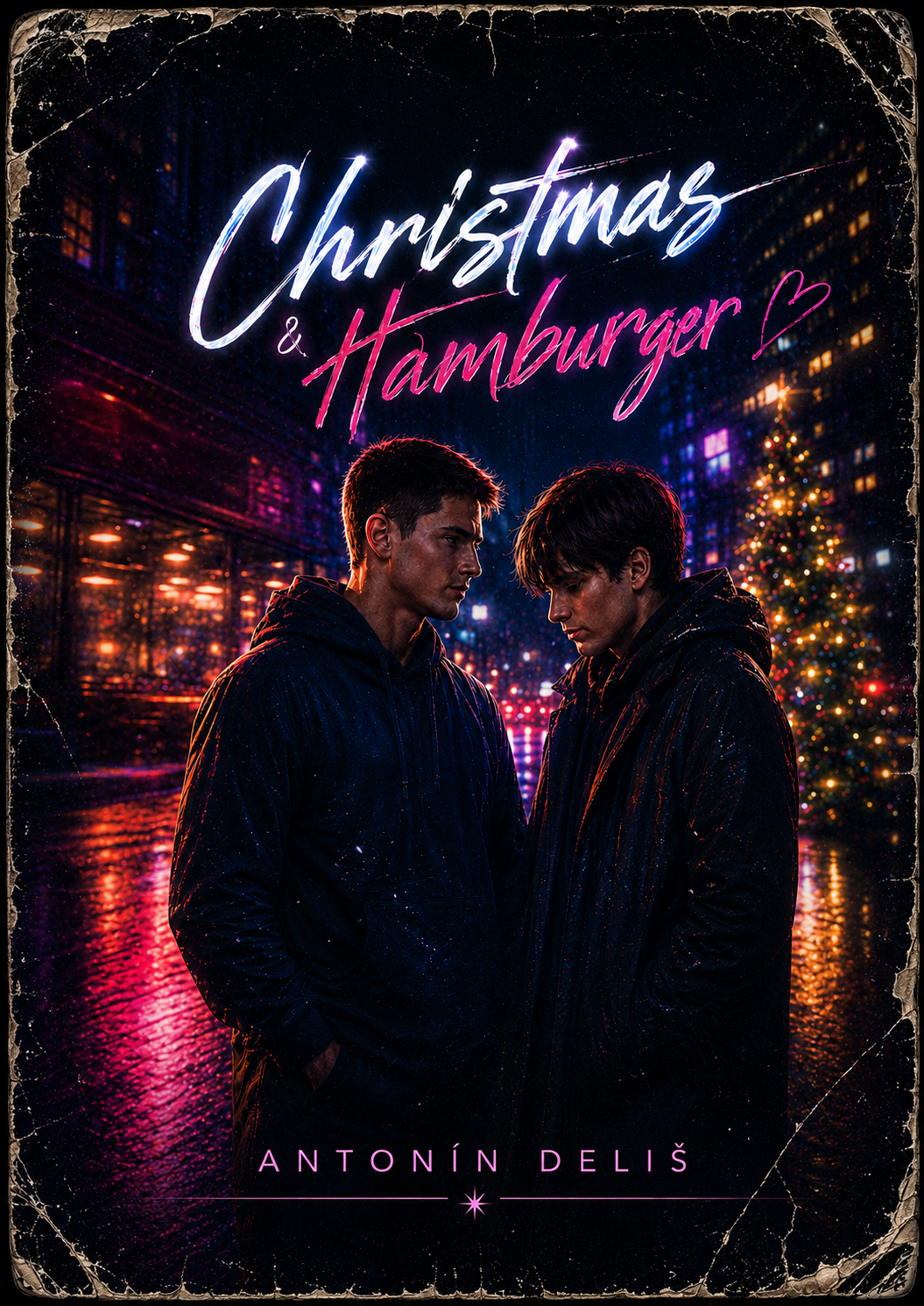
If I were to say in retrospect where exactly Christmas and Hamburger came from, I wouldn't be able to point to a single moment, a single sentence or a single image. This book didn't come about by me sitting down and deciding to write a Christmas story about two people. Rather, it had long been pieced together from things that at first glance seemed unrelated: from music, from film, from Chinese, from neurological mysteries, from […]

If I were to say in retrospect where exactly Christmas and Hamburger came from, I wouldn't be able to point to a single moment, a single sentence or a single image. This book didn't come about by me sitting down and deciding to write a Christmas story about two people. Rather, it had long been pieced together from things that at first glance seemed unrelated: from music, from film, from Chinese, from neurological mysteries, from Hamburg, from winter Prague, from a mobile translator, from images I carried in my head, and also from the question of whether I could write something more accessible without stopping being myself.
And then from one more thing, which in the end was perhaps the most important: from an affectionate conversation with my Petr, with whom we started exchanging our own tender nicknames.
Christmas and Hamburger are the two of us.
At the beginning was a question that sounds perhaps ordinary: could I write a young adult novel in such a way that it would entertain not just readers, but myself as well? I didn't want to just try out a genre. I didn't want to imitate a template where two people meet, fall in love, something gets in their way and in the end it turns out whether the obstacle disappears. I was interested in whether a relationship-focused, fragile, almost Christmas story could be written while not losing my own way of writing within it. Whether melancholy, music, weirdness, the body, awkwardness, language, the city and everything that truly interests me in writing could remain in it.
I'm not sure if Christmas and Hamburger is a novel or a novella. In scope, it is somewhere in between. It has under two hundred pages, additionally complemented by images. For me, it is mainly a lyrical story. Except not lyrical in the sense that it should stand on complexly expanded sentences and ostentatious language. The lyricism of this book is for me rather in images. In the repetition of certain gestures. In the fact that for a moment people speak through a translator and for a moment the phone is shoved into a pocket. In the fact that someone is standing by the water. That someone is holding a cup. That someone doesn't know what to say, and precisely because of that something comes into being.
A big challenge for me was to pare down the text to a minimum. To let it breathe more simply than I am perhaps used to. Not trying to explain everything. Letting the image do the work of the sentence. Letting the reader inhabit the space with their own imagination. In this sense, Christmas and Hamburger is for me narrated almost more like a film story than like a lyrical prose based on verbal ornamentation. The camera looks. The character stands. The phone glows. A tram drives by. The water flows. And meaning doesn't always have to be said out loud.
The first real impulse came from elsewhere. I came across a report about a man who woke up after an injury and started speaking a different language. I wasn't drawn so much to the sensationalism of that report, but to that fissure in the idea that language is a solid thing. I started looking for other similar cases. People after injuries, after neurological events, after a blow to the head, after waking up from unconsciousness. Sometimes they spoke of a foreign accent, sometimes of the return of a long-learned language, sometimes of the brain suddenly making accessible a different path than the usual one. I was fascinated by how little we know about what happens inside a person when they speak. How far from self-evident is the sentence we utter.
That is what gave birth to Christmas and Hamburger.
I didn't want his Chinese to be a gimmick. I didn't want it to be just a quirk that the story would use to sell a mystery. I was interested in what happens when a person understands the world around them, but the answer comes out in a different language. When their inner Czech and their spoken voice stop overlapping. When they aren't mute, but become almost mute to those around them because they speak a language that others cannot accept without translation.
Christmas therefore understands Czech, but Chinese comes out of his mouth. He can write. He can use a mobile phone. He can reach for a translator. Except that the translator in this book is not an ordinary technical aid. It is a fragile bridge. A screen between two people. A place where awkwardness, silence, and longing must fit into a short sentence. And at the same time, it is still inadequate. Because understanding words does not yet mean understanding a person.
Originally, I perhaps thought this book would lead me to Chinese practically as well. That I would start diving into it more, that I would learn more than a few words. That hasn't happened yet. Chinese remained more like an open gate. But even that ultimately fit the book well. Hamburger doesn't learn Chinese in it either like a student fulfilling a curriculum. He learns to approach it because someone he cares about suddenly lives on the other side of the language.
An important word for me became liú. A word that can carry staying, flowing, leaving, current. The exact meaning changes depending on the context. And that was precisely what interested me. That "staying" doesn't have to mean freezing. That closeness doesn't have to be a cage. That a person can stay with someone and still keep moving. That love is not necessarily a return to an old language. Perhaps it is a willingness to enter a new one.
Concurrently with this, the album of the same name Christmas a Hamburger was being created. Music for me in this book was not an accessory added at the end as a mood decoration. It was one of the ways the story came into being. The individual tracks gradually became chapters: ZAARE, Too Dark For You, After You Left, Somehow We Do, Pretty Boy, Snow in Your Hair, Something Happened to My Words, Say It Softly, Christmas and Hamburger, ZAARE Lullaby. Each title carried a piece of the plot, but even more so, it carried the tone. Sometimes I had the musical mood first and only then the scene. Other times a character arrived and the track retroactively opened up a space for them.
ZAARE was more than just a name from the beginning. It was composed of my identities, names, tracks, inner layers. ZEUS, ALEŠ, ANTONIO, RAJNEESH, ENDRALON. An acronym, a mantra, an entrance gate. In the book, it remained as the first note of the entire story, as the mood of the beginning, when it is not yet precisely known what is happening, but the body already knows that something must change. Hamburger arrives in Prague and cannot yet explain why. The body knows it before the head. That is important to me. A person often cannot explain their movement until they are already on the way.
Related to this is the time 2:45. It did not appear in this book by accident. It stems from the title of my book Usuš své vlasy v 15:30, 2:45 and returns here as an authorial trace from another story. More and more I realize that some things in my books do not need to be explained right in the book where they first appear. Sometimes their meaning only opens up elsewhere, in a different story, in a different character, in a different situation. Perhaps the answer to the question of why Usuš své vlasy v 15:30, 2:45 is named precisely that way can also be found partially here — in Hamburger's nighttime hour between the old room and the journey. At the moment when the head is not yet deciding, but the body already knows that staying is impossible.
While writing, I realized one more thing again. Not all scenes that are created have to stay in the book for which they were originally written.
I ended up completely cutting one such scene from Christmas a Hamburger. In it, Christmas and Hamburger were walking through Prague and passing a porn cinema. Christmas just remarked in passing, "That's a place you wouldn't want to visit." It was a short, ordinary scene that grounded both heroes more firmly in a specific Prague. In the end, I removed it because it distracted from the lyrical rhythm of the book.
Still, I didn't throw it away.
From the very beginning, I had a feeling that this moment perhaps didn't belong here. That it belonged in a different story. Maybe one day it will appear in the pentalogy Usuš své vlasy v 15:30, 2:45, where the same event could be seen from the other side. For some scenes don't belong to just one book for me. They belong to the world where individual stories meet, pass each other by, and sometimes finish each other's sentences in ways they would never say fully on their own.
Hamburger came from Hamburg. From the black-and-gold apartment. From a room that was beautiful and at the same time, after Dominique, became unbearable. From a place where someone loved the atmosphere, but couldn't bear the person behind it. Dominique was never a villain to me. Just as Dominik in the Christmas a Hamburger section is not a villain. I was interested in people who only like a part of another person. Sometimes truly, tenderly, attractively, almost lovingly. But only a part. An image. An atmosphere. Beauty. Melancholy. Smoke in the light. A hand on the shoulder. Not the whole weight.
Out of that came Too Dark For You.
Hamburger is not "too dark" as a pose. It is not self-pity or theatrical darkness. It is a fact he has to admit to himself after Dominique. That someone loved his black-and-gold room, his clothes, his music, the smoke, movement in the night, but didn't want to stay for the things that were no longer beautiful. For the fear, the fatigue, the truth that gets in the way in the room. Hamburger's darkness is not a flaw for him to remove. It is a part of his existence. And when someone couldn't bear it inside, Hamburger starts wearing it outside: in his jacket, his boots, the gold detail, the way he takes up space on the sidewalk.
Christmas has a similar pain, but placed differently. Dominik saw him as a pretty boy. A beautiful, fragile, slightly melancholic person you could come up to, touch, be close to for a while and then leave again. Dominik didn't have to be evil, either. He just liked closeness without responsibility. And Christmas has to name the fact that closeness without a price is not closeness. It's politeness.
The fifth chapter is therefore not just a plot stop for me. It's a ritual. A candle, angel wings pastry, sugar on the fingers, a piece of paper folded into quarters, a button that belonged to Dominik. Christmas doesn't know Hamburger there yet. He mustn't know him. That is precisely the point. He isn't calling a specific person. He's just releasing Dominik and making room for someone who won't play games with him. That space is more important than the meeting. Without it, the later meeting would just be a romantic coincidence. With it, it is the movement of two people who don't know each other yet, but each is already leaving behind something that wasn't enough for them.
One of the cinematic traces made its way directly into the book in the chapter where Christmas and Hamburger arrive on a movie set. The character of Zhang Li is inspired by the actress Zhang Ziyi — not as a literal portrait, but as a reminder of a certain cinematic elegance, focus, fragility, and strength in one body. I was interested in that peculiar moment when another world momentarily opens up within the intimate story of two people: a film, the crew, a foreign language, working with the image, a famous face who is at the same time just a person in a specific space.
At the same time, a personal memory from the filming of The Wheel of Time was reflected in this chapter. Not as a grand story, more like a small return. After years, I found myself there again in the presence of Rosamund Pike, whom I had once experienced at the beginning of her career, and suddenly those two distant moments strangely connected. It wasn't any grandiose meeting or a story told for effect. Rather, a quiet moment that lodges in a person's memory because they feel in it a peculiar connection between two distant points of their own life.
It is precisely this energy of the film set — the crew's focus, working with the image, foreign languages, a famous face ordinarily present among the others, and the feeling that some meetings in life do not return out loud, yet they still return — that indirectly found its way into the scene with Zhang Li. And it is right there that it also becomes apparent how Christmas's Chinese is not just a loss or a malfunction, but also the ability to be precise, present, and needed in another language. Hamburger sees him in a new language not as lost, but as real. This is essential for me: Christmas's Chinese is not just a loss. It is also a new home, even if strange, uncomfortable, and uninvited.
A major cinematic trace for me was Wings of Desire. A film about a city, silence, observation, the desire to be human, about a special kind of melancholy that is not dead, but listening. It didn't make it into the book as a quote. Rather, as a way of perceiving the city. Winter Prague in Christmas and Hamburger is not a backdrop with Christmas lights for me. It is a space that carries people who do not yet know where they are going. Trams, wet sidewalks, Vodičkova street, Wenceslas Square, Hot Grill, the Vltava river, a Chinese bistro. A city where a person can get lost enough to encounter something new.
Another hidden cinematic affinity for me was Krzysztof Kieślowski's The Double Life of Veronique. Not in the plot, but in the motif of dual existence, echoes, synchronicity, two lives that can miss each other and yet somehow know about one another before they meet. In this book, there are Dominique and Dominik, Hamburger and Christmas, Hamburg and Prague, the old language and the new language, the image and the person behind the image. Everything is mirrored in some way, but never completely simply.
Belonging to the bedrock of the book is also my own internal mythology: the word Vroucnopotir from Endralon — the chronicle of the angels of starry Avalon, the sound of a word that doesn't act as information, but as a bodily reverberation. Vroucnopotir is not meant to be an explained fantasy concept. It is more of a tone that the body catches before the mind does. A sound in the chest. Something that cannot be retold, but according to which one can stand up, leave, return, stay. In such words, I have always been interested in the fact that they are not lexicographically precise, but bodily true.
At one point, I also made a music video for this book, in which I sing. I didn't perceive it as a self-serving attraction, but as another layer of the same process. With Christmas and Hamburger, the text, music, image, and voice constantly mixed for me. Sometimes I had the feeling that the song knew before the chapter did. Sometimes the video opened up an image that the prose was only just catching up to. Sometimes I sang something I didn't yet know how to write precisely.
During the revisions, I was most careful not to turn the book into something too smooth. It was tempting to explain certain things. To write a sentence behind an image telling the reader what to feel. To iron out odd turns of phrase. To make it "nicer prose." But this book needs to stay a bit strange. Big emotions in it are not supposed to arrive as big sentences. They are supposed to arrive like a telephone someone picks up. Like communion sugar on fingers. Like a mug. Like an empty hook. Like a green jacket. Like a word that cannot be translated in just one way.
So to me, this book is a story about translation, but not just linguistic translation. Pain is translated into objects here. Longing into a gesture. Silence into a mobile phone. The city into walking. Love into the willingness to let another person be in the language they happen to have left or created.
Christmas a Hamburger do not reach each other because they understand each other right away. They reach each other because neither starts fixing the other. Hamburger does not wait for Christmas to return to the old language. And Christmas does not need to be saved as a beautiful, sad boy. Both must learn to let go of something: Dominique, Dominik, the old room, the old picture, the old language, the old way of waiting.
And perhaps that is why this book is a Christmas book. Not because it features December, candles, snow, sugar, and lights. But because Christmas in it is not a decoration. These are the days when a person asks what else might still come. Who might knock. What language one can learn. What it means to stay. What it means to let things flow.