ENDRALON.SPACE · ČLÁNEK
10. 7. 2026
Chapter 8: Absence
The lounge was full of people and only the piano had no one standing by it. Petr noticed this as soon as he walked in. Right away. Like when a person steps into a room where the light should be on and finds that it is dark. Someone had pushed the stool in front of the piano aside. The lid was closed. There were no sheet music left on the piano, no glass with pencils. Just a smooth dark surface of wood. Petr headed toward […]
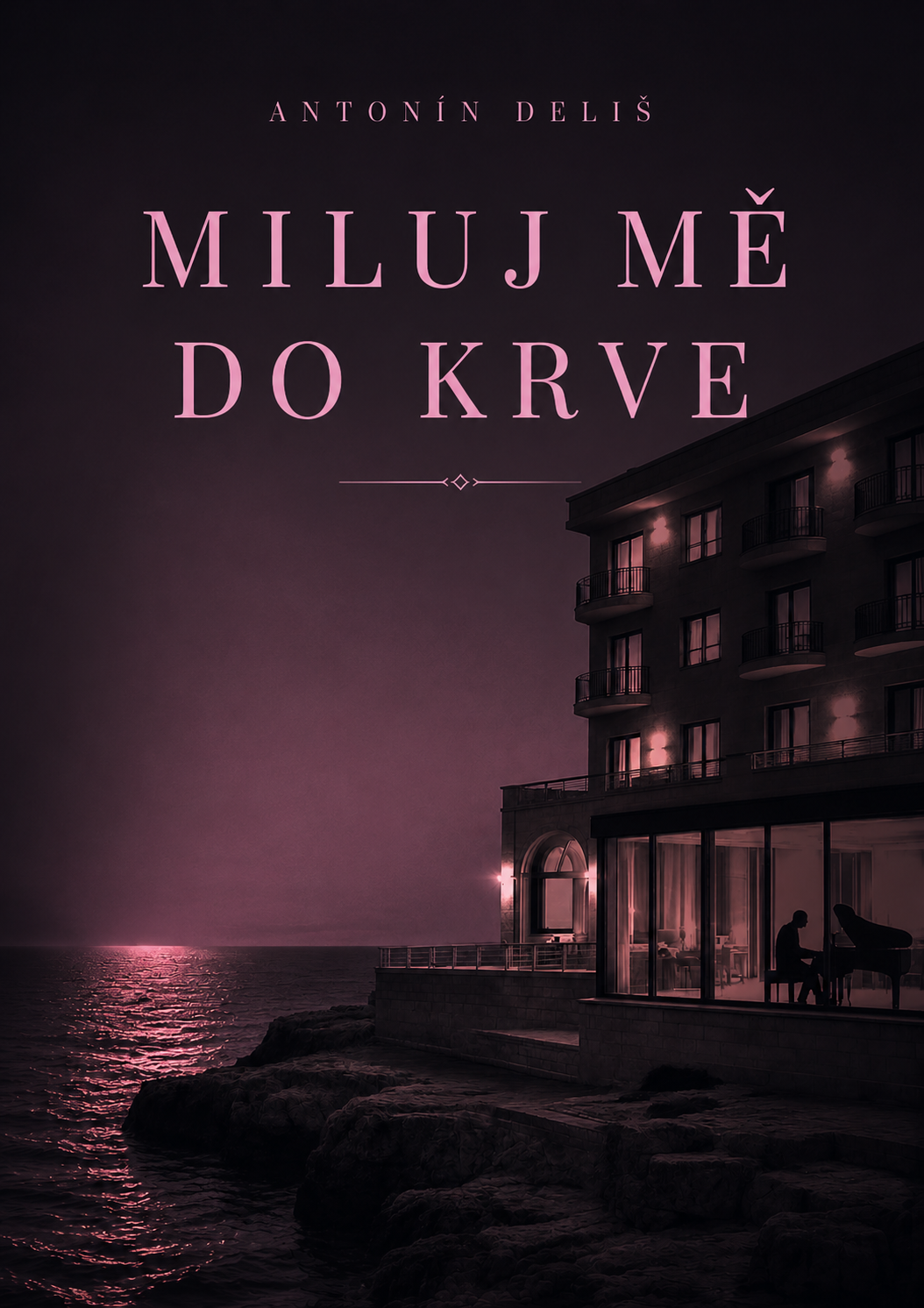
The lounge was full of people and only the piano had no one standing by it.
Petr noticed this as soon as he walked in. Right away. Like when a person steps into a room where the light should be on and finds that it is dark.
Someone had pushed the stool in front of the piano aside. The lid was closed. There were no sheet music left on the piano, no glass with pencils. Just a smooth dark surface of wood.
Petr headed toward the table by the pillar where he used to sit.
Otherwise, the room functioned like any other evening. Three men stood at the bar, a family sat by the window with a teenage son who was looking away from everyone else. Waiters carried glasses and trays, moving among the tables with the routine of a long season. The lights were the same. The air was the same. From somewhere on the terrace came the distant chiming of church bells, one o'clock, two, three — Petr wasn't counting them on purpose, but he was counting them anyway.
Only the piano was empty.
Petr sat down and called the waiter.
„Pivo, prosím.“
The waiter nodded and left.
Petr scanned the room again, this time more slowly. The adjacent table, the bar, the terrace. The door to the hallway where Radúz usually came from. Around seven, or a little past seven. Always from that direction.
The door remained closed.
The waiter brought a beer.
“Excuse me,” said Petr.
The waiter stopped.
“Isn't the pianist here tonight?”
“The pianist is absent today,” he replied with neutral politeness, as if he had already repeated that sentence several times.
„Rozumím.“
Číšník odešel.
Petr took a sip of beer.
Absent-minded.
The exact word, it does not feel like a space. The pianist is absent. As if it were a completely ordinary matter requiring no further communication.
Music began to play from the speakers. Soft, instrumental, without a distinct melody.
Petr se podíval na klavír.
He stood there as always. They hadn't moved him, hadn't covered him, hadn't adjusted him. He simply remained in his place without the person who brought him to life.
Without Radúz it was just an object.
He reached into his pocket for his phone and opened messages.
Radúz.
Their last exchange was two days old. Short, ordinary. Petr had asked about the boats to Gozo back then. Not because he wanted to go, but after their conversation, he needed to say something specific. Radúz replied. Three sentences. Information. Nothing more.
Silence ever since.
Petr wrote a short message.
I don't see you in the lounge today.
He sent it and laid his phone on the table face up.
He waited.
A group of tourists walked past outside the window. One of them gestured and the others laughed. The door to the hallway remained closed.
The green dot didn't appear.
Petr picked up his beer and took a sip. Ice clinked in a stranger's glass at the next table as someone pulled it closer—a small, regular sound he wouldn't have noticed otherwise.
Radúz could be anywhere. At the hotel, at the other end of the island, at his mother's in Gozo. He could be sick. He could have the night off. He could simply—and this was the most likely—have a free evening like any employee in any job in the world.
Petr knew that.
Yet last night kept coming back to him. The conversation. The way Radúz stood up. The way he said good night. The handshake, which was brief, formal, and yet somehow different from the previous ones. Or maybe he was just imagining it.
Why did you come?
The question had been on his mind since yesterday. Not the answer. The question.
Radúz hadn't asked it by chance. Radúz didn't do things by chance. Every word from him came only after that moment of silence in which other people start to speak. It was his habit, his way, and over that year Petr had learned to wait.
Why did you come?
And he had said I don't know.
Except what if that question wasn't an invitation to self-reflection? What if it was a farewell that Petr simply misread?
He looked at his phone.
The message remained delivered, unread.
Petr picked up the glass and turned it in his hand. The condensation crawled onto his palm.
Sorry, he'd said yesterday. For not asking.
Radúz said: don't apologize for that.
Why couldn't he apologize? Does a person only apologize when they realize what they're doing? Or only when great harm is caused? Can't they apologize simply because they didn't know what they would cause? But how could a person apologize for their own stupidity?
Perhaps Radúz just wasn't the kind of person who accepts apologies easily, because accepting an apology means admitting that it hurt.
Petr tried to stop speculating.
Someone at the bar ordered in Italian and the bartender replied in English. One of the men in the group laughed loudly. A new track came from the speakers, slightly faster than the previous one.
Petr opened his phone again.
Delivered. Unread.
Radúz either hadn't seen the message, or he had seen it and hadn't opened it. Or his phone was turned off. Or he'd left it somewhere and hadn't gone back for it.
Or he left.
It remained hanging inside him.
What happened after their conversation?
Radúz turned and headed into the side hallway. Peter saw him cross the threshold. Then the door closed and it was all over.
And today, an empty piano.
The waiter's sentence.
The pianist is absent today.
Peter tried to stop the chain of assumptions, but he was too slow. The sentences came one after another and each of them opened up two more.
Radúz asked him why he had come. Petr said I don't know. Maybe Radúz expected a different answer. Maybe he didn't expect one at all. Maybe that question wasn't even a question. Maybe it was a period. A way to say: don't come here for me, because I'm not here for you.
Or vice versa.
Or not at all.
Petr took a sip of beer and closed his eyes.
This was precisely what he knew how to avoid at work. Interpretation without data. A story composed of clues that could have been coincidental. An empty piano. Silence on the phone. A sentence from the previous evening.
The empty piano could mean illness, a day off, a change of schedule, a technical problem, anything.
Silence on the phone could mean that Radúz was sleeping, working, eating dinner, or simply didn't have his phone with him.
The sentence from the previous evening could mean curiosity, concern, or simply the words of a person speaking directly.
Petr knew that.
Still, it didn't work.
Someone at the bar pushed back a stool and stood up. A wind rose on the terrace and the door rattled.
Petr opened his messages again.
Delivered. Unread.
The green dot was missing.
For a moment he looked at those two words, realizing how much he depended on that little icon. A green circle, a few pixels: I am here, I am available, I exist on the other end.
Without it, Radúz was just a name in his phone.
And an empty piano in a room full of strangers.
* * *
Petr left the lounge without his beer.
He left it on the table, three-quarters full, and simply got up. The waiter turned to look at him, but said nothing. Petr walked through the lobby and out onto the promenade.
Outside, the heat was heavier. The air was still, saturated with salt and the scent of restaurants that hadn't closed yet. The lamps along the promenade glowed orange, and groups of tourists moved beneath them. Somewhere above the water, a gull cried out, sharper than he would have expected, and immediately vanished back into the murmur of voices.
He walked without a destination.
Or so he told himself.
Radúz's message remained unread. Petr knew it was just the message status. Technical information. It's not proof of anything!
And yet he kept rewriting it inside himself.
He walked past a corn stand. The kernels were popping on the grill—small, regular signs that something was happening. The vendor stood aside, looking at a phone that remained silent. Further along, a few couples leaned against the railing above the sea, their voices blending into a single quiet murmur.
Then he saw them.
Markéta and Yassin were sitting on the stone railing further down the promenade, where the path turned toward the harbor. They sat facing each other, each on one end of the low pillar, and talked. The distance between them was not great. Yassin leaned forward, his hands resting on his knees. Markéta had her legs pulled up under her and was saying something. She made a brief hand gesture and laughed.
Petr slowed down.
There was nothing in this that he hadn't seen before. He had seen them together on the rocks. He had seen them by the hotel. He had seen how Yassin waited when Markéta jumped across a stone. He knew what it looked like.
Even so, he didn't look away.
It wasn't the physical closeness that bothered him. It was something else. The way Markéta spoke, with a calm and naturalness as if she had known Yassin for longer than a few days. As if she didn't need to explain anything next to him. Yassin interrupted her mid-sentence, said something brief, and she accepted it without resistance. She just nodded and continued.
Petr stood on the promenade and watched his daughter.
With such effortless familiarity.
And it was precisely that which struck him.
He turned his gaze toward the sea.
He had never seen Radúz like this. From the outside. Always up close, always inside the situation. Never as a witness to someone else's conversation.
He turned back.
Yassin straightened up and took out his phone. He showed the screen to Markéta. She stepped closer, read or looked at what was there, and made a brief comment. Yassin smiled faintly and put the phone away.
Petr should have moved on.
He should have gone back to the hotel, to the room, to Žaneta. There was nothing he needed to see. There was nothing he could learn from, nothing he could fix or control. Markéta was sitting there with the guy she wanted to spend time with, having a conversation.
And yet he stood still.
Maybe because Yassin was different from what Petr had initially thought. Markéta was giving her time of her own free will. She didn't need an explanation or permission.
Or maybe because Markéta looked like someone Petr didn't know well at all. Different from the way he carried her in his head.
He took out his phone.
Still nothing.
He put it back away.
Markéta laughed again, this time quietly, with just a slight movement of her shoulders. Yassin said something else and jumped down from the railing onto the pavement. He stood next to her and both of them looked out at the sea.
Petr walked further along the promenade.
He didn't look back.
* * *
The room was dark, but Žaneta wasn't sleeping.
Petr recognized it as soon as he entered. She was lying on her back with the blanket pulled down to the other half of the bed, staring at the ceiling. She didn't move. She didn't cough. She did nothing to comment on his arrival. She just lay there and waited.
Petr quietly closed the door.
He took off his shoes and carried them to the wardrobe. He threw his shirt over the back of a chair. He did it slowly, as if every movement might be the one that would wake her, even though he knew she wasn't sleeping.
„What time is it?“ she asked finally.
„Eleven, maybe half-past.“
Žaneta nodded.
Petr sat on the edge of the bed and stayed that way for a moment. Outside, behind the blinds, the sea could be heard. Here it always reached them quietly, without pounding waves, more like a distant murmur. Like the air in an empty room.
„Where have you been?“
„Downstairs. In the lounge.“
Silence.
„For a long time.“
“Yeah.”
She didn't seem to need an explanation. Yet she left the sentence hanging in the room. Petr could feel it.
He got up and walked into the bathroom. He turned on the water, but not too much so as not to wake Markéta behind the wall. He washed his face and stared into the mirror for a moment. In the yellow light, his face looked older than he had seen himself in Radúz's eyes.
He returned to the room.
Žaneta sat up in bed. She draped a scarf over her shoulders, which she used instead of a bathrobe, and pulled her legs out from under the blanket. She sat on the edge and looked at the floor.
“Aren't you asleep?” said Petr.
“I slept for a while.”
He sat down in the armchair by the window. There were five meters between them, two beds, and ten years of unsaid things.
Žaneta ran her palm across her cheek.
„How was it downstairs?“
„Empty.“
She looked up.
"Empty?"
"Most of the evening. The pianist wasn't playing tonight."
"Yeah." She was silent for a moment. "That's a shame."
Petr nodded.
He didn't know whether she meant Polychord, or the slower song, or nothing specific at all. Žaneta used to say things like that. Sentences that could be both empty and full at the same time, and Petr was never quite sure where he stood.
“Markéta came an hour ago,” she said.
“I knew she was in the hotel.”
“Did you see her?”
“On the promenade. She was walking with Yassin.”
Žaneta adjusted her scarf.
„And?“
„Nothing. They went together. It was fine.“
„So you've calmed down.“
She didn't say it as a reproach. More as a statement she confirmed to herself midway through the sentence.
Petr leaned back in the armchair.
„A bit.“
„A bit.“
Žaneta lowered her eyes to her fingers. She ran her thumb over the nail of her index finger, as if there were a snag that needed fixing. Petr knew the movement. She did it when she was thinking about what to say.
"Petr."
“Yeah.”
She didn't continue right away.
Outside behind the blinds a scooter rode past and the engine sound passed through the room like an impersonal message.
„You've been somewhere else the whole vacation.“
She said it quietly.
„Where else?“
„I don't know where you are. But I know where you aren't.“
Petr stopped moving.
Žaneta raised her head.
"You are not in the lounge, even though you are in the lounge. You are not at breakfast, even though you are sitting at the table." She didn't hurry. "Markéta sees it too."
"Markéta sees what she wants to see."
„That's fair.“ She shrugged slightly. „But I'm not.“
Petr took a sip from the glass of water that was sitting on the nightstand on his side. The water was lukewarm. It had been sitting there since morning.
„I have work stuff,“ he said.
„I know.“
„The boss hasn't called in a week. It's—“
„Peter.“
He stopped.
Žaneta looked at him like someone who has time to wait, but doesn't want to wait.
„What?“
“It's not the first time she didn't reply right away.”
He picked up the glass and put it back down. The glass clinked softly against the wood of the small table, a little louder than he expected.
„Tenhle rok je jiná situace.“
„Možná.“
„It is.“
Žaneta neither denied nor confirmed it. She just sat there on the edge of the bed with a scarf draped over her shoulders, looking at him in that way Petr could never quite read. Not blindly. Not suspiciously. More like someone who had waited a long time to sit down, and now they had.
„The pianist didn't play today,“ she said after a while.
„I told you.“
„And that made you nervous.“
Petr didn't move.
„Why would that make me nervous?“
Žaneta shifted her scarf to her other shoulder.
„I don't know.“
She said it so calmly that it took him a second to realize what had actually been said.
Petr looked at the blinds.
An orange streak of light from the promenade penetrated through the slats. It moved gently, as if there were a wind outside, even though there was none.
"I know that pianist from my last stay," he said.
„I know.“
"We used to meet in the lounge."
„I know.“
Two words. The same. Without any change in tone.
Petr looked at her.
Žaneta was still sitting quietly, hands in her lap, her gaze resting loosely on him. She didn't look like a woman waiting for a confession. She looked like a woman who had stopped waiting and was sitting only because getting up would be pointless.
"So?"
„So nothing,“ she said. „I'm just saying what I see.“
„And what do you see?“
She looked at her palms for a moment.
„I see that for the last few days you've been waiting for something all the time.“
Petr remained silent.
„For what?“
„That's just what I don't know.“
Petr took another drink. Lukewarm water. The second gulp was no better than the first.
„That sounds very, well…“
„It's just a feeling.“
„Žaneta.“
“Yeah.”
He opened his mouth, but no sentence came. He sat in the armchair by the window with an empty glass in his hand, looking for a way to say something that would be true and at the same time vague enough to move around in.
He didn't find it.
Žaneta stood up.
She walked over to the nightstand, straightened the glass of water on his side, and then turned to her side of the bed. She didn't look at him.
„I'm going to sleep.“
„Žaneta.“
She stopped.
“I don’t want to argue,” he said.
“Neither do I.”
“I’m tired.”
“I know you’re tired.” She looked back over her shoulder. Just for a moment. “So go to sleep.”
She lay down. She pulled the blanket up to her neck and turned on her side, away from him.
Petr remained in the armchair.
Beyond the blinds, an orange strip of light swept across and vanished. The sea kept murmuring. Markéta beyond the wall was silent—either she was asleep or sitting in the dark looking at her phone, and Petr didn’t know which was better.
Žaneta was breathing peacefully.
Or she was trying to.
Petr couldn't tell if the difference existed, or if he was just imagining it.
He got up. The blanket on his side of the bed was folded. He lay down.
The darkness was orange.
He lay on his back, knowing that Žaneta hadn't said anything that could be called an accusation. She had only spoken a few sentences. She hadn't wanted an answer. And yet, somewhere in the middle of those sentences, he was like a picture that didn't have a title yet, but whose shape was already there. Clear and precise, and Petr saw it and knew he was seeing it, while at the same time not wanting to touch it, because a touch would turn it into something definitive.
Žaneta didn't move on the other side of the bed.
Petr closed his eyes.
Radúz hadn't come. The boss kept silent. Žaneta had seen what she had seen.
And none of them said the most important thing.