ENDRALON.SPACE · ČLÁNEK
12. 7. 2026
CHAPTER 7 – The One-Eyed Stone
He went out early in the morning before breakfast, before coffee, even before the apartment could take on its daytime shape. He dressed in the dark—jeans, a thin fleece hoodie, damp-weather shoes—and stepped outside. It was the end of August. The air was colder than during the day, with dew on the grass and the scent of soil that had sweated out everything it absorbed during the day overnight. The spruce behind the fence [...]
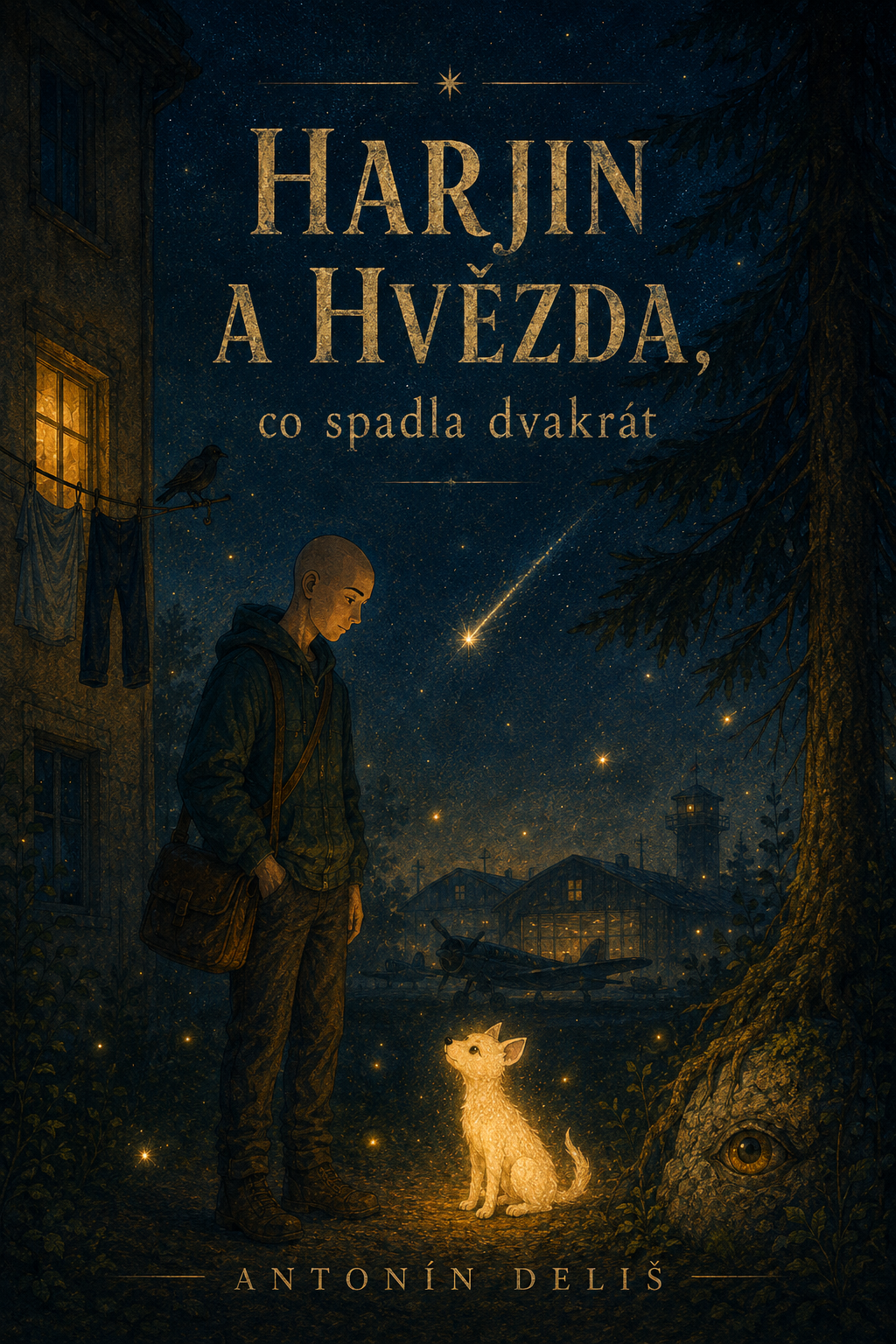
He went out early in the morning before breakfast, before coffee, even before the apartment could take on its daytime shape. He dressed in the dark—jeans, a thin fleece hoodie, damp-weather shoes—and stepped outside.
It was the end of August. The air was colder than during the day, with dew on the grass and the scent of soil that had sweated out everything it absorbed during the day overnight. The spruce behind the fence was dark and still, its branches motionless, its needles silent.
Harjin walked through the gate.
The path knew itself.
His feet followed the route they had walked so many times with Amaril side by side—under the chestnut tree, under the linden tree, past the intersection with the old telephone pole, across the first bend of the Rokytka. But now they walked alone, without a leash in his hand, without the tiny clicking of claws on the pavement.
The silence on the street was different from the silence in the apartment.
In the apartment, it was enclosed — four walls, a ceiling, a floor, and in that space, absence. Out on the street, it was open, melted into the gray sky, into the trees, and into the distant hum of Prague beyond the rooftops. Harjin carried that silence within himself differently.
Rokytka made itself heard before he saw it.
Rustling in the meander behind the field, a slight movement of water over pebbles. Harjin heard it and slowed down. He came to the bank of the small river. It flowed calmly, dark and silvery at the same time in the morning light, depending on how it caught the reflections of the sky. The water level was low — a transitional level, different from spring. Wet pebbles lay near the bank, moss in the gaps, one larger flat stone jutting out into the water.
Harjin stood by the bank. The water flowed. He swept his gaze across the surface, looking for silver dust. That strange reflection that used to be there sometimes in the evening or in the twilight light, shifting and quietly glowing.
He wasn't there today. Or perhaps he wasn't there yet. The light was too early, too gray.
He continued along the Rokytka towards the viaduct.
The viaduct was where it had always been.
Harjin saw it from afar as a dark arch over the road, with thin traces of rust on its concrete rib. It hummed with the distant pulse of Prague even when no train was passing. As if vibrating on its own, out of old habit.
Harjin walked over to the entrance beneath the arch.
He stopped.
It was a conscious pause. He stood at the boundary — the outside light behind him, the shadow of the viaduct ahead — and realized how accustomed he was to crouching down here. To taking Amaril in his arms. Carrying her beneath the arch across the puddle.
He approached alone.
The puddle was still there.
Harjin walked around it to the right. Two steps, a wide arc around it, then back onto the path.
Just the way Amaril always did it.
He walked under the viaduct.
The air inside was thick, humid, with the scent of old stone and rust from the tracks overhead. Sound rounded out within the arch. Harjin walked slowly. He ran his hand along the concrete wall — cold, rough, a thin layer of moisture that didn't disappear even in summer.
Then he emerged on the other side.
The hill was before him.
The grass on the slope was flattened, dark with dew, with grasshoppers that were not yet jumping. Too early in the morning even for them. Too cold. Harjin walked up. His feet knew the route, they knew where the slope was steeper and where the soil gave way beneath his boots.
Up top, it was quiet. A strong wind, just a gust that swept across the grass and moved on toward the trees beyond the hill. Harjin stood at the top and looked down at the Rokytka below him.
The stream was flowing.
Silver and dark at the same time.
As always.
Harjin walked over to the place where they used to sit.
Step.
The second.
Third.
There.
Stone.
It was there, as always. Flat, overgrown into the slope, with moss on top and lichen on the side. Harjin looked at it for a moment.
It was the same and yet it wasn't. Harjin was different, and thus the stone was different too. Before, it was a place to sit and watch the water. Now it was a place to sit and watch the water and Amaril is not there.
Harjin stepped closer.
He crouched down by the stone — beside it, right where he used to sit — and placed his hand on the patch of moss.
The moss was damp. Cold and thick, with a fibrous texture that held water like a small sponge. Harjin ran his palm over it. The moisture lingered on his skin.
Then he moved his hand to the center of the stone.
Where no moss grew.
It was a place smoother than the edges. Harjin hadn't noticed it yet — in the middle of the stone was an area.
Oval.
About as large as Harjin's palm. Smooth in contrast to the surrounding roughness. Not polished, not worked. Rather naturally smooth, as if the material had matured differently in that spot.
Harjin ran his fingers across the surface.
The smoothness was pure.
Without cracks, without lichen, without drifted dust that otherwise settled in every imperfection. As if that part of the stone repelled deposits.
Or was simply maintaining its cleanliness.
Harjin leaned in closer.
In the morning light, the surface looked slightly different from its surroundings. Darker. Not markedly so—it wasn't a hole or an entrance. It simply had a different sheen. Like obsidian set into grey granite.
Harjin ran his hand over it again.
With his fingers.
With his thumb.
With his entire palm.
And that was when he felt it.
Warmth.
It came quietly, without a flash or a sound. Just warmth—not like from a sunspot, not like from a stone warmed by the day. Something different. Deeper. As if it were coming from inside the stone, from a place where the material was older than its surroundings.
Harjin did not move his hand.
He remained with his palm on the smooth surface.
Then came the second sensation.
A beating.
Scarcely perceptible. Like a pulse measured through a layer of fabric, when one does not know whether they are feeling reality or their own blood in their fingertips.
Harjin held his breath.
Once more.
A beating.
Slow and steady. Steady in a different way than a heart. Longer between beats, more patient. As if the thing inside the stone were beating according to its own time, regardless of Harjin's.
Harjin stayed.
The light had shifted a little in the meantime. The sun was climbing behind the clouds, and the cloud cover was thinning where it was closest. A flash of light passed through that thin spot — not direct, but diffused, strong enough to change the color of the grass and the surface of the Rokytka below them.
And the smooth face of the stone changed in that light.
Just for a moment.
But Harjin saw it.
As if the surface had a depth it hadn't had before. As if there were a layer within the darker material, and within that layer, motion — not the motion of matter, but the motion of light coming from elsewhere.
Harjin narrowed his eyes.
And then the memory came.
Through his hands.
The warmth of a small body in his palms. Fur, short and soft, with beige patches beneath his fingers. A weight that was lighter than air and yet unmistakable for anything else. Breathing—small, regular, with short pauses.
Harjin let out a breath.
He didn't manage to name it, because it was unnameable. It was physical and complete, precise as a fingerprint in wax. A memory that didn't arrive through the mind, but through the palms.
Then the milky eye.
He saw it suddenly so close, as if Amaril had pressed her head against his elbow once again. A clouded, lighter eye with a milky layer over the pupil, through which the light refracted differently. An eye that had never seen like the other, and yet Harjin remembered it with a precision that now gripped him by the ribs.
He pulled his hand away from the stone.
He had the impression that he had opened a door and behind it was a different air. He didn't know how much he wanted to breathe it in.
He sat on the slope of the hill with wet hands, looking at the stone.
The stone was motionless.
The smooth patch in the middle was the same as before. Darker than its surroundings. Oval. Half-closed.
Harjin had the feeling he was looking at something that had existed before the world around it. Perhaps even before the word for such things.
He looked up at Rokytka.
The stream was flowing.
Harjin wiped his hands on his jeans—from the moisture of the moss, from the heat of the stone, from things he had no way of wiping off.
He thought of the cherry tree.
It came on its own. Grandmother's garden, August, a knot in the wood at forehead height, oval and smooth. Smoother than the bark. Without cracks.
The tree has an eye, he had said as a five-year-old.
Here was a different eye.
Harjin approached the stone again.
This time he stood, not sitting. He looked at the smooth surface.
An obsidian eye.
That was how he saw it.
Not metaphorically, nor as a poem. Like an eye set in stone, with a dark pupil and a layer of light behind it.
Amarila's milky eye.
A knot in the cherry wood.
The reflection on the Rokytka.
Everything in him came together without words, as naturally as the warmth of the body and its weight join in the palm of a hand.
He bent down.
He placed his palm on the smooth surface.
This time he didn't pull it away.
The warmth returned. More intensely, as if the stone knew that Harjin was holding it on purpose this time. The beating was clearer. Not loud — still gentle, still through a layer of material. But unmistakable.
Harjin closed his eyes.
And another image came.
A hill from a bird's-eye view — grass, the Rokytka below, the viaduct, Hloubětín beyond it. And on the hill, two figures: Harjin and a small white animal side by side. They were sitting by the stone. They were looking at the water.
Harjin knew it was them.
It was just a flash, then the image vanished. Emptiness remained. It was not cruel. She was gone, but she left a trace behind. Like when you take your hand out of the water and it takes a moment for the surface to settle.
Harjin stood with his palm pressed against the stone.
Then he felt a change.
The warmth shifted to the center of the surface, to the darkest point, and from that point came a gentle pressure. Moving. As if there were a heart beneath the stone and that heart had drawn closer to the surface.
Harjin let out a breath.
Slowly.
And with the exhale came a direction that didn't point the way like a map or an arrow. It smelled like the slope of a landscape pulling you in one direction and not the other. Harjin felt it in his hips, his knees, his soles.
Further.
Beyond the hill.
Beyond the Rokytka.
Across the place he knew as a boundary.
The pressure in his palm intensified.
And then the eye opened.
The darker patch on the stone changed: depth appeared in its center, like a pupil widening in the dark. It opened, and in that opening there was no light from without, but light from elsewhere. Calm, silvery, moving.
Like fireflies.
Like a reflection on the surface.
Like the dust on Harjin's hands after the first night.
Harjin did not move.
He watched.
The Eye held him with its gaze.
Something in his chest began to loosen, something he hadn't known he was still holding. An old heaviness from the morning when he opened his eyes and Amaril was not by the bed.
A tear came unannounced.
One.
It slid across his tattoos, across the lines on his face, across the marks and dots that Harjin bore as a conscious map of his life. It fell onto the smooth surface of the stone and was absorbed instantly, without a trace.
The Eye in the stone did not close.
It kept looking.
And in that gaze was an old image of Amaril: not when she was ill. Not when she was dying. Nor even the one from that last morning, but Amaril from the first night. A small white body in the impact depression. A milky eye. Warmth.
Harjin accepted the vision. In a state that lies beyond joy and pain — where things simply are and a person carries them without asking whether it is right.
Then came the knowing. Harjin knew that Amaril was not gone the way things are usually gone. No one said it. The stone promised nothing. He knew it because the hands that carried her still remembered.
And the memory of the hands is a different kind of knowledge than the memory of the mind.
But he also knew a second thing.
This was not a return.
The stone would not return Amaril to his arms. It would not slide her across its smooth surface into his palms like an object that was lost and has now been found.
It would not be like that.
Harjin knew this, and it hurt differently. Slowly. Like a truth that arrives cautiously, because coming quickly it would kill.
The eye moved again.
The light in its depth shifted. It didn't vanish. It merely moved, as though turning not toward Harjin, but toward the entrance.
And from that shift came a pull.
Beyond the hill.
Across the threshold.
Beyond the edge of the woods.
Harjin pulled his hand away from the stone.
He stood above the smooth surface and looked at it. The eye was still open — or still there where it had been. Dark, calm, silvery inside.
Then it closed.
The smooth surface remained a smooth surface. Darker than its surroundings, oval, without cracks.
As if nothing were.
As if everything were.
Harjin ran his hand across the back of his neck.
He felt warmth there.
A strange warmth. The trace of a touch that had been there and now was gone. Something was moving under his skin — not painfully, but with a sense of presence. Like light finding its way.
He couldn't see it.
But he knew it was there.
Mapa z hvězd.
Ne ze slov.
Only in the body.
He walked on.
Beyond the hill, on the side where the slope descended toward the old field and the edge of the wood. The grass underfoot was still wet from dew. Shoes squelched with every step.
Harjin didn't turn around to look at the stone.
He knew it would be the same as always.
Flat, overgrown with moss, with a smooth oval surface, old and quiet.
The field was beyond the slope.
He walked across it without hurrying. The air changed with every minute as the sun climbed behind the clouds—with that kind of distant light that does not illuminate specific things, but gives the entire landscape a different tone.
There were no fireflies.
The morning was too bright. But Harjin felt their places—the damp grass by the ford, the edge of the field where the balk joined the forest. The places where they glowed in the evening.
He walked toward the forest.
The edge was visible from afar—the first trees, young and sparse, with white rain marks on the bark. Beyond them older ones, dense, dark. Between them and the field was a strip of bushes and reeds, full of moisture and riverside scent.
Harjin walked through the reeds.
The branches reached for his sleeves, damp and cold, like hands without purpose.
He stepped to the edge of the forest.
The light changed instantly.
It didn't disappear.
It transformed.
The gray morning outside became a different gray in the woods — deeper, more fragrant, with layers that didn't exist outside. The scent of moss, decaying leaves, resin, old wood. The air was more humid. Every breath brought more.
Harjin stopped at the first line of trees.
He looked into the woods.
There was gloom among the trees. The trunks stood like pillars, some closer, some further away, and the light passed between them in thin strips, low, almost near the ground. Where the beam of light struck the moss, it glowed green.
Nothing moved.
Not a bird.
Not a wind.
Harjin took a step further.
The grass beneath his feet turned to moss and pine needles, quieter, softer, without a rustle. The step was different. Too quiet, almost as if the landscape were swallowing the sound.
A second step.
Third.
Then he heard a bird.
Not a song. More like a short signal — two notes, gentle, with a pause between them. Harjin raised his eyes.
On the branch of a spruce above him sat a bird. Small, dark, with a bluish tinge of feathers on its wing, right where the light caught it. Exactly like the one on the birdbath in the garden.
Or something similar.
Harjin looked at him.
The bird looked down.
It hopped from branch to branch, deeper, toward the trunk of the old fir tree, and stopped there.
Harjin watched it.
And then he followed it.
Not because the bird had commanded him.
Because the pull was the same.
The one he felt under his palm on the stone.
The one who got him out of the apartment in the morning.
The one who walked all the way from the spruce tree across the viaduct and the hill to here.
The forest accepted him silently.
Trees closed around him — Harjin walked among the trunks, across roots, past places where the ground dipped into small hollows full of moss.
The light was fading.
It didn't disappear.
It changed.
It ceased to have an external source and became something else — diffused, almost shadowless, like light in a mist.
Harjin walked on.
A bird hopped from branch to branch ahead of him. Always a little further. Always within sight. Never too close. As if it were keeping the distance on purpose.
Then the forest changed.
Harjin felt it first, and only saw it afterward.
The air was different. A bit heavier. Not more humid—heavy in a different way, as if it contained something extra. The scent changed: still moss and needles, but beneath them something Harjin had no word for. Old and calm and slightly metallic.
The light was different.
Harjin looked up and saw the sky through the branches — but the sky had a different tone. More bruises in the gray. More depth. As if a piece of the sky had been overexposed through a different filter.
He stopped.
A bird was sitting on a branch right in front of him.
He looked at Harjin.
Then it took flight.
It flew over Harjin's head — Harjin felt the draft of its wings, warm and brief — and dropped down on the other side.
Beyond the trees.
Beyond the line, which wasn't geometric, yet clear all the same.
Beyond the place where the forest ceased to be that forest.
Harjin walked toward that line.
A root lay beneath his feet, thick, protruding above the surface of the soil like a parenthesis.
Harjin stepped over it.
The air changed instantly.
Like stepping from one room into another with a different temperature. Harjin felt it on his skin, on his bare skull, in his nostrils. The air was cooler, yet fuller, as if it contained more.
The forest beyond that line was the same and different.
The trees were trees.
Trunks, branches, needles, roots.
But the light between them did not fall from above. It came from the sides, from the ground, from places where the moss was a little lighter. Diffuse, shifting, without a source.
Harjin stood and watched.
Beneath his feet was moss.
He exhaled.
And then he felt that warmth on the back of his neck again.
Stronger than on the hill. As if the drawing beneath his skin, that invisible map, lit up like light passing through paper.
The bird was gone.
Harjin didn't look for him.
He looked into the woods beyond the line—into the deeper gray, into the shifting light, into a space that wasn't quite his world, and yet was a landscape he knew.
Somewhere there was water.
He heard it distantly, softly. A rustling, too quiet for a river, too present for rain.
Harjin took a step.
He stepped past the line.
And the world beyond it was there.
Trees.
Mech.
Pohyblivé světlo.
Cold.
And the pull that now wasn't directional, but was all around. As if the landscape itself were reorganizing around Harjin and adjusting its gravity to his presence.
Harjin stood still.
He looked at his hands.
Right.
Left.
With his fingers.
Skin that still carried the warmth of the stone, that carried the memory of fur and beige spots, of blankets, bowls, and a leash on a hook.
He was alone.
And yet not.
The air around him was too present for solitude. In that light which came from nowhere else, in that sound of water without a source, in the trembling of moss beneath his feet, there was something Harjin did not know by name, but knew in his body.
Like the warmth of a small body in his palms.
Like a heartbeat in the stone.
Like a brush of wings overhead.
Harjin closed his eyes.
He accepted the air.
He exhaled.
And when he opened his eyes, he was in another light.