ENDRALON.SPACE · ČLÁNEK
9. 7. 2026
Kapitola 6 – Snow in your hair
Someone in the next room turned on the shower. The pipes in the older building started trembling with their characteristic rattle that cuts right through the wall. Hamburger lay on the bed and stared at the ceiling—white, with a white lightbulb, no golden line. I'm in Prague. For a moment he thought he was lying in Hamburg, in the black-and-gold apartment. Only the rattling of the pipes behind the wall brought him back. Hostel. Vodičkova […]
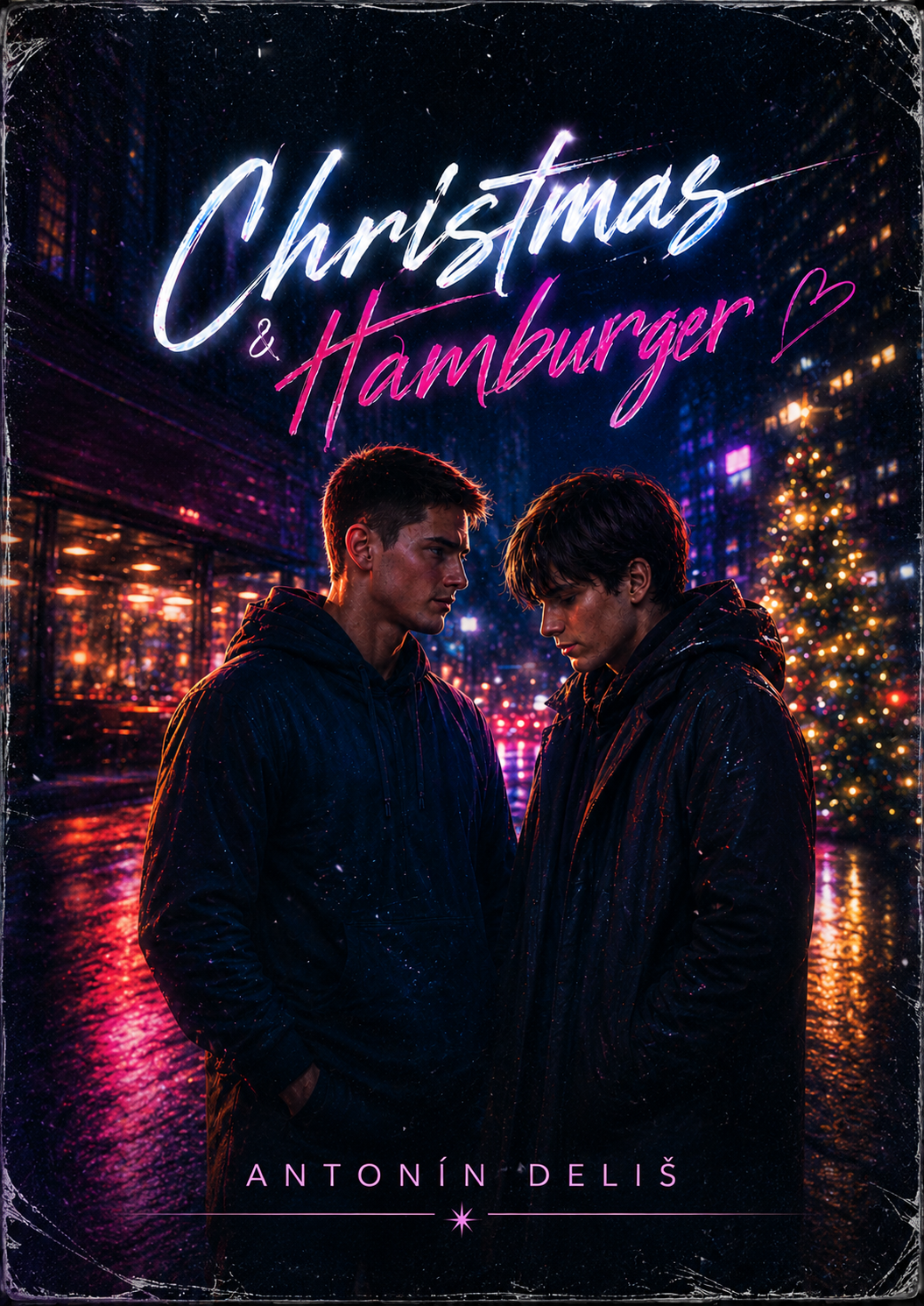
Someone in the next room turned on the shower. The pipes in the older building started to vibrate with their characteristic rattle that carries right through the wall. Hamburger lay on the bed and stared at the ceiling—white, with a white lightbulb, lacking any gold trim.
I am in Prague.
For a second he thought he was lying in Hamburg, in the black-and-gold apartment. Only the clanking of the pipes behind the wall brought him back.
Hostel. Vodičkova Street. Prague.
He stood up.
Two people in the room were still sleeping. Or at least lying there. One with an earphone in, the other with a jacket thrown over their face as an improvised shade. Hamburger quietly took his things from his suitcase and went out into the hallway.
The bathroom was free.
Hostel bathroom. The mirror a little too small, a little too high, set for an average person, not for Hamburger.
Shower.
Brushing teeth.
He got dressed in front of the hallway mirror. A narrow reflection. Jacket, this time not the big one with the asymmetrical zipper, but shorter, darker, with a high collar. Trousers. Scarf — dark, shorter than yesterday, wrapped only once around his neck. Gold hoop earring. Glasses. Suitcase locked under the bed. Key card in his pocket.
He went out.
Prague in the morning was different from Prague in the evening.
Every city is different in the morning, but Prague surprised him with its solidity. In the evening it was luminous, dreamlike, shifting, in blue-gold light where things lost their precise outlines. In the morning the outlines were harder. Wet pavement with reflections, but not romantic ones. Practical ones. It had rained here. The surface is slippery.
The tram on Vodičkova Street arrived and departed with its electric sound. No poetry. Just a simple tram.
Hamburger walked. Prague carried him the way a city carries a man who isn't resisting it right then. He just walked and Prague was all around.
Wenceslas Square in the morning.
Fewer tourists than in the evening, but not empty. Prague wasn't empty even at seven in the morning in December. People were heading to work, coffee stands were opening, someone was unpacking newspapers at a kiosk. The billboards were still glowing, because billboards don't know when it's morning. They glow just in case.
Hamburger walked through the middle of the square and the Czech around him sounded different than in the evening. In the morning it was more direct, less ceremonial, practical.
Two bread rolls and a coffee to go.
Good morning.
Bye.
Hamburger listened like someone who had returned to a language he had stopped using, and now heard it from the outside. From that peculiar distance where you know the thing, but aren't quite inside it yet.
He entered the arcade.
The one from yesterday, with the mosaic floor and a bench and a light without a clear source. In the morning it looked different. The shops were opening, the blinds were being pulled up by hand, one with the metal clap of a guide rail, the other with the cadence of an electronic lock. The mosaic floor had more colors in the morning light. In the evening they had merged. In the morning they stood out.
Hamburger walked slowly through the arcade.
At the other end, where Christmas a Hamburger had hung in the evening, there was a different scene now. The lights were still there, but by day they were not lights. Just metal chains, slightly transparent curtains with no substance.
Hamburger looked at it and thought: it's nicer at night.
Then he thought: of course.
Night has its own direction.
Breakfast.
He bought a coffee from the window by the arcade. A small stall, one man behind the counter, an espresso for eighty crowns, a paper cup. Hamburger paid, took the coffee and walked on. It was strong, hot and good.
He just walked.
Alleys where cities of different eras blended — turn-of-the-century houses next to a prefabricated housing relic, a modern facade next to a Vietnamese convenience store, next to a pharmacy, next to a closed gallery. Hamburger watched this and drank his coffee.
In Hamburg, his inner voice had been loud. It spoke German, it spoke constantly, commenting on things, returning to every trace of Dominique. In Prague, it was quieter. Not because the pain had vanished. Prague forced him to perceive the outside. It was new, or rather unappropriated, and an unappropriated city demands more presence than a place you know by heart.
Prague forced him to be here.
That was surprising.
And he was grateful for it.
It began to snow.
He felt it on his jacket first. Then he saw a white speck in the air. Then another. Snow in Prague in December. A logical thing, and yet unexpected at that exact moment when he was standing by the corner greengrocer finishing his coffee.
It was snowing.
Light. The kind that stays on your jacket, but melts on the ground because the pavement is still too warm. It was white and quiet in the air, and Prague relaxed beneath it. The gold-and-blue character of the winter city gained another layer.
White.
Hamburger raised his head.
Flakes fell on the glasses and remained for a moment before melting. On the scarf. On the collar of the jacket. On his hands when he pulled them out of his pockets.
On his hair. He touched them. They were softly damp, not wet. Snow in the hair. A small thing.
I am here. In this weather. In this city.
He walked on.
He reached the tram stop without any intention. He simply walked, the tram stop was there, the tram was just arriving, and the doors opened. He got on.
The carriage was half empty. This time he sat down. By the window, on a seat with slightly faded padding, the kind found in public transport that has been in use for a long time.
Outside the tram window, Prague in freshly falling snow.
Still light, quiet. A thin white layer was beginning to settle on the wires above the tram, visible only from a certain angle. Hamburger looked through the misted-up window. The wires in the snow and mist were silver, white, and blurred.
Like snow in hair stretched over the city.
He pulled himself away from the window.
He looked inside the tram.
Two elderly people — a man in a leather jacket with a newspaper, a woman with a bag full of things, the plastic handles slightly stretched over each other. A couple of students with backpacks. A woman with a child in a pram by the door, phone in hand, not like an absence, more like a different kind of vigilance, the way parents with a phone are vigilant.
Nobody knew him.
Nobody on the tram knew who Hamburger was, why he was sitting in a Prague tram with snow in his hair and an empty coffee cup in his hand.
Anonymity in a strange city. You don't have to be anyone.
The tram stopped. Hamburger looked outside.
The National Theatre, or somewhere nearby. The river. Through the window he saw the Vltava embankment — wet stone, water, the bridge, mist over the river on a snowy morning. He didn't get off.
Next time.
He finally got off a few streets away from the river, but walked towards it. In winter, the riverbank was neither a marketplace nor a row of bars. Just a river embankment, wet stones, a cold dark river, and fog at the height of the trees on the opposite bank.
He stood by the railing.
The Vltava below him.
Every river is different. The Vltava was not the port of Hamburg. It was not salty, heavy, vast. It did not have harbor silence with the scent of oil, iron, and wet rope. It was riverine. A different width, a different darkness, a different depth. The fog over it was different from the fog over the Elbe, over the docks.
Hamburger looked at her.
The water moved imperceptibly. It carried leaves, branches, small things that had fallen into it further up. It carried them silently.
The snowfall intensified slightly.
The flakes were bigger, still not heavy, but more visible. They fell onto the river and vanished instantly from the surface. On Hamburger's collar, hair, and hands resting on the railing, they lasted a moment longer.
The reflection of a riverside lamp, still lit, shattered into golden dots in the moving water. Hamburger watched them, and it was distantly like the shadows of a carousel. Only without the pain.
He could stand there and look at the water.
And it didn't hurt.
Then came voices. From the left, more distant, but distinct. In a different language. At first Hamburger heard the tone — not German, not English, not Slavic. A different rhythm, different melodic patterns. He heard them and didn't know from where. Then they were covered by the tram above, birds over the river, the wind.
He let it drop.
But that language stayed in him a moment longer than the other sounds. A tone that didn't blend into the background. Hamburger didn't name it. Just a sound that came, left, and left a trace. Not because it was important. Rather because it was foreign.
He walked along the river.
Wet stones, metal steps down to the water with a thin white layer, benches with snow on the seats. Hamburger walked and the snow fell and the river flowed. Prague above beyond the embankment lived at its own pace — streets, trams, voices. Down by the river time ran differently.
It was a good place for not thinking.
For walking, when the mind idles, the body carries itself and things in the background arrange themselves.
That man in the bistro with the phone and wet hair.
Hamburger stopped.
Why had he returned to him.
He stood by the railing above the river and wondered at it. He was an anonymous person in a bistro. Ten seconds of peripheral vision. Nothing.
Still.
Warum. (Why.)
Hamburger asked himself and had no answer. He only knew that he had turned around. Last night, on the street. He turned around after a figure with dark hair and the figure disappeared around the corner. That was all.
Snow was falling on his hair.
He raised his hand and brushed it off. Hand through hair, damp back of the hand. A small thing. And yet the moment when you feel that you are outside, in the weather, in the winter, in motion. The body occupies space. Space responds.
He walked on.
Lunch was lonely and good.
He found a small restaurant. Soup, bread, water. He did not order beer. A table by the window, of course. Hamburger always chose a table by the window, because a window gives a view and a view gives hands to a body that otherwise doesn't know what to do while eating without company.
Beyond the window was the embankment and snow.
The snowfall grew heavier again. Flakes larger, denser, the weather bolder. Prague outside the window had turned white: roofs, windowsills, the shoulders of people walking past outside. The tram wires above the street already had a thick white line.
Hamburger ate his soup and looked outside.
Czech was sounding from the neighboring table.
Two men around forty were talking about work, an order, a project that was getting complicated. Hamburger wasn't listening to the content, only the rhythm.
At home in the language and yet like a guest.
He finished eating. Paid. Walked out.
Prague was white, wet and alive.
Afternoon.
He returned to Wenceslas Square unintentionally. Perhaps the tram brought him there, perhaps he walked through an arcade and came out right back there at the other end. This time with snow on the stalls, roofs and caps of tourists taking pictures of the snow-covered Wenceslas Square with its Christmas decorations.
Hamburger walked through the center.
Snow was falling on his shoulders. The lights of Wenceslas Square refracted differently in the snowy air than in clean air — more, warmer. Golden light in the snow mist.
He stopped at the subway entrance. The short December light was beginning to wane.
He stood at the entrance and let people pass him. They came, they left, they descended into the station, they came back out. A constant stream. Hamburger stood in it like a man who had stopped where everyone else kept going.
Snow was falling on his hair.
A gentle chill. A slight dampness. He remembered the morning, the first sighting of snow, the physical presence of winter.
And then other hair.
Dark hair with drops of rain.
The man from the bistro.
Why he kept returning to him.
A small mystery without an answer. The Hamburger kept returning to him because he kept returning to him. Prague is large and anonymous, and yet one man with a phone remained in his field of vision longer than the others.
It doesn't have to mean anything.
It probably doesn't mean anything.
Hamburger walked away from the station.
Another passage near Wenceslas Square. Different from the mosaic one. Larger, more direct, with higher ceilings and more international shops — chains, a pharmacy, an optician, coffee. He walked through it and emerged at the other end onto a smaller, quieter street. A few shops. A café with frosted glass.
Hamburger stopped by it.
Not because he wanted coffee. The window was fogged up and behind the mist shone a warm yellow light. The silhouettes of people inside were blurred, moving slowly, sitting, standing, gesturing.
One silhouette stood up from a table.
It came to the counter by the window. Hamburger saw it only through the mist: a dark shape, a part of an arm reaching for a cup, then hair — or the shape of hair — dark, with light on the edge.
Hamburger blinked.
The silhouette took the cup and turned away from the window.
A man in a cafe. A dark-haired man in a warm cafe behind a misted-up window. Yet a strange warmth poured into his veins.
Hamburger walked to another street, toward the tram stop. Snow was still falling. A few people were standing at the stop. Hamburger stood at the edge. Hands in his jacket pockets. Someone stood next to him. A presence. A distance of half a meter. A body in space. He didn't raise his eyes. He looked down at the pavement—wet, snowy, with footprints.
The tram arrived.
People got on. Hamburger with them. Behind him the others, or some of the others, not all of them were waiting for this line.
He stood by the door, holding the handrail.
The tram started moving.
And then the scent.
The closeness of another jacket, another person, another day that person had spent outside. Hamburger didn't recognize a perfume or anything specific. He just registered that someone was standing quietly next to him.
He didn't raise his head.
The tram was moving. Outside the window, streets, snow, wires, and lights rushed past. Hamburger looked outside. The presence beside him continued without moving.
A man riding a tram.
Nothing more.
A stop.
Hamburger got off on impulse. The doors opened and the movement carried him out.
He stood at the stop.
The tram left.
Behind it, the end of the street, a shop window, an arcade, snow. And then nothing specific. The city went on.
Hamburger stood there and thought to himself: what was that.
No answer came.
Across the street, around the corner, a sleepily glowing sign. Hot Grill.
Hamburger caught a glimpse of it for a moment and then went elsewhere. Into the street to the left, where there were fewer tourists and more of everyday Prague.
Then he stopped.
On the corner, where the street turned right, someone was walking by.
A dark jacket. Low, not quite warm enough for December. Dark hair. A phone in hand. And snow in their hair — not just a little, but a lot. As if coming from a place where it snowed harder, or as if they had spent a long time outside. The white layer on the dark hair looked almost deliberate.
Hamburger stopped.
The figure rounded the corner. One step, another. Phone in hand. Then hesitated. Perhaps lost, perhaps looking for a street, perhaps checking a map. Just a fraction of a moment. Snow was falling on the dark hair, and the white layer clung to it.
Hamburger saw the profile.
An incomplete shot across twenty meters and snowfall. Young. Face slightly down, toward the phone, then up, into space.
That profile turned. Not completely. Just by a quarter. For a moment, the gaze directed toward the spot where Hamburger was standing.
Hamburger didn't know if he had seen him.
Probably not.
Distance. Snow. Phone. The gaze was searching the street, not a specific person.
Then the figure turned and disappeared around the corner.
Hamburger stood.
He told himself: green jacket. Dark hair. A lot of snow in the hair. Phone in hand.
He told himself: bistro. Last night. Dark hair wet from rain. Phone in hand. Jacket not quite warm enough.
He told himself: probably a different person.
Prague is big. Prague has people. Dark hair is common. Green jackets are common. Phones in hands are so common that a person without a phone is stranger.
Probably a different person.
But he turned around the corner. Just like last night. A movement the body makes before the head, and then the head realizes what happened and has no instruction on what to do about it.
Around the corner was a sidewalk.
A few people. But the figure in the green jacket wasn't among them. It had vanished into the crowd, into a shop, into a side street, into the anonymous density of Prague, where a person disappears in twenty seconds if Prague doesn't want anyone to find them.
Christmas a Hamburger stood on the corner and it was snowing on him.
Prague lived behind him. Distant tram sounds. Orange and golden shop window lights. Signs, people, footsteps, Czech, tourist English, other languages that passed by and vanished.
He turned back.
He walked.
Snow in his hair.
That wet, silent snow that has no plan in Prague in December and yet covers everything evenly: roofs, wires, windowsills, the hair of passersby, and the head of a man who stands on the corner, not knowing who he turned around for.
Somehow.
Prague knew where the paths led. It led them without instruction, without arrows, without a clear plan. Across tram stops, arcades, bistros, riverbanks, and street corners where a person turns around just because they turn around, and their gaze finds something or doesn't.
Hamburger walked through winter Prague.
It was snowing.
The wires above the tram line glistened with silver.
Prague walked with him — gold, blue, white, in the short December light, almost dark already. In the blue window between day and night, when things lose one outline and take on another.
Snow in the hair is not a sign.
And yet it was there.
For a moment, it was there.
And the body knew it.