ENDRALON.SPACE · ČLÁNEK
8. 7. 2026
Chapter 4 – SOMEHOW WE DO
Hamburger got on the subway, there were few people in the car — a woman with bags, an older man with a newspaper, two tourists with backpacks looking at a map on a phone and whispering in English. He didn't sit down. He stood by the door, suitcase beside his foot, hand on the grab handle. Exit at Muzeum. Hamburger walked through a corridor full of stairs, scrolling advertising billboards. From the posters, light flickered onto his face [...]
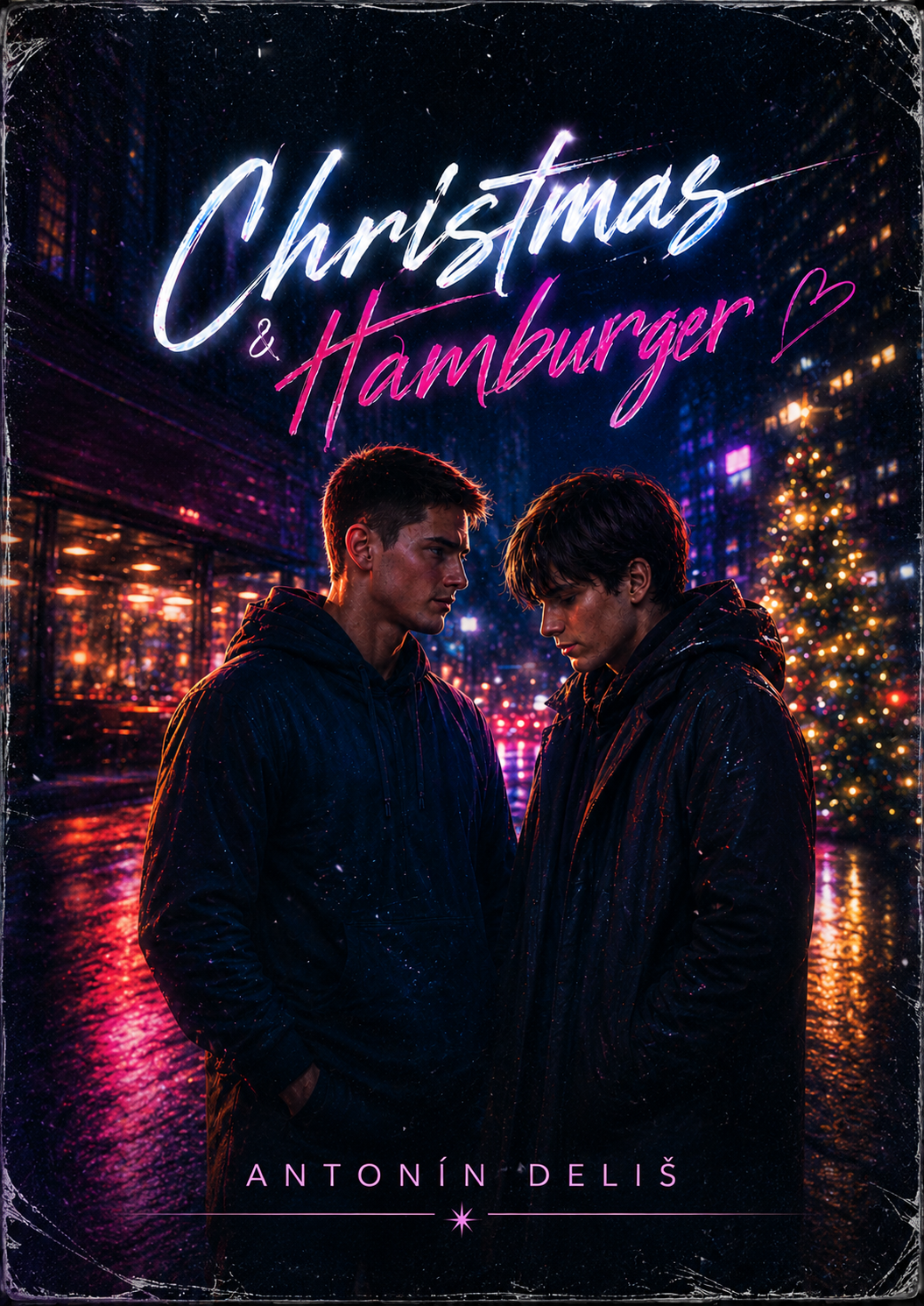
Hamburger got on the subway, there were few people in the car — a woman with bags, an older man with a newspaper, two tourists with backpacks looking at a map on a phone and whispering in English. He didn't sit down. He stood by the door, suitcase beside his foot, hand on the grab handle.
Exit at Muzeum.
Hamburger walked through a corridor full of stairs, scrolling advertising billboards. From the posters, light flickered onto his face. He kept walking following the signs to the exit.
He came out onto Wenceslas Square: wet pavement, illuminated advertisements on the sides of buildings, stands selling punch, mulled wine and trdelník pastries, tourists with and without cameras, also Czechs presumably, walking down the middle of the square with a fast Prague stride — slightly forward, slightly impatient, as if they were always in a hurry and at the same time knew exactly where they were going.
Hamburger stood by the subway exit and looked. How many years ago was he here last? Five? Six?
Wenceslas Square remained Wenceslas Square: tiredly festive, overflowing with tourists, more than it would like. The sky in a grey-gold winter color reflected in the windows of the houses.
He walked down, pulling his suitcase behind him.
His shoes on the wet pavement sounded almost musical—thicker soles, a sharper sound, a little more presence. A couple walked past with a dog. A man in a high-vis vest with cables over his shoulder. A girl with headphones was walking, smoking, and reading Villon aloud.
Hamburger focused on the smoke.
A white string in the air. The wind quickly scattered it.
He took out his phone.
Vodičkova Street. The hostel was just around the corner. He recognized it by the small sign by the intercom—a logo with two arrows and a name that was neutrally international, the kind that could hang in Prague, Berlin, or anywhere else. The interior lighting behind the glass doors was cold and white.
Hamburger opened the door.
Reception.
A desk, behind it a person of about twenty, with bangs and the expression of composed diligence where you answer questions while your mind is racing with what's for dinner at home. Hamburger stepped up and showed the reservation on his phone.
The receptionist checked it, clicked the keyboard.
“Room four. Shared, six beds, but you only have three people in there right now. Here's your key card.”
He slid the card across the counter. Hamburger took it.
“Checkout at eleven.”
„Right.“
That was the extent of the dialogue.
He grabbed his suitcase and went up the stairs.
The second-floor hallway had that specific hostel light — energy-saving bulbs, a bit too white, the hallway brighter than the rooms, more public than private. A space where people pass each other in towels, with coffee from the kitchen or a backpack on their backs, and nobody looks into anyone's face for long, because that is the unwritten hostel convention, at least as Hamburger knew it.
Room four.
He opened the door, the interior was exactly as he had expected. Six beds, three bunks of two, six small lockers with locks, narrow windows overlooking a gray courtyard, concrete, and a dumpster. Two beds occupied — luggage, a thrown jacket, headphones. The people they belonged to were not in the room right now.
Hamburger took the bed by the window, the bottom bunk. He pushed his suitcase underneath and sat down.
The room was quiet.
Not like Hamburg. There, the silence was full of Dominique. Here, the silence was empty and clean. The hostel walls didn't know him. The bed didn't know him. The locker with his key number didn't know him. He was here without context, and that was bearable. More than bearable.
He laid his phone on the pillow.
In December, it got dark quite fast. At half past four, the streets were filled with light-darkness — that layer when daylight is no longer enough and the night is just arriving. The blue hour between day and night, in which things lose one outline and take on another.
Hamburger got up.
He couldn't just sit on the hostel bed and look at the ceiling with the white light bulb. In the apartment in Hamburg, you could sit and look at the ceiling because that ceiling had a golden line and context. Here, a ceiling was just a ceiling, and that got old pretty fast.
He took his jacket.
He went out.
Prague in the blue hour.
He walked out of Vodičkova Street onto Wenceslas Square. He walked down the square without a plan, then turned right into a street, then walked along the shop windows. Prague was moving around him, and Hamburger was like a body without a trajectory in it. He was moving, but not toward a place. Rather chasing the sound of Czech around him.
Two women in a fast dialogue, switching topics so quickly he caught only fragments: "I'm telling you, don't go there," "Marek is —," "I know, but still —." A boy with a phone and headphones: "that's cool, I'll be there at six." A vendor at a punch stand shouted to a departing customer: "have a nice evening." And she back: "you too."
Hamburger heard it, but the Czech language was dissolving in his head like snowflakes on the ground.
He stopped by a shop window. Sweaters folded neatly, Christmas decorations, nothing out of the ordinary. But the window reflected the street behind him, and in it Hamburger saw himself for a moment: jacket, scarf, glasses, golden detail. The suitcase was gone. Just hands in pockets and Prague behind him in the reflection. The background behind his image was golden and blue.
Black apartment, gold and blue.
Only it wasn't an apartment. Prague.
Prague was gold and blue and Hamburger stood in it like a picture he had put on over his body. Christmas lights all around, a tram rolled past around the corner and its light flashed in the shop window for a moment and disappeared.
He tore himself away from the shop window.
He walked on.
An arcade.
It began to drizzle. He didn't like the moisture on his jacket and in his hair. The arcade was dry and a little warmer, so he disappeared into it. He walked through the arcade and Dominique was no longer in his thoughts. It surprised him that he wasn't there. Hamburg yes, the apartment yes, but he as a concrete presence no longer. As if Prague had left Hamburger on its territory for a moment without that concrete weight.
At the end, the arcade widened. There was a bench there, old-world-inappropriately, as if someone in the past decade had said that right here there would be a bench, and it had stayed there ever since. On the bench sat a man with a dog at his feet, eating a sandwich. The dog was large, blunt-muzzled, with the canine calm that large dogs have—nothing upsets them, because everything moves slower than can surprise them.
Hamburger walked past them.
Beyond the arcade was a different part of Prague. Narrower streets, fewer tourists, more ordinary shops. A butcher's. A greengrocer's. A pharmacy with a neon green cross. The rain had picked up just a fraction, just enough to make a person pull their scarf higher. That jacket with the asymmetrical zipper, deliberately oversized, functioned as a mobile version of his own room.
A sentence came to him in German — unexpectedly, for no reason.
Du gehst jetzt. (You are leaving now.)
You are going. That is a fact. His feet are moving, Prague is all around, his shoes clicking on the cobblestones.
Hamburger laughed.
Du gehst jetzt.
A German mind in a Czech city. Body in motion, pain in the background, Dominique beyond the horizon. Prague at dusk.
He stopped at the corner.
The street emptied into a wider avenue with tram lanes. Overhead stretched the trolley wires, a few cars drove by, and people walked on the sidewalk. A tram arrived — golden, Prague-style, a bit worn down, as if it had been that way forever. It opened its doors. A few people got off, a few got on. The doors closed and the tram moved off again. All that remained was the electrical buzzing of the wires.
Hamburger crossed the tracks.
On the other side was a bistro. It wasn't some new place with a hipster sign and a candle in a jar. An older bistro. An eighties or nineties facade, bearing a post-revolution dream of America, when the word Grill or Burger carried more hope than truth. The sign above the door glowed a little sleepily. In the window, a menu in a plastic frame: hamburger, fries, chicken. Prices in korunas.
Hot Grill.
Hamburger stood outside and looked at the sign.
He hadn't eaten anything proper for ten hours. A paper cup of coffee at the station in Hamburg. A dry roll on the train from Berlin, bought at a kiosk without thinking. Nothing more.
He went inside.
Plastic trays stacked by the counter. A queue of a few people. The light above the food a little too white and harsh, a light that makes food visible, but not very appetizing. Behind the counter, a woman in an apron was checking orders on a terminal. The hum of the deep fryer. The smell of ketchup and meat.
Hamburger joined the queue.
In front of him was a man in work clothes — a construction jacket, boots with toes covered in mortar. Behind him, the door opened again and someone else walked in.
Hamburger registered him only out of the corner of his eye.
A young guy. Dark hair a little damp from the rain. A jacket not quite warm enough for December. A phone in his hand.
Nothing more.
The line moved forward.
The man in work clothes ordered quickly and in Czech — two words, a gesture at the menu, a card to the terminal, done. Hamburger looked at the menu above the counter and chose just something that could be eaten.
Hamburger menu.
Large fries.
Food that had his own name in the title and at the same time had nothing to do with him.
When his turn came, he ordered.
"Hamburger menu and large fries."
The woman behind the counter entered it into the terminal.
"One hundred and twenty in total."
He paid by card.
He took his number, his tray, and stepped aside.
Behind him, a young person with a phone moved. Hamburger watched him with the peculiar sensitivity of someone in a foreign city who knows no one, and for a moment that allowed the kid to step out of the anonymous buzz.
The young man looked at the menu.
Then at the phone.
Then at the menu again.
Hamburger looked away.
He didn't want to stare. He didn't want to turn him into a travel souvenir. It was his first evening in Prague and he was hungry. In his hand was the order number, and outside the window lay the wet, golden, blue city.
They called his number.
Hamburger picked up the tray with a hamburger and fries and sat down at a table for one — a narrow top, a single stool, a spot for people who eat alone and don't need extra space.
Hamburger was exactly what he was—an older bistro, a dream from the nineties, meat, bun, ketchup. Hamburger was hungry and chewed without thinking.
He ate and watched through the window the hustle and bustle of the street on the wet pavement, the wobbling tram wires, and the Christmas lights of the shop windows. A golden tram in the golden light, silver wires above it. Prague outside moved to its own rhythm. People on the sidewalk hurried under umbrellas. The shop window opposite glowed red. Around the corner, Christmas illumination flickered, white chains above the street.
For a moment, he had the feeling that someone in the room was watching the same tram. He didn't know who. He didn't turn around. Just a minor synchronization without proof. Two people in the same space react to the same movement and don't know about each other. Or they do, but not enough to do anything about it.
Somehow.
The English word came without context.
Somehow.
Somehow a person in motion stays in motion. Somehow the train runs. Somehow a hostel bed supports a body it doesn't know. Somehow Prague carries Hamburger, even though Prague doesn't know about him.
He finished eating.
He carried the tray to the stand by the door and went outside.
The rain had grown heavier. Just a little, but it was real rain now. Hamburger pulled his scarf higher and stepped out onto the pavement. Prague around him was golden and wet, the tram wires overhead silver in the storefront light.
Footsteps without a destination, just movement. Vodičkova Street carried him back, or rather onward via another route—past shops that were beginning to close, past people hurrying away from the rain, past a stop where people stood with their hands in their pockets, looking at the timetable.
Hamburger thought of the young guy with the phone. Dark hair wet from the rain. Phone in his hand. A jacket not quite warm enough for December. A brief snapshot from the bistro that was supposed to mean nothing, and yet remained somewhere in the folds of his mind. There was something about it he couldn't name. The slightly unusual presence of someone like what sometimes happens somewhere abroad on holiday. Something not to be overestimated. Now he was a young man in a bistro with a phone. That's the whole story. Nothing happened.
And yet he looked back over his shoulder, in the direction he had come from. The street behind him. The bistro was around the corner, out of sight. Rain. Storefront lights. No one he knew.
Hamburger turned back around and kept walking.
Christmas lights above the pavement.
Prague, moving.
Czech in the ears. German in the head.
Somehow.
Somehow.
Somehow we do.
This time a full sentence.
Quietly, only in the head, without a melody.
It goes somehow.
A flash.
The Hamburger turned around. Behind him, about twenty meters away, on the border of light and dark, someone was pacing back and forth. Maybe that kid from the diner. Dark hair. A jacket. A phone in hand. Visible only for a moment in the flash of light. The Hamburger stopped. The figure took a step into the dark beyond the lit street, a second step, and then disappeared around a corner, into the crowd or just into that darkness beyond the lights. The Hamburger looked only at that moment when you turn around and don't know what you were looking for. Or if you were looking at all. Then he turned back.
Lights above, reflections below.
Hamburger went into the night and Prague went with him.
Without a promise.
A city that carries the one who moves.
Lights above the street in December.
The quiet sound of a tram wire in the wind — thin and silver, like a note held a moment longer than necessary.
Somehow we do.
Hamburger.