ENDRALON.SPACE · ČLÁNEK
5. 7. 2026
Chapter 2 – The man at door number twenty-seven and the hero with squeaky keys
He stood in front of the house and looked at the keys as if expecting an answer from them. The keys, however, did not answer. Keys are more honest in this regard than most people or devices. They do what they are supposed to do, unless they jam, and when they jam, there is nothing personal about it. Doors do not take revenge on a person. They are just old, poorly adjusted, and have been through more hands than any […]

He stood in front of the house and looked at the keys as if expecting an answer from them.
The keys, however, did not answer. Keys are more honest in this regard than most people or devices. They do what they are supposed to do, unless they jam, and when they jam, there is nothing personal about it. Doors do not take revenge on a person. They are just old, poorly adjusted, and have been through more hands than any novel.
The building in Prague 3 was exactly what a building should be when it wants to remind you that coming home is not a triumph, but an administrative task. The plaster held only in places where it had probably realized that falling off would be unnecessary extra work. The door was heavy, scratched around the lock, and by the handle it had that glossy, greasy semicircle formed by years of human fingers, bags, sleeves, groceries, nervousness, and weather.
Next to the doorbells were names.
Some new, printed, carefully tucked behind plastic. Some old, faded, with letters that were hardly letters anymore, but rather traces left by people. One name was taped over with adhesive tape. Another was missing entirely, but a lighter rectangular patch remained on the doorbell, like when a role is peeled off a person and there is nothing ready underneath.
My son didn't look at those doorbells.
He looked at the keys.
He had more of them on his ring than he needed. That is also a family trait. A person carries keys to things they haven't unlocked in ages, just in case. To the basement nobody goes to anymore. To an old mailbox that was replaced years ago. To a lock that perhaps no longer exists, but the key still does, and thus one feels it would be disrespectful to throw it away.
He found the front door key on the third try.
That doesn't happen to heroes.
At least not the drawn ones. They have capes, signals in the sky, caves, bases, vehicles, sometimes even a butler. My son had a bunch of keys, two of which looked similar, one bent suspiciously, and one was good for nothing, yet felt important to the touch.
He slid the key into the lock.
It didn't turn.
He tried again.
Still no go.
The third attempt was more successful, provided we consider success to be a state where the metal catches, you have to wiggle the key slightly up, then down, then toward you, and then you mustn't flinch when the lock clicks as loudly as if it had just decided the fate of a dynasty.
The door gave way.
Not willingly. The house in Prague 3 did nothing willingly. The house permitted things after due consideration. Like an old aunt who does open the door for you, but only after checking through the peephole to make sure it really is you and that you aren't followed by anyone who might want to borrow a drill.
He went inside.
The hallway received him with the scent of an old house. A blend of dampness, dust, basement, long-ago wiped-away bleach, overripe flowers from some apartment, and something metallic that couldn't be precisely named, but you knew it belonged there. Old houses smell like old families. Everyone claims they don't notice it, but a visitor recognizes it immediately.
The light came on with a delay.
Not a dramatic one. A practical one. The kind that says: yes, yes, I'm coming, a person can't do everything at once. A yellowish bulb lit up on the ceiling, weak and brave, probably forty watts, if not less. Today's world could produce a human image in a few seconds, write a love letter for someone afraid of their own voice, and plan a vacation on a planet you couldn't afford anyway. But the hallway still had a bulb that looked like it would apply for a disability pension if it could.
My son stood in that light.
Not in latex yet.
I consider that important.
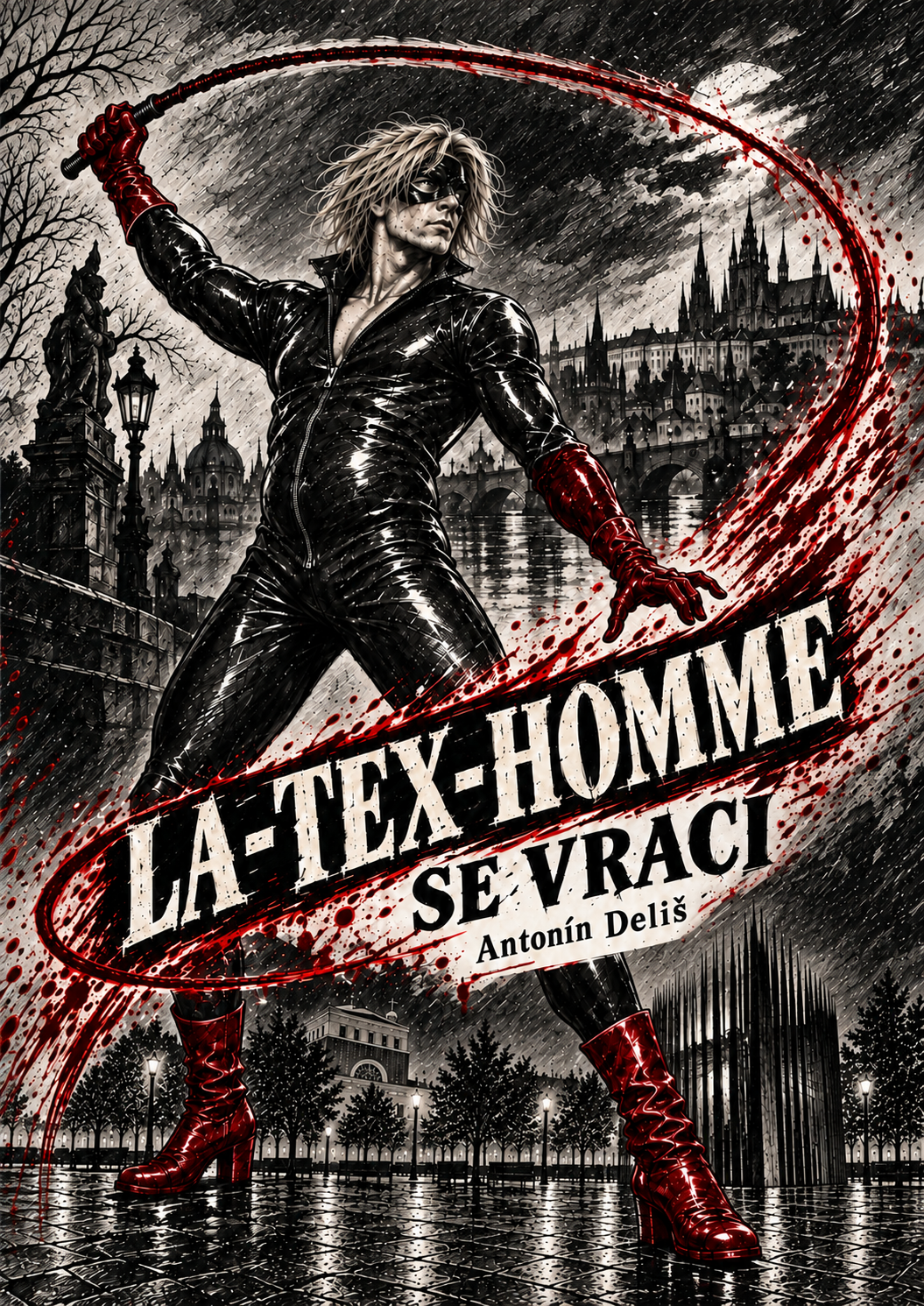
So far he was dressed normally, as much as the word normally can be used for a man who has a box labeled LA-TEX-HOMME in his back room and is clearly about to go back to it. He had a jacket, shoes, a bag, tiredness in his shoulders, and the expression of a man who came home but isn't sure whether home is a place or just an address.
A lock clicked somewhere upstairs behind the door.
Then silence.
Then a very quiet rustle.
The peephole.
Of course.
The peephole is the eye of the house, but a cowardly one. It only looks from one side and even pretends to be a security feature. In a building where people have lived for a long time, you don't need cameras. You have peepholes, curtains, ajar doors, female neighbors with a trash can, and men who walk their dogs six times a day because a dog is an excellent excuse for keeping an eye on society.
My son raised his head.
Not much. Just enough to show that he knows.
And he lowered it again.
That was wise. You don't argue with a peephole. A peephole has no arguments, only a field of view.
He walked towards the stairs.
The elevator was there, but an elevator in an old building is something you only use when you are willing to accept the possibility of spending a certain portion of your life stuck between floors. My son took the stairs. Not because he was a hero. Because sometimes the decision to take the stairs is just an expression of distrust towards technology that features linoleum flooring, metal doors, and a mirror placed in such a way that you realize during the ride you look worse than you thought.
The stairs creaked.
Every house has one step that will betray even a thief. Here, there were several. They creaked in different tones, as if passing a message among themselves: he's coming. He's coming up. He's carrying a bag. He looks tired. Yes, it's him.
A hero whose keys rattle.
A hero whose stairs creak.
A hero who in 2026 might perhaps have a digital lock, a smart wristband, facial recognition, and doors that open on command, if he didn't live in a house where a smart lock would probably get offended after the first winter and where facial recognition would anyway run into the lady from across the hall, who recognizes everyone before the algorithm does.
He reached the apartment door.
Number twenty-seven.
Here he stopped.
Not for long. Just for that kind of moment a person needs when they know that behind the door isn't just an apartment. There is everything that got put off. Things on the table. A bill. A mug. Silence. The back room. Boxes. Dust. An old name. And something that had been waiting so long it stopped waiting in the manner of things and started waiting in the manner of an accusation.
He pulled out the right key.
This time right away.
I'd give him that.
He unlocked the door.
The apartment door opened into the dark.
And my son walked inside like a person coming back from outside.
Not like a legend.
Not yet.
A legend first had to take off their shoes.