ENDRALON.SPACE · ČLÁNEK
11. 7. 2026
Chapter 11: Echoes
Petr remained sitting on the edge of the bed. He listened to the water behind the closed door. Yassin struck him as a danger. All week he had been piecing it together into an image of something ominous. Now he sat in the room, looking at the empty bed of Markéta. The injury was minor. Yet he had the feeling that something was slipping away from him. He didn't know if it had to do with Yassin, Markéta, or if it was connected at all. He only knew, […]
Petr remained sitting on the edge of the bed.
He listened to the water behind the closed door.
Yassin struck him as a danger. All week he had been piecing together the image of something menacing from this.
Now he sat in the room and looked at the emptiness of Markéta's bed.
The injury was minor.
Yet he had the feeling that something was escaping him.
He didn't know if it had anything to do with Yassin, Markéta, or if it was related at all.
He only knew that the previous evening had ended in a way he still didn't understand.
Water started running again behind the bathroom door.
Petr raised his eyes.
And let it go.
* * *
Petr left the hotel without a destination. Or at least that's what he told himself.
The promenade was different in the morning than in the evening — fewer people, more shade, waiters mopping the terraces and locals walking by with shopping bags without even looking at the sea. The sun beat down on the stone at a sharp angle. Petr squinted his eyes and kept walking along the railing. From somewhere on the water came the quiet squeaking of ship ropes against the pier.
Markéta had gotten up quietly in the morning and disappeared. She didn't say where. Žaneta was sitting on the balcony with a book and Petr didn't ask her if she knew more, because he knew she didn't, and even if she did, she wouldn't have told him anyway.
He thought of Yassin.
For a whole week he pieced it together from fragments. The more he thought, the more precise the picture became.
He stopped.
They were both sitting on the low steps by the embankment.
Markéta and Yassin.
There was no Karimah with them. They sat on the second step from the bottom, shoulder to shoulder, and Yassin was saying something. Markéta listened. She didn't turn around. Then Yassin stopped talking, and she lowered her head and nodded.
Petr remained standing on the promenade.
He could neither leave nor arrive.
Yassin did not lean towards Markéta. He didn't shout, didn't gesticulate, didn't touch her. He sat straight, hands resting on his knees, and spoke calmly, like a man saying a sentence that cost him effort, but saying it all the same.
Markéta nodded again.
Then she said something short. Yassin ran his palm across his face and looked at the sea. He remained sitting like that for a moment. Then he turned back to her and Petr saw him nod, just like she had a moment ago.
Two young people saying things to each other after an argument that didn't get said during the argument. Without witnesses. Without parents. Without the need for anyone from the outside to confirm it for them.
Yassin got up first.
He reached his hand down to Markéta. She took it and stood up beside him. Then she let go and adjusted herself a bit. Yassin was still saying something and Markéta smiled at it.
Both turned toward the stairs.
Petr moved. Quickly, without thinking, he walked twenty meters further to a display window with ceramics and stopped in front of it like a man who knew exactly why he was looking at blue bowls.
He heard footsteps.
Markéta and Yassin walked past without stopping. They were speaking English, quietly, just fragments—Petr caught a word, two, nothing from which he could form a sentence.
Then they disappeared around the corner.
Petr remained by the shop window.
In the reflection of the glass, he saw the promenade behind him. Empty in the spot where they had been sitting a moment ago.
He thought about what he had expected to see.
For almost a whole week, he had imagined Yassin as a problem that would manifest visibly — something he could name, something he would have the right to react to. The blood on the stones had almost convinced him he was right. Markéta at night with a distraught face had convinced him again.
Now he saw two people sitting on the steps by the sea.
They were talking to each other.
They were listening to each other.
And they didn't look like people who wanted to hurt each other.
Petr didn't know what to think of it.
Perhaps he had misread Yassin all along.
Perhaps not.
Perhaps he just hadn't seen enough.
He pulled his gaze away from the shop window.
In the morning, the sea was bright, almost transparent. A boat moved across the surface, small and slow, as if it had nowhere to rush, its engine buzzing quietly somewhere in the distance.
Petr turned around and walked back to the hotel.
* * *
Afternoon. Valletta.
Petr went to see Žaneta because he had nowhere else to go.
Or at least that's what he told himself.
Valletta at noon — streets full of people who didn't know if they were hungry or just looking for shade. Žaneta walked calmly, shoulders relaxed, a handbag over one shoulder, sunglasses on her nose. She wasn't in a hurry. She didn't stop unnecessarily. From somewhere above came the quiet buzzing of cicadas, steady, almost inaudible until one consciously noticed it.
Petr walked beside her.
“This street, not that one. To the right. I know a café.”
The café had five outdoor tables and all of them were taken. Žaneta didn't even look at them and headed inside. It was cooler inside, with two ceiling fans and an old light-stone floor. She chose a table by the window overlooking the street.
They sat down.
Petr glanced over the menu without reading it.
The waiter arrived. Žaneta ordered iced cold coffee, Petr the same. The waiter left.
„Do you like coming here?“
„It's my first time here.“
Petr looked up.
„But you said—“
„I said I knew of a café. I read about it.“
He nodded.
Žaneta looked through the window at the street. A group of tourists passed by with hats and bottles of water in their hands. Behind them, a local woman with a bakery bag. Žaneta followed her with her gaze until she disappeared around the corner.
Petr pulled out his phone.
Then he hid it again.
The waiter brought the coffees. Žaneta took the glass with both hands and took a slow sip.
„How is Markéta?“
Petr looked at her.
„You see her just as I do.“
„Yeah.“ Žaneta put her glass down on the table. „But I’m not asking myself. I’m asking how *you* see her.“
Petr didn't speak for a moment.
„Tired.“
„And?“
„And I don't know what happened.“
„She knows.“
Outside, a scooter rode across the pavement, loud and fast, and vanished again. Žaneta didn't even move.
„Will you stop thinking about it?“ she asked.
Petr looked at the glass.
„Not easily.“
„I know.“
Žaneta continued to watch the street.
„It's nice here,“ she said.
Petr looked around.
„More so than on the promenade. There are too many people there.“
„You like places without people.“
She turned to him.
„I like places where I don't have to step aside for anyone.“
Petr smiled slightly.
Žaneta did too. Just the corner of her mouth.
Outside the window, a man walked by with a small dog. The dog stopped in the shade under a bench and refused to go any further. The man stood and waited. Without irritation. He simply waited.
Petr watched him for a moment.
„Are you okay?“ he asked.
Žaneta looked at him.
„Why?“
„Just like that.“
She watched him for a moment. Then she returned to her coffee.
“Yeah.”
Petr nodded.
He didn't know if it was true. But she didn't look like she wanted to confide or explain. She sat opposite him, drank her cold coffee, and looked out at the street.
She was simply here.
"Do you remember when we were here for the first time?" he asked.
Žaneta thought about it.
"A long time ago. Markéta was little."
"Ten years."
"Yeah." She nodded. "She complained that it was hot."
„The whole vacation.“
„And then she didn't want to go home.“
Petr smiled slightly.
He remembered it precisely. Markéta at the airport. How she had turned back toward the glass doors before departure, as if she wanted to catch one last glimpse of the island.
He told Žaneta.
She nodded.
„I don't remember that.“
Petr stopped.
„Really?“
„I remember the airport. The flight delay.“ She shrugged. „Just not that.“
Petr ran his finger along the glass of the tumbler.
The whole time at the table, Žaneta hadn't mentioned Radúz. She hadn't mentioned the boss. She hadn't asked about the lounge or the empty piano.
Petr realized he had been waiting for it.
And perhaps that was precisely why some of what Žaneta actually said had escaped him.
The waiter brought the bill without anyone asking for it.
Žaneta looked at him.
“I'll pay.”
“Let it be.”
“I'll pay.” She took out her wallet. “You paid for breakfast this morning.”
Petr didn't object.
Žaneta left the banknote on the table and stood up.
Outside it was still hot, but differently than in the morning. Heavier. More stagnant. The shadow on the opposite side of the street was wider now.
They walked.
Petr walked beside Žaneta.
The street sloped down toward the harbor.
Žaneta pointed at something in the shop window.
Petr looked.
And only after a few seconds did he realize that he hadn't been thinking about Radúz for some time.
* * *
Afternoon. Hotel.
Petr sat on the edge of the bed and looked at his phone.
The display remained dark.
The boss had been silent for nine days.
Radúz did not write.
The green dot didn't appear.
He turned the phone over in his hand. The metal edge was warm from his palm. He laid it on the bedside table, screen down, and picked it up again.
He opened his messages.
The boss. Last message nine days old. I'll confirm.
Radúz. Last message to Radúz three days old. I am at your house. Delivered. Unread.
Petr closed the conversation and put his phone down on the bed beside him.
The sea could be heard outside the window. The same constant murmur that drifted up every evening, sounding louder now because there was nothing else in the room.
He stood up.
He walked over to the window and pulled the blind aside slightly. Down on the promenade, tourists were strolling by. A couple stopped in front of a restaurant to read the menu on a stand. A waiter passed them carrying a tray of glasses above his head.
Petr let the blind drop back down.
The boss had been silent for nine days.
That never happened. In twenty years of her career, she had never been quiet this long. Confirmation always meant: in a day, two days, three at most. Not nine.
Not without a single word.
He reached for the phone.
He wrote a short message.
I need to know the deadline.
He sent it and waited.
The message status changed to delivered.
Then to read.
Then nothing.
Petr put the phone back on the bed.
He walked into the bathroom, turned on the cold water, and washed his face. The water was icy, almost unpleasant, but he needed to feel something clear. He dried his face with a towel and looked in the mirror.
His face felt unfamiliar.
No different.
Just more distant.
He returned to the room.
The phone lay on the bed.
Petr sat down next to it and dialed his boss's number.
He waited.
One ring.
Two.
Three.
Then a voice. Not hers. Automated, female, professional.
The subscriber you have called is currently unavailable.
He hung up.
He remained sitting with the phone in his hand.
The boss was silent. Radúz was silent. Markéta kept silent about what had happened. Žaneta said only what she wanted to say, and nothing more.
Petr sat in the middle of the room with the feeling that everyone around him knew more than they were telling him.
Not because they were lying to him.
They were simply going on with their lives, and he had stopped seeing it.
He stood up and went out onto the balcony.
The air was warm, almost still. The sea had an afternoon color, blue through gray, and in an hour or two the first lights of ships would begin to appear on the surface. Somewhere down on the promenade, ice clinked in a glass at a distant table.
Petr leaned against the railing.
Nine days.
Radúz hadn't shown up in the lounge for several evenings.
Markéta was sitting on the steps with Yassin, and Petr didn't know what to make of it.
Žaneta seemed calmer than him, and that was what unnerved him the most.
Everything around him looked normal.
The people down on the promenade. The sea behind the hotel. The phone in his hand.
And yet he had the feeling that something was escaping him.
Something important.
Something others may have understood long ago.
He took out his phone one last time.
No message.
No ringtone.
Just the time on the display. 15:30.
He put the phone back.
He stood on the balcony until the light over the sea began to change.
Then he went inside and closed the glass door behind him.
* * *
Evening. The hotel lounge.
Petr entered the lounge at eight and immediately knew something was wrong.
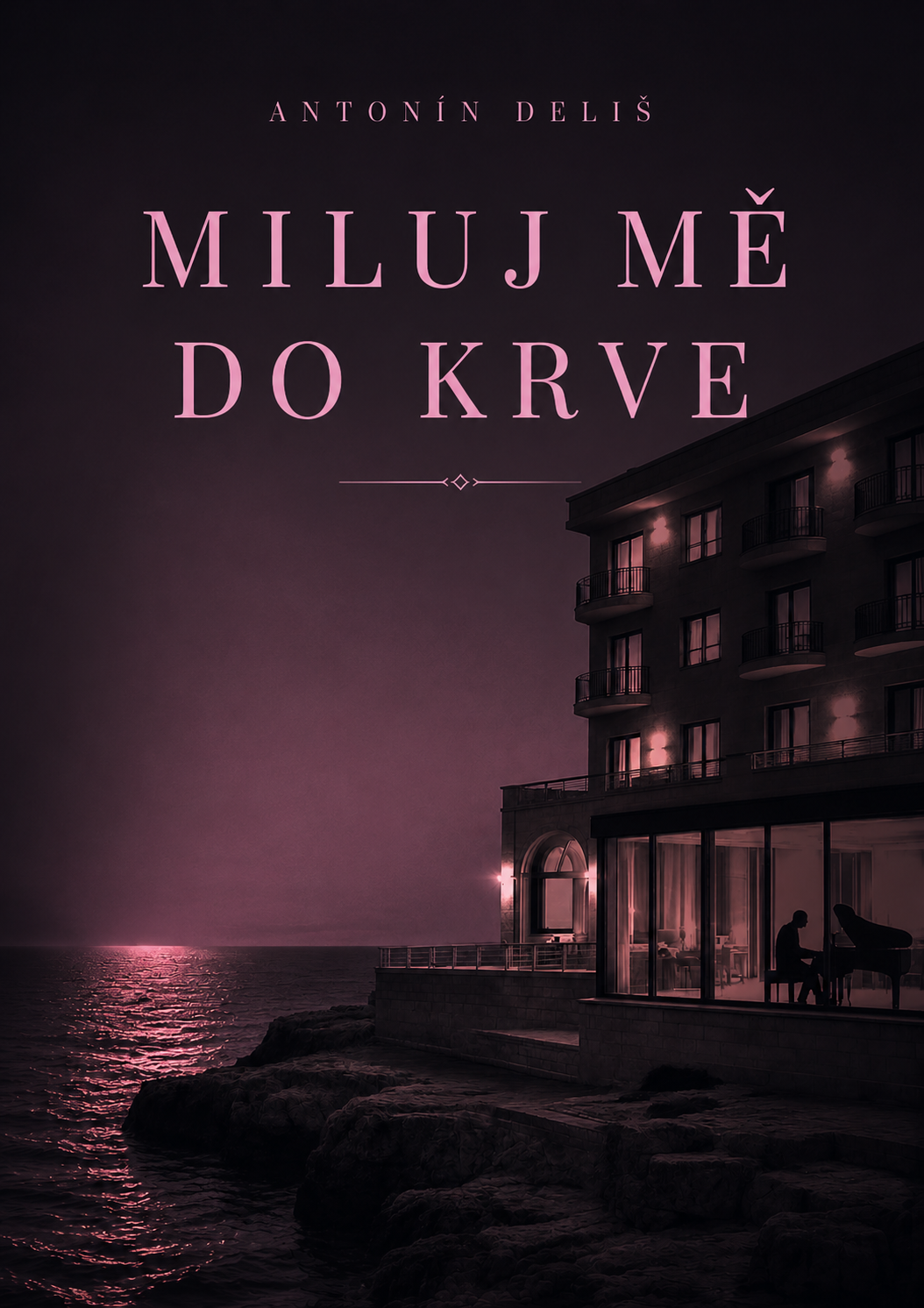
The piano was occupied.
The man sitting at it had his back to the door, just like Radúz used to. Roughly the same height, dark hair. Petr stopped at the entrance and it took him a full two seconds to admit to himself that it wasn't him. The man was younger. He moved differently — faster, with smaller pauses, like a man filling time, not like a man creating it.
He walked over to the bar.
"Beer."
The bartender nodded. Petr turned on his stool so he could see the piano.
The man played well. That was Petr's first observation. Technically clean, without hesitation. The melody was clear and the rhythm precise. The guests at the tables were listening, just like always.
And yet it was completely different.
The lounge was the same. The lights the same, the very same tables by the windows, the very same waiters, the same air conditioning temperature. The scent the same. The sound of glasses the same.
Only that one person was missing.
He got a beer. He took a sip.
The man at the piano moved on to another piece without interruption, smoothly, like a connection between two trains. The guests at the next table didn't even notice the transition. A woman laughed at something the man opposite her was saying and covered her mouth with her hand.
Petr watched the piano.
It wasn't clear to him what he was actually expecting. That Radúz would come. Or that he would write to him. Or that at least that green dot would appear. That something would happen to put a sentence in his mouth that he would know what to do with next.
The man at the piano didn't glance into the room even once.
Radúz used to do that.
Sometimes in the middle of a piece. A quick glance across the guests, to no one in particular, as if he needed to know how the room was breathing.
Petr took his beer and moved to a table by the pillar.
The man finished the piece and flowed into the next one without a break. None of the guests commented on it. One of the men at the bar turned toward the piano for a moment, then back to his friend.
Petr realized just how precisely that was how it worked.
Music in a hotel lounge is not a performance. It is an environment. Guests don't come for the pianist. They come for a glass and the atmosphere, and the piano is just part of the decor, much like the candles or the dim lights.
Radúz knew that.
And yet he did it differently.
He sat at that instrument with the calm of a man for whom the room was secondary, and precisely for that reason, the room took notice of him. He compelled people to listen by not needing them to listen.
Peter took a drink.
The new man played well.
But that didn't stop anyone in the room from moving.
An older couple by the window was talking over the music. Three women at a back table were taking photos of each other and laughing at the results. A waiter was pacing back and forth with a busy expression. Everything was functioning exactly as a hotel lounge should.
Petr realized this and didn't know what to do about it.
Within a year he had grown so used to Radúz that he was as distinct to him as a footprint. He grew accustomed to that specific voice in that specific room. To the weight of the pauses between tracks. To the way Radúz transitioned from one thing to the next—precisely, with a short silence between them that said: that was one thing, now comes something else.
The man at the piano made no silence.
Petr put his beer on the table.
He realized that for several minutes he hadn't been listening to the music.
Just the piano.
That spot where Radúz used to sit.
The man at the instrument transitioned into a slower piece. Petr didn't know it. Maybe he'd heard it somewhere on the radio. Maybe not.
It didn't matter.
He looked around the room.
Guests were drinking, talking, laughing. Waiters moved between the tables. The evening was unfolding precisely as it should.
Only he felt as though he were sitting somewhere where something had ended long ago, something the others hadn't even noticed.
He finished his beer.
He stood up.
He walked out of the lounge into the hotel lobby, where there was a different kind of silence.
* * *
Žaneta had gone to sleep at ten. Markéta returned shortly after her, knocked on the door, said good night, and vanished into the adjoining room before Petr could say anything. The door closed quietly, without a slam.
Petr remained sitting on the balcony.
Down on the promenade it was almost empty now. Two women were walking slowly along the railing, one of them gesturing. Restaurants were closing their terraces. The light from a lamp below the balcony illuminated an empty table, on which only an ashtray and a plastic cup left by someone who had departed an hour or two ago remained.
He picked up his phone.
No message from Radúz.
None from the boss.
He hid it.
The lounge behind him was empty now. He knew it without going back there. The foreign pianist had finished playing, the guests had left, the waiters had mopped the floor. The place that had drawn him for all of nine days was completely silent behind the glass.
Petr ran his palm along the railing. The concrete was still radiating heat.
Markéta had been sitting on the steps with Yassin that morning. They were talking. They were listening to each other. There was no fear, no danger, no gesture to grab onto. Just two young people telling each other things that are sometimes said only in the morning, outside, without an audience.
And yet Petr had stood twenty meters away from them by a shop window with ceramics, watching them.
As if waiting for Yassin to finally give him a reason.
He straightened up.
Whenever something didn't add up over the last nine days — an empty piano, Markéta's late arrival, Žaneta's remark about being somewhere else — he stepped in quickly, precisely, even before the facts could show him what they actually were. A spokesman. They paid him to keep others from having doubts.
Only it didn't work on himself.
The boss had been silent for nine days and Petr turned that into a report on his own end. Radúz hadn't come to play and Petr turned that into a breakup. Markéta had come home at night with a flustered face and Petr turned that into Yassin being a threat.
He filled every silence.
He occupied every empty gap.
Down below the balcony, a shadow stirred. A cat crossed the pavement and vanished under a car at the edge of the street.
Petr looked out at the sea.
Radúz's apartment was tidy. Mugs in their place. Medicines in three rows. The box folded precisely so it could be picked up. A photograph of a woman on a stone wall, a woman Petr had never seen, whom he had never thought about, because he never thought about what Radúz lived when the lounge closed.
Ferries on a slip of paper. Last week's date. So simple, so concrete, so completely outside all the stories he had been building the whole stay.
Radúz could have been in Gozo. With his mother. At the hospital. On a ferry. He could have been anywhere where a person simply doesn't have time to reply to messages because something is happening to them, something like ordinary life.
And the boss.
I will confirm.
Nine days.
He could have called a colleague. He could have written to his assistant. He could have done anything other than wait and turn the waiting into a catastrophe.
He did none of those things.
The air stirred from the sea. A little chill arrived, the first all evening, and Petr closed his eyes for a second.
Behind the glass door, Žaneta was sleeping.
Peacefully, regularly, like a person who had somehow made peace with this place and this evening and this room.
Petr had watched her the entire stay, looking for signals in her. Silence. Glances. Sentences that would linger a second longer. He was turning her into a cipher.
While she sat in cafes and looked out at the street, paid for coffee, and pointed out display windows to him. She placed her hand on Markéta's shoulder the night she arrived with a flushed face, and in the morning she sat straight at breakfast and wasn't in a hurry to go anywhere. She said only what she wanted to say, and left the remaining silences as silences, not as mysteries.
Other things bother me.
What kind?
Different.
Petr opened his eyes.
The sea was flat and dark at night, and the ship lights on the horizon barely moved.
He wondered how much of the past nine days he had spent watching the people he loved. How much of that was care and how much was just the need to know what was happening, to feel like things were holding together. To feel like he was protecting.
Markéta told him: everyone slips.
Žaneta told him: a little.
Radúz told him: you didn't ask.
Three different people. Three different sentences. And all three came back to him only now, in the night, when no one was explaining anything to him anymore.
He left his phone on the table inside.
He stayed on the balcony and looked out at the sea.
Nothing was happening.
No message arrived. No signal explained what the boss intended or where Radúz was. Markéta was sleeping behind the wall, and Petr still didn't know what exactly Yassin had said that she didn't want to hear a second time.
He knew almost nothing.
And yet, for the first time, he allowed himself to admit that perhaps the biggest problem wasn't what he didn't know.
Perhaps the problem was also everything he was filling those empty spaces with himself.
He stood on the balcony and looked out at the sea.
This time without a phone in my hand.