ENDRALON.SPACE · ČLÁNEK
12. 7. 2026
CHAPTER 10 – The Star Falls Twice
The forest closed silently behind them. Harjin walked and Naeve walked beside him. Light was increasing among the trees — more translucent, with the tint the air has just before dawn or right after a storm. As if the landscape had drawn a breath and held it, merely changing its composition. Naeve didn't speak. Neither did Harjin. They walked along a stream that rippled more brightly than in the morning. Every pebble on the bottom […]
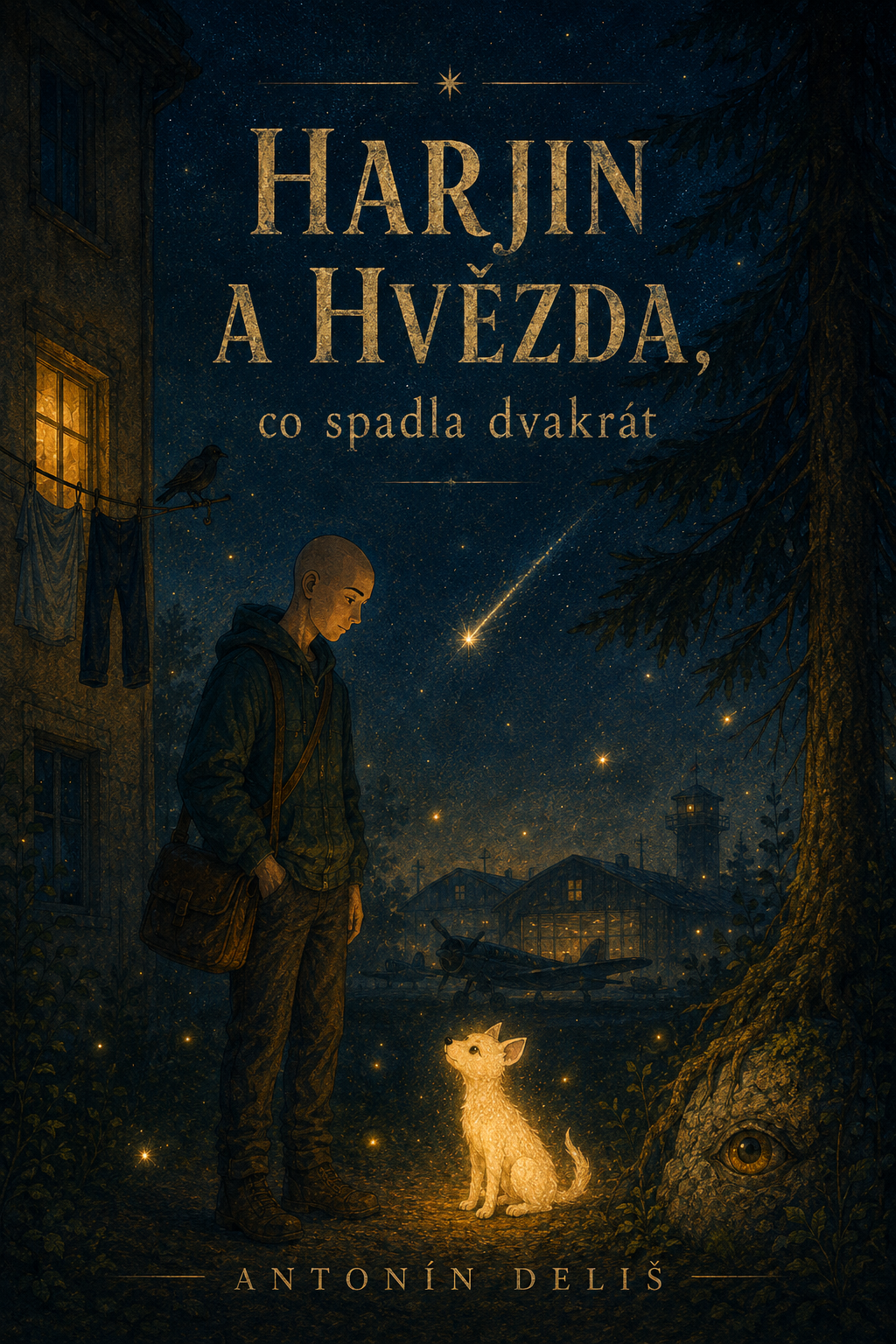
The forest closed silently behind them.
Harjin walked and Naeve walked beside him. Light was increasing among the trees — more translucent, with the tint the air has just before dawn or right after a storm. As if the landscape had drawn a breath and held it, merely changing its composition.
Naeve didn't speak.
Neither did Harjin.
They walked along a stream that rippled more brightly than in the morning. Every pebble on the bottom was sharper, every rustle clearer. Harjin heard it and thought of Rokytka. Of how it flowed beneath the hill and how silver dust settled on the surface in the evening. Of Amaril, who used to sit by the stone and look at the water with a half-closed milky eye.
Naeve stopped.
Harjin took another step and also stopped.
He turned to her.
She was standing between two trees and looking into the distance. Not past the trees, but higher, toward the place where the crowns ceased to be crowns and became only a dark edge against the lighter band of the sky. The amber eye watched that light. The milky one was half-closed.
Harjin waited.
Naeve said:
„You know where to go."
Harjin nodded.
„she said. Yes."
Naeve looked at him. In the amber eye was a light that was neither from this forest nor from the sky beyond the trees. It came from elsewhere.
The balk by the Rokytka.
A depression in the grass.
Silver dust on his hands.
„Must I go alone? he asked.
Naeve looked at his face — from the tattoos, across the bare skin of his scalp, to the lines and dots he had chosen, which hadn't faded even here. She traced them slowly, like someone reading a star chart they knew by heart.
„Not alone, she said. But without me. What awaited him was a place she could not go in the form she now stood in.
He reached out his hand.
Naeve wobbled slightly — the same tremor in her shoulder as back then, when he was giving her the little stone. Then she stepped half a step closer.
Harjin ran his fingers through her hair — once, slowly, from her forehead to her shoulder — and felt beneath his fingers its softness, a beige hue where the light caught it.
Beige specks.
Fine fur.
Another shape, another presence, the same warmth.
Naeve stood in silence.
Then she said:
„I'm coming too. Just a different way."
Harjin looked at her. In the amber eye was a calm that was not emptiness, but fullness — the milky eye opened a little more, translucent and mobile, like a window into a space that Harjin would never see directly.
„Naeve,“ he said.
He stopped.
He didn't know what to say after that word. There were too many things there, and each would need a different voice. Grief, which was still the truth. Realization, which was also the truth. Presence, which was the truest of all.
Naeve tilted her head.
To the left.
A centimeter.
And that movement was the entire answer.
Harjin let out a breath.
Pak šel.
The forest changed with every step.
The trees gradually thinned, the moss gave way to clumps of grass, and the light between the branches stopped being diffused and began to have a direction.
Harjin walked on; pine needles and dry soil returned beneath his boots. Then denser grass.
Then wetter grass with a scent that came simultaneously from afar and close by.
Rokytka.
Harjin stopped. He turned around.
The forest was behind him. Dark, deep, with the first line of trees subtly distinct from the ones behind it. Naeve was not standing there. The forest was just a forest — pine needles, roots, mist low to the ground.
But the air beyond the edge was different.
Harjin felt it on his skin. A little warmer. A little less dense. Like passing from one room into another where the breath is different.
He walked out to the fields.
The mound was where it had always been.
Harjin walked up to it out of old habit. Through the damp grass, across the ditch, climbing up to the small flat space among the stones. The stone with the single eye was in its place. Flat, grown over into the slope, with moss and lichen. A smooth oval surface in the center, darker than its surroundings, half-closed.
Harjin stepped up to it. He squatted down. He ran his palm over the smooth surface. The warmth came instantly—deeper than the first time, more direct, as if the stone knew what Harjin had brought and what he still had to bring. The beating came after the warmth—slow, patient, regular in a way different from a heart.
Harjin left his palm in place.
The eye moved.
The darker area transformed into depth—silvery, shifting, with the same light that Harjin had seen in Naeva's milky eye, in the fireflies above the Rokytka, in the silver dust on his hands the first night.
Images came.
A small white body in the hollow.
The basket by the radiator.
Fur beneath his fingers in the night.
A bowl.
A blanket.
The empty edge of the mattress.
A silence that had no bottom.
Harjin accepted them one after another, without haste, like pebbles from the Rokytka. Each with its own weight. Each one true.
Then came another image.
Naeve by the stream.
Naeve tilting her head.
Naeve with closed eyes, while a bird sat on her shoulder.
Naeve saying: I am here. Just differently.
And that image was just as true as all the others.
Harjin let out a breath.
The beating in the stone grew stronger. Not painfully. Present. As a confirmation. I hear you and you hear me.
Then the eye indicated the direction with a movement of light within. The light shifted to the edge of the smooth surface, then behind the stone, then further across the hill, toward the horizon.
Toward the place where the horizon began to be a different kind of bright.
Harjin raised his head.
Above the Rokytka stream was the horizon. The same as always—grass, water, the distant roofs of Hloubětín, Prague beyond them. But in one place, right where the horizon dipped toward the surface of the small river, there was a light.
A different light.
Harjin knew it.
It wasn't the sun. It wasn't any light from this world. It was the light from the first night — silver dust on hands, a flash that illuminated the tattoo, the shaved head, the warmth of a small body received in the palms.
The light fell toward the surface of the Rokytka.
It was shimmering.
Harjin stood up from the stone.
He withdrew his hand from the smooth surface and felt warmth behind him — at the nape of his neck, at the lower part of his throat, down his spine. A map he hadn't known was there until the stone lit it up. He couldn't see it. But he felt every line, every point, every stroke, as if the light had passed through his skin and drawn something there that had always been his and was only now revealing itself.
He walked over the hill.
He descended toward the Rokytka.
The light was above the surface.
A moving glow, delicate, silvery-white with a tinge of blue, hovering above the surface of the little river at the spot where the Rokytka curved.
Harjin knew it.
Not of this year nor of this place. From the hollow, from the night, from the silver dust.
He stepped closer.
The glow did not move.
It did not shrink, it did not recede.
She waited.
Harjin stopped on the bank.
The water flowed calmly beneath the glow, with the rustle he knew from years of walks. The pebbles on the bottom had a slightly different brilliance here too—more translucent, as if the surface of the Rokytka were giving up more in this light.
The glow shimmered like a reflection from two mirrors at once—something that is itself and at the same time the image of itself, and in that doubling the depth of another dimension arises.
Harjin recognized her.
With his body, not his mind.
With palms that once bore a different warmth.
With shoulders that had adjusted to a different weight.
The place behind the sternum, where things settle and remain.
Amaril.
Only the realization that came as quietly and precisely as the morning arrives.
Harjin knelt by the shore.
The grass was wet. The water murmured around the pebbles. The glow shimmered above the surface, and Harjin was close.
The glow remained where it was. Above the water. Light, mobile.
Harjin reached out his hand. His fingers bridged the distance, brushing through the cold air above the surface. The glow did not recede, yet it could not be grasped. It slipped between his fingers like light, like warmth, like breath — present and absent at once, real and unstoppable. Harjin closed his hand. Empty, and yet not entirely empty. A trace remained on his skin. Warmth. Gentle, precise, the distance of a single breath from his skin. Like the warmth of a small body held in the palm all night, lingering even after the body is gone.
Harjin remained kneeling by the bank.
The glow shimmered.
The stream was flowing.
And then he understood.
I won't let you go.
That sentence had been within him since the first night. Since the hollow, since the warmth welcomed into his palms. It was as true as a first breath, as a first gaze, as the feeling of hands refusing to let this back into the dark.
But the shape was not light.
The body was not light.
The basket was not light.
The claws on the tile were not light.
They were places where the light went.
The little dog could leave.
The light went on being carried.
Carried like a shimmer on the horizon, like a reflection on water, like warmth in the palm after a touch that has ended. Carried like something that is within him, not outside him. That does not need to be held tightly in order to shine.
Harjin passed his palm over the surface of the Rokytka.
The water was cold.
The glow shifted at the point of contact, accepting the movement of the hand as part of its own mobility.
Harjin left his hand in the water for a moment.
Then he pulled it back.
He stepped across the threshold, which was not in the water, but within it. Across the place where the holding ends and the carrying begins. The glow above the surface shimmered. And then it spread. It spread — like a drop of paint in water, into a circle, into a layer, into a pattern that is everywhere and nowhere. The glow passed over the surface, over the grass on the bank, over the pebbles, over Harjin's hands, over the tattoos, over his bare skin.
It passed right through.
Not like pain.
Like light through paper.
Harjin stood by the Rokytka and was it.
Light within himself.
With warmth that doesn't go out just because the body has left.
With silver dust that stays on the hands even afterwards.
Then darkness came. It came as always—gradually, from the edge, first into the depths of the forest, then across the hill, then to the water's surface. Harjin stood by the Rokytka and watched the light transition into another kind of light. The glow above the surface was not visible, or not visible as a glow—but Harjin knew it was there.
Like knowing about the warmth behind a wall that both holds and lets it through.
A sound came from afar.
A deep hum.
A train.
It was crossing somewhere beyond the viaduct. Harjin couldn't see it, only heard the hum approach, swell, culminate, and pass beyond the horizon.
Then there was silence.
And in that silence, the landscape changed.
Harjin felt it before he saw it. The air was different—less dense, with a scent that didn't belong to the other world. Wet soil. Pine needles. Water. Prague air on the edge of autumn, mixed with the smell of asphalt, old gardens, and distance.
He opened his eyes.
He was by the Rokytka.
The same Rokytka.
But different.
Or he was different.
He stood in the same place, on the same bank, but the world around him had its usual weight, its usual breadth, its own way of light falling on things and things reflecting it back.
The hill behind him.
The viaduct in the distance.
Hloubětín beyond the rooftops.
Harjin raised his hands.
He looked at them.
Fingers. Knuckles. Working lines. Grease under his nails that never quite comes out.
And hair.
Harjin ran a hand over his head — and his hand met hair. Long. Hair that wasn't there when he left. He ran his hand over his head again, more slowly, from his forehead to the nape of his neck.
Fine.
Soft.
Light.
He lifted a part in front of his eyes.
Blond.
Not white like in the other world. Not that stellar white which belonged to the landscape beyond the gate, Naeve, to stone, to light without a source. Blond. Warm, alive, with a hint of gold where the evening light caught it.
Human hair.
His hair.
Harjin let them go.
He placed a hand on his face.
The tattoo was where it had always been. The strokes and dots and lines—like his star map, it remained.
He traced a finger across the line from temple to temple.
He was here.
He stood by the Rokytka stream, on the autumnal edge of day, with a facial tattoo and blonde hair that wasn't his and now was, knowing he had passed through what can only be crossed dead center.
Loss.
Proměna.
Nošení.
He let out a breath. He walked along the Rokytka. His feet knew the way. Harjin walked slowly — likely because his body was still adjusting to the weight of a world that had more precise contours than the one he had come from. The grass whispered at his side, the pebbles on the path were the right pebbles, the damp soil smelled of damp soil.
A bird flew off from a bush. Harjin didn't even manage to catch a glimpse of it — just a flash of movement, wings, then air, then the silence after departure. The bird was gone. But the air still fluttered behind it for a moment.
Harjin walked toward the viaduct. Under the arch, it was cool and damp as always. The smell of concrete and rust. Harjin walked through — alone, without a leash in his hand, without a small glance beside him — and bypassed the puddle on the right, in two steps, in an arc around it, then back onto the route.
He didn't look back.
He walked on.
Hloubětínská Street welcomed him as always — old houses, the linden tree on the corner, the gate behind which stood a spruce. Harjin walked slowly and looked at the things he knew: from the crack in the sidewalk to the shape of the old chimney. In front of the gate, he stopped.
The spruce was behind it. Large, dark, old. Harjin watched it through the fence. The branches reached close to the window, the needles were dark in the twilight light. Down at the base of the trunk was moss — dark green, dense.
He opened the gate.
He walked across the small garden.
He stopped by the spruce. He ran his palm over the bark. The tree that holds the house together.
Then he unlocked the apartment.
The air inside was the same.
A little dry, smelling of old wood and also the perfume of all the things that were and are here. Harjin stepped inside and stood by the door for a moment.
The basket was in its place.
By the radiator, in its corner. Empty, with the depressed center of the cushion where a small body had lain for years.
In his chest he felt a light. Not the kind that would fill the emptiness. More like an emptiness in which there is light. Both at the same time. Both true.
Harjin stood by the window until the light outside began to fade into dusk.
Then he went to the desk.
He sat down.
He ran his hand over the wood—over the grooves, over the stain by the corner, over the spots smoothed by years of touching. The table was a table. It had been here before Harjin and would be here after him.
A thing that holds.
Outside, a spruce rustled.
Harjin felt a stir of air in the hair he now had. He ran his hand over it again, more slowly. Fine, light, warm from his own body. Not stellar. Living blond hair that wasn't his and now is. Harjin closed his eyes.
Evening came.
The sky outside the window turned to a darker blue, then to grey, then to a nighttime tone with a single star visible through a gap in the clouds. Harjin stood up, turned on the small desk lamp — the one with the warm light and low shade — and went to the kitchen.
He made tea.
Simply.
Kettle.
Mug.
Note.
Waited.
Poured.
Took the mug to the table.
He looked at the spruce behind the window — by now just a silhouette in the dark, a dark outline against the faint light beyond the roofs. The branches moved. One short gust, and they were still again.
Harjin drank tea.
He thought of Tarn. Hands stained with grease, a mug on a crate, a bolt handed over without a word. Steel-blue eyes that asked for nothing, only accepting presence. A bit of Tarn, a bit of Soryn, a bit of Kámen.
He thought of the madam clerk and her sentence about the spruce.
To a mother who calls and will be practical, because fear never found another language with her.
To the grandmother and the cherry tree with a knot in the wood.
To the eye in the wood.
To the eye in the stone.
To the milky eye.
To the light that passes from one shape into another and in the transition does not lose what it was.
He finished his tea.
Outside, the spruce shuddered again.
And from that shudder — from the rustling of needles, from the movement of the shadow across the glass, from the thing that came behind the wind — came a feeling.
Just a feeling.
Like the breath of a small body next to a sleeping one. Like the warmth that lingers in the palm a moment after you let go. Like the awareness of something within a person that takes its origin not in the present, but in what has been.
And what has been is not lost by having been.
Harjin ran his hand over the edge of the table.
A melody ran through his chest.
He hadn't planned it. It came on its own — without notes, without words. A tone, then another, then a pause. Like the beginning of something he knows, but doesn't yet know how it all sounds.
He sang quietly.
To himself.
Into the quiet apartment.
For the spruce behind the glass.
Sentences without words.
A melody without a name.
Then came the first word.
Or rather, a name.
From the place behind the breastbone, where things settle and wait until there is room for them.
Anna Lou.
Quiet, gentle, as if the landscape were whispering it rather than him—like the sound of a stream around a pebble, like a gust of wind through pine needles, like the distant hum of a train that has passed and gone beyond the horizon.
Anna Lou.
Harjin did not speak it aloud.
He only felt it in his mouth like the shape of a possibility that isn't here yet, but might be one day.
Just a place that opens up inside a person again when they accept what they have to accept.
Okno.
Za ním smrk.
Jméno v tichu.
Harjin sat at the table in the apartment beneath the spruce and was who he was: a man with tattoos and blonde hair and an empty basket by the radiator and a light in his chest that did not belong to him yet was his, that could not be grasped and yet carried him,
Outside, a bird was circling.
Harjin didn't hear him.
The air beyond the window was different.
The spruce whispered.
The Rokytka flowed beneath the hill.
And upon the surface lay silver dust, fine and shifting, like a record of things that were and are, merely in another form.
Anna Lou.
Like an echo.
Like a possibility.
Like the light that is yet to come.