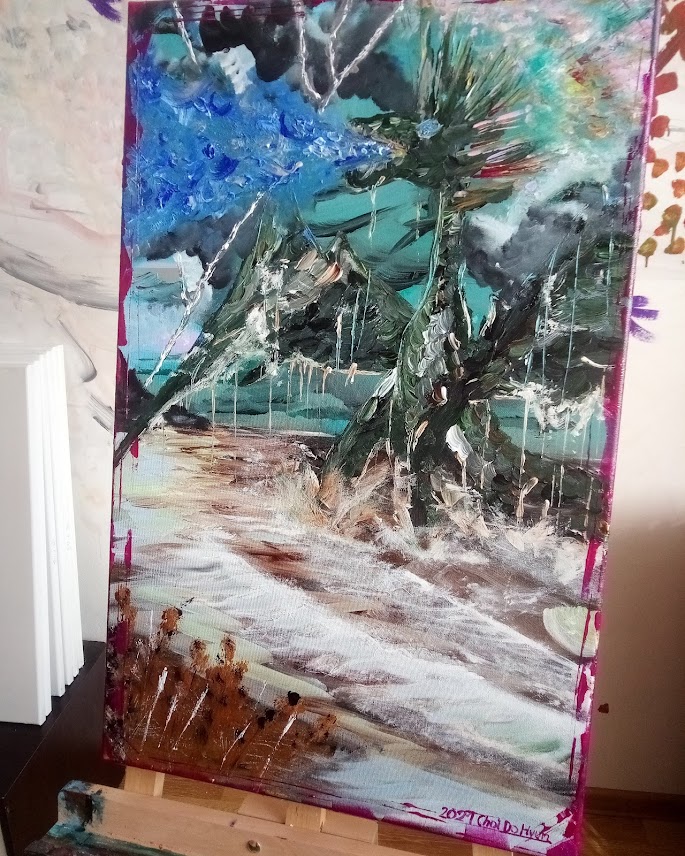
Wo hashamanarf! Vaheela nasan.
Acrylic on canvas 50x80cm
Vaheela nasan
Vaheela nasan is an idiom that could be translated as:
"I was lucky."
In Endralon, it means the following:
I was lucky to be born.
I was lucky that I was born.
I was lucky to be born and to have survived.
I was lucky to be born here.
I was lucky to find out where I come from.
I was lucky to be chosen by an earthly family.
I was lucky.
Furthermore, this means:
I was lucky in some specific matter.
I was lucky even when I don't realize I was.
I was lucky, even though I realize the exact opposite.
Vaheela nasan dissolves all negative statements about one's life—not by denying what is happening to me, but by bringing the hidden to the surface.
It is like a cleansing process from mud. In the ritual, I connected with mother earth, anointed my whole body with mud, danced during a thunderstorm, and kindled a fire within myself—awakening the following knowledge within me:
Honoring the primal human aechrq.
Honor to the angels of starry Avalon.
Honor to ancient customs (dragon energy).
Furthermore, the joining of elements:
earth
fires
waters
air
ether
Reverence for the dog as an ally.
Reverence for the train (sheema) as a symbol of the modern era.
Regai hente as the golden rule.
Reverence for initiation by angels.
Endralon wakkrha sha.
Celebration of a new birth.
And right within that new birth, the realization of Vaheel nasan was hidden like a bright grain of sand. We can imagine it as a dragon rising from the waters of unawareness. The consciousness of our power – connection with the energy of ancient times. The dragon emerges from the sea (prehistory), breathes a blue flame (the primordial word – the manifestation of the will of the heavens through the voice), a halo lights up around its head – a connection with angels, and it steps onto the shore (the primordial human aechrq).
The painting "Wo hashamanarf" represents an emotional and visually powerful canvas on which the artist explores the themes of survival, destiny, and connection with nature. The work is characterized by a raw and expressive technique, where the blend of colors and the format of the painting evoke a deep personal and collective subconscious.
Technique and color palette The painter uses acrylic paints here to create a dynamic scene full of energy and movement. Dominant blue-green tones are accompanied by vibrant red and yellow accents that add to the intensity and emotional charge of the work. The technique of applying paint is rough and instinctive, which reinforces the impression of spontaneous expression.
Symbolism and interpretation This painting reflects the artist's deep contemplation on life's journey and coming to terms with one's own past. The complexity and randomness of the formations on the canvas can symbolize the chaos and uncertainty of life, while bright colors and upward lines can represent hope and renewal.
Comparison with other artists and relation to contemporary art The work recalls the abstract expressionism of Jackson Pollock or the spontaneous gestures of Willem de Kooning, but with a distinctive thematic focus that shifts from traditional abstract forms to the depiction of more concrete emotional states. The piece also resonates with a trend in contemporary art that focuses on introspection and the exploration of internal psychological landscapes.
Significance of the work "Wo hashamanarf" is not only an aesthetic experience, but also a meditation on the meaning of existence and human resilience. Here, the artist communicates their feelings regarding fate and happiness, as reflected in the multilingual title of the work, which expresses the realization of one's own fortune in complex moments of life.
This painting is the first sold painting of the artist, which led him to the question of what people look for in paintings. Why was this particular painting his first sold painting?
Wo hashamanarf! Vaheela nasan.
This painting already has its owner.
Do you like my painting and want to support me as a painter?
Painting with signature: Choi Do Hyun
TECHNICKÉ ÚDAJE · ORIGINÁLNÍ DÍLO
Wo hashamanarf! Vaheela nasan.
- Rozměry
- 50 × 80cm
- Kus
- Originál, jediný exemplář
Obraz není v aktuálním přehledu Galerie obrazů označený „NA PRODEJ“. Z tohoto článku proto není možné jej objednat.