ENDRALON.SPACE

ANTONÍN DELIŠ · HEAVY CONTEMPORARY ARTIST

GUIDE ↗
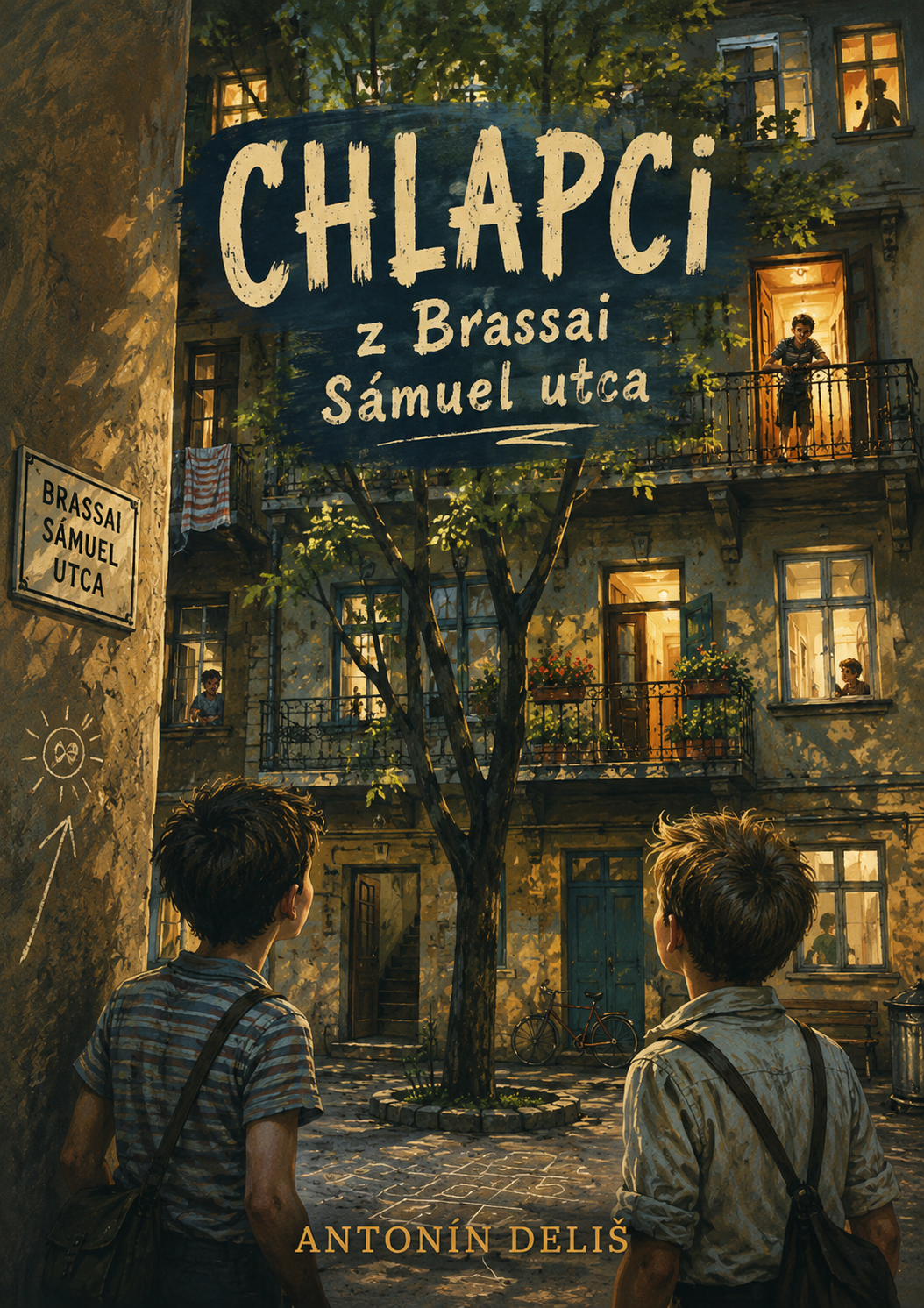
Chlapci z Brassai Sámuel utca — oficiální obálka knihy

LITERÁRNÍ PRÓZA · DĚTSKÉ DOBRODRUŽSTVÍ · BUDAPEŠŤ

Chlapci z Brassai Sámuel utca

Antonín Deliš

Parta chlapců, pavlačový dům a jedna budapešťská ulice, která se může stát celým světem.

E-KNIHA SE PŘIPRAVUJE

VSTUP DO SVĚTA KNIHY

Vyber si, kudy vstoupíš

Budapešťská ulice, dětská parta, kniha a její hudební svět.

ForendorsČTENÍ · SLEDOVATWattpadČTENÍ · SLEDOVATČíst zdeČTENÍ NA POKRAČOVÁNÍSpotifySOUNDTRACKDatabáze knihKARTA KNIHY
VinylHUDEBNÍ VYDÁNÍ · PŘIPRAVUJE SE
E-knihaE-KNIHA · NEDOSTUPNÁ
AudioknihaAUDIOKNIHA · PŘIPRAVUJE SE
Kniha u partneraTIŠTĚNÁ KNIHA · PŘIPRAVUJE SE

VIDEO ZE SVĚTA KNIHY

Jak jsme se přejedli palačinkama

Video vložené v původních materiálech knihy.

Videoklipy a vizuály ke knize ↗

O KNIZE

Na první pohled

ENTER THE WORLD OF THE BOOK


FORENDORS →


WATTPAD →


READ HERE →


SPOTIFY →


VINYL


AUDIOBOOK


BOOK AT PARTNERS


RATE BOOK ON DATABÁZE KNIH →

"Buy ↓"

Chlapci z Brassai Sámuel utca is a story of children from Budapest. A book about a gang of boys from one tenement house, about balcony corridors, courtyards, stairs, tunnels, pigeons, Lake Balaton, and a summer that only seems endless while you are still living it. Brassai Sámuel utca is a short street in Budapest. On a map, perhaps just a connection between a few places. In the story, however, it becomes the whole world. Boys live there who do not yet know that their childhood will one day end. They run up and down the stairs, shout across the balcony corridors, hide in the courtyard, chase pigeons, invent their own rules, do things they shouldn't, and build adventures bigger than the whole city out of ordinary places.

The narrator is eight-year-old Benci Nagy. Not an adult man getting emotional over the past. But a child who is still right inside it all. He sees the world from below. Through the railings, the older boys' shoes, the doorknob, the dusty stairs, the courtyard where everything echoes, and the street that holds exactly as many secrets as children can carry.

Chlapci z Brassai Sámuel utca are a story about friendship, childhood adventures, and a world that smells of summer and mystery. About a Budapest that is not a tourist postcard, but the place of the first gang, the first runs away from home, the first feeling of belonging somewhere. This is not about returning to real childhood exactly as it was. It is a return to a place where memory meets story. And where a single street can for a moment be bigger than the whole world.

VSTUP DO PŘÍBĚHU

Vstup do příběhu

Budapest.

Spring.

Fluff in the air.

Starý činžák.

Dvůr.

Balconies.

Stairs you can run down faster than you should.

Windows from which someone is always looking.

Tunnel.

Café.

Pigeons.

A spa day with the hags.

And the boys who simply cross paths one day.

Benci doesn't yet know that something is just beginning, something worth remembering one day.

For him, it's just a day.

Another day on the street.

Another reason to run outside.

Another secret that needs to be solved before someone calls for dinner.

Except some summers settle inside a person differently.

Some groups of friends come together for just a moment.

And yet they remain in our memory like home.

HLAVNÍ POSTAVY

Osm chlapců z jedné ulice

01 · BRASSAI SÁMUEL UTCA

Benci Nagy

The eight-year-old narrator of the story.

Benci is not an adult author looking back. He is inside the action. He sees things the way a child sees them: accurately, with curiosity, sometimes wrongly, sometimes much more truthfully than adults.

For Benci, the house is the world. The balcony is the border. The courtyard is a kingdom. The street is a place where anything can happen. He does not yet know that some moments become memories before a person can understand them.

And that is precisely why his perspective matters.

He does not want to explain childhood.

He wants to live it.

02 · BRASSAI SÁMUEL UTCA

Márty Németh

A nine-year-old boy from the gang. He is one of those who can instantly turn an ordinary thing into an idea. Sometimes a word, a look, a challenge is enough—and the day takes off in a completely different direction than it was supposed to.

Márty brings movement, resourcefulness, and the childlike assurance that the world is here to be tested into the story.

03 · BRASSAI SÁMUEL UTCA

Gyözö Cserdi

A nine-year-old boy who belongs to the gang just as inseparably as the courtyard, the stairs, and the noise from the street. Every children's group has its inner tension, its agreements, its small betrayals, and its alliances.

Gyözö is a part of this lively boys' chemistry.

Not as a character from a catalog of traits.

But as one of those without whom the gang wouldn't be a gang.

04 · BRASSAI SÁMUEL UTCA

László Timár

A ten-year-old boy among the younger and older kids. An age when a person still runs around with the others, but is already starting to understand a bit that there are rules you can't just run away from down the stairs.

László can be a bridge in the gang.

Still a child.

But already a bit further along.

05 · BRASSAI SÁMUEL UTCA

Bálint Juhasz

An eleven-year-old boy from the gang. He belongs to those who already have more courage, more defiance, and perhaps also more need to pretend they aren't afraid of anything.

Bálint is at the age just before childhood starts to feel suspicious.

He is still part of the game.

But the game is already beginning to change beneath him.

06 · BRASSAI SÁMUEL UTCA

György Baranyai

A twelve-year-old boy. Older, more visible, perhaps a bit mysterious to the younger ones. In every group of kids, there are those who already seem almost like adults, even though they are still children.

György stands closer to the border beyond which the childhood world begins to break.

And that is precisely why he is important to the younger boys.

07 · BRASSAI SÁMUEL UTCA

Tamás Molnár

A twelve-year-old boy who brings another shade of older boyhood into the story. An age when a person still returns to the yard, but is already looking elsewhere as well.

Tamás is one of those who both sustains and disrupts childhood adventure.

Because with them comes the first shadow of adolescence.

08 · BRASSAI SÁMUEL UTCA

István Szöllössy

Thirteen years old, the oldest of the gang.

He stands with one foot in childhood and the other already somewhere else. To eight-year-old Bence, he might seem like someone almost grown up. Yet thirteen is still an age when a person doesn't yet know what is happening to them, only that they already feel something changing.

István is the boundary.

He still belongs among the boys.

But childhood is already beginning to slip away from him.

SVĚT KNIHY

Místa příběhu

📍 Budapest

📍 Brassai Sámuel utca

📍 tenement with gallery walkways

📍 courtyard

📍 stairs

📍 surrounding streets

📍 tunnel

📍 cafe

📍 Nyugati railway station

📍 pigeons

📍 spa

📍 Lake Balaton

📍 surrounding parks, bushes, and green belts

Each of these places is more than a backdrop.

The house is a whole world.

The balcony corridor is a stage, a hallway, a hideout, and an observation post.

The courtyard is the square of a children's kingdom.

The stairs are a racetrack.

The tunnel is a test of courage.

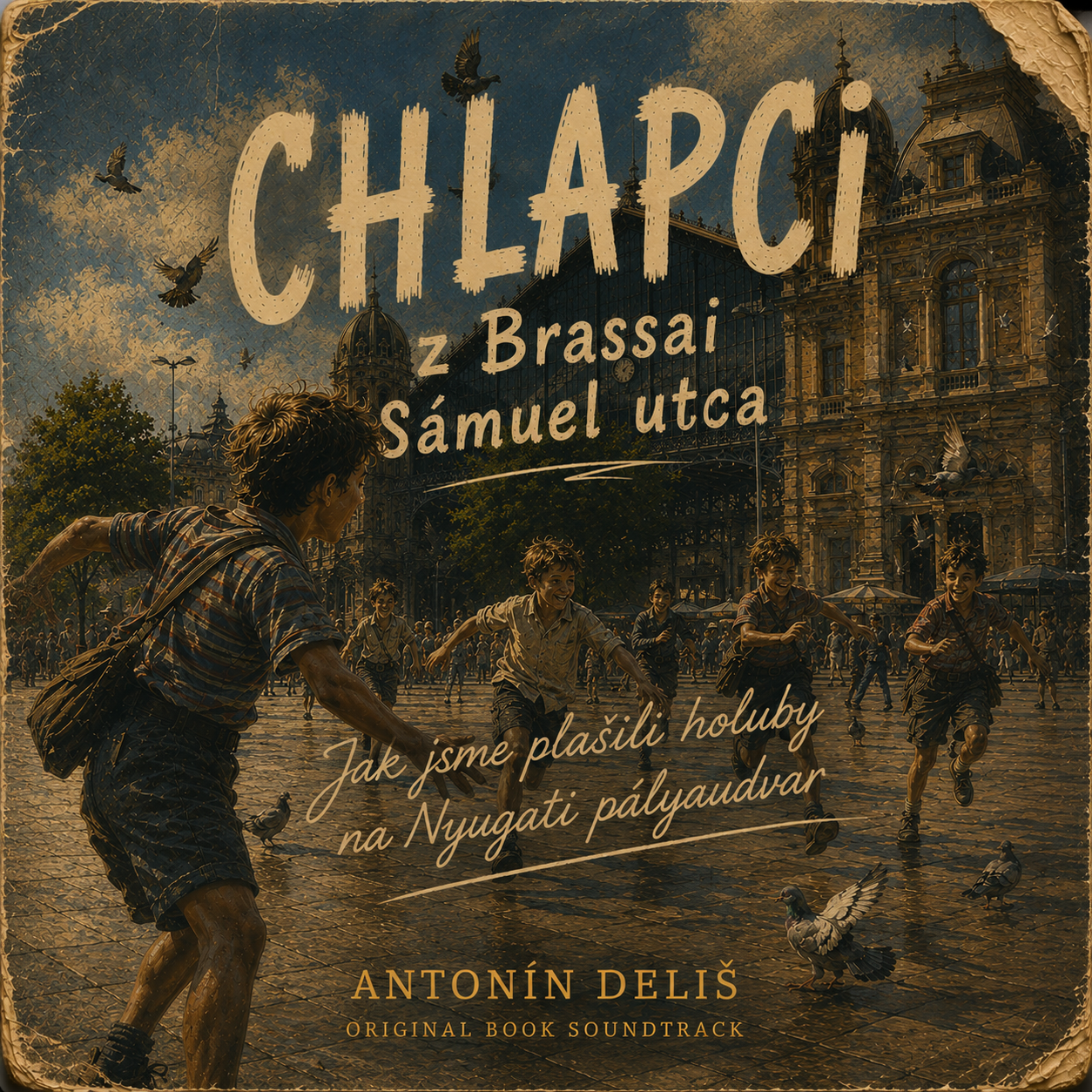
Nyugati pályaudvar is loud, large, and full of pigeons.

Lake Balaton is distance, water, and a summer that feels larger than an ordinary day.

And Brassai Sámuel utca is not just an address.

It is a place invented by the story so that one could return to a memory.

SVĚT KNIHY

Co v knize najdete

a childhood story from Budapest

a gang of boys

balcony galleries

courtyards

stairs

tunnel

pigeons

Balaton

first cigarettes

bathhouse with granny

down in the air

endless summer

childhood rules

secrets

friendship

first hints of growing up

nostalgia without the sentimental coating

the city seen through children's eyes

a world that is both small and vast at the same time

SOUNDTRACK KNIHY

Soundtrack knihy

The books of Antonín Deliš are often created alongside music.

U Chlapci z Brassai Sámuel utca is a soundtrack on the way back to Budapest — among tenement galleries, courtyards, staircases, pigeons, summer light, early boyish adventures, and a peculiar childhood melancholy that only appears in hindsight, when one realizes that certain things will never return.

The first soundtrack album carries the mood of the question: How we actually met.

This is not just music for a plot.

It is an attempt to capture the moment when a few children in a single building become a gang. When strange boys become "us." When the courtyard turns into territory, the stairs into a route, the street into a map, and an ordinary day into a chapter.

The music for this book contains Czech fairytale melodies, the light of Budapest, childhood playfulness, and a sadness that does not force itself into the story, but quietly waits somewhere around the corner.

The soundtrack is a memory even before it became the past.

▶ Listen to the book soundtrack

▶ Music videos and visuals for the book

ZAJÍMAVOSTI ZE SVĚTA KNIHY

Zajímavosti ze světa knihy

The book is not a literal transcript of the author's actual childhood. It is based on memories of life in Budapest, but Brassai Sámuel utca is a literary and imaginative street.

The true memory of the place is mixed with fiction in the book.

ZAJÍMAVOSTI ZE SVĚTA KNIHY

První obraz knihy

The first image of the book is fluff.

There is fluff everywhere.

It flies through the air, clings to clothing, settles on windowsills, dances before one's eyes, and turns an ordinary street into something a little unreal.

This is important to me: the story does not begin with a grand adventure.

It begins with a mood.

With the air.

A day that could be ordinary, if it weren't for a gang, a street, a courtyard, and everything a child needs to turn a place into their own kingdom suddenly appearing in it.

Fluff is light.

But in memory, it stays heavier than it seems.

Because some things are at first just in the air.

And only later do we understand that the whole beginning was made of them.

ZAJÍMAVOSTI ZE SVĚTA KNIHY

Dům jako celý svět

V Chlapci z Brassai Sámuel utca the house is almost a standalone character.

It has stairs that people run up and down.

Balconies to call out from.

A courtyard where you wait to see who comes out.

Windows with adults behind them.

Doors that can be open, closed, or forbidden.

To an adult, it's just an apartment building.

To children, it's a map.

Every floor has a meaning. Every corner can be a hiding spot. Every sound might mean someone is coming. And every way out is an expedition at the same time.

A child's world doesn't need a huge space.

It needs a place that can be occupied by imagination.

And that is precisely what the house on Brassai Sámuel utca is: a small universe where one learns who is their person, who is older, who is afraid, who lies, who runs away, and who waits.

ZAJÍMAVOSTI ZE SVĚTA KNIHY

Budapešť jako vzpomínka

Budapest in this book is not a postcard.

It is not a city of monuments, grand shots, and tourist phrases.

It is a city where people live.

A city where one knows the way to the shop, the sound of the stairs, the position of the courtyard, the smell of the house, the stops, the bushes, the parks, the railway station, the water, the heat, the dust, and the light at a certain time of day.

And that is precisely why it can be so powerful.

Because home is often not defined by grand places.

It is defined by the small ones.

By the spot where a person stood when someone first called them outside.

By the place people fled from.

By the place where they waited.

By the path one walked toward Lake Balaton only in imagination long before ever actually arriving there.

Chlapci z Brassai Sámuel utca are a book about Budapest as a place that never returns in full.

It comes back in fragments.

In down.

In pigeons.

On the stairs.

In the boys' voices.

ZAJÍMAVOSTI ZE SVĚTA KNIHY

Parta a její pravidla

A children's gang doesn't form with a ceremony.

There is no declaration.

It is not sealed with a signature.

It simply happens one day that someone calls out to someone, someone joins in, someone runs away, someone comes up with an idea, and suddenly a "we" exists.

We from the house.

We from the street.

We who know where we are allowed to go.

We who know where we are not allowed, but will go anyway.

In the gang, there are younger and older ones. Courage and fear. Admiration and jealousy. Small betrayals. Great alliances. First secrets. The first feeling that a person is not alone.

And also the first realization that not everyone stays in the gang for the same length of time.

Some boys are already heading out of childhood.

Others are still completely inside.

And right between them lies the tension of the whole book: the summer is shared, but each of them will eventually leave for somewhere else.

ZAJÍMAVOSTI ZE SVĚTA KNIHY

Co inspirovalo vznik knihy

Chlapci z Brassai Sámuel utca grew out of a personal memory of Budapest.

Not as an exact autobiographical record.

Rather as a return to a feeling: the first place of one's own, the first boyish gang, a single summer, a city that settles inside a person even after they leave.

Chlapci z Brassai Sámuel utca is a literary street in this sense. It's not only important where it lies on the map. What matters is what it allows to be told: a house, a courtyard, balcony walkways, surrounding paths, the chance to run outside and meet someone who changes the world for a moment.

The book stems from nostalgia, but refuses to be sweet.

Childhood in it is no safe greenhouse.

It is full of beauty, but also awkwardness, fear, corporeality, first forbidden things, older boys one wants to measure up to, and adults who are close by yet often completely elsewhere.

The children's perspective is important.

Bence does not narrate like someone who understands everything in hindsight.

He narrates like a boy who is watching, running, getting startled, getting excited, misunderstanding something, and understanding something else more precisely than adults do.

That is precisely why the book can be tender without being soft.

And nostalgic, without lying.

ZAJÍMAVOSTI ZE SVĚTA KNIHY

Čas knihy

Chlapci z Brassai Sámuel utca are the story of one childhood period.

It begins with spring, downy fuzz, and the feeling that everything is only just starting.

Then comes summer.

Long days.

The heat.

Dvůr.

Expeditions.

Balaton.

Pigeons.

First cigarettes.

Boredom that turns into adventure in a split second.

And somewhere beneath it all, the realization slowly creeps in that childhood isn't endless, even if it feels that way.

The oldest boys are already standing on the edge of adolescence. The younger ones don't see it yet. Benci certainly doesn't. For him, what matters is what happens today. Who's going outside. Who said what. Who betrayed whom. Who laughed. Who ran the furthest.

Yet the reader can sense that it is precisely from days like these that memories are eventually made.

Not grand ones.

Not momentous ones.

But the kind that return years later.

Perhaps just because fluff happens to be drifting through the air again.

PRO ZARYTÉ FANOUŠKY KNIHY

Ještě zůstat ve světě

Hudba, video, wallpaper, moodboard a čtení na Wattpadu.

AUTORSKÝ A VYDAVATELSKÝ CYKLUS

Jak vznikají a vycházejí moje knihy

My books are not published in all formats at once. Each goes through a gradual authorial and publishing cycle.

  1. I write the book.
    The text, characters, world, atmosphere, and the entire authorial context are formed.
  2. At the same time, I compose music.
    Songs, motifs, moods, and a soundtrack are created for the book.
  3. I release the music.
    First on SoundCloud, then on Spotify, Apple Music, Amazon Music, and other platforms.
  4. I release physical music.
    Selected projects are followed by vinyl.
  5. The book goes to Forendors.
    It appears there in advance as part of supporting my work.
  6. The book goes to the Endralon Space website.
    It gets its own page, information, excerpts, links, and context.
  7. The book goes to Wattpad.
    I publish it there gradually, chapter by chapter.
  8. The printed book follows with partners or via the printing platform.
    This is a publicly available edition of the book.
  9. After that, I am preparing an e-book.
    First PDF, then EPUB. It is not just saving a file, but typesetting, checking, and preparing a readable version.
  10. The audiobook follows.
    That comes only after the text and book part of the cycle.
  11. Finally, signed author copies arrive.
    I have the books printed, sign them, and send them to readers personally.

What this means for readers

When a book does not yet have a PDF, EPUB, audiobook, or signed copy available, it is not an error or a forgotten item.

It means the book is currently in a certain stage of publication.

I add formats gradually, without a fixed timeframe, as the entire authorial cycle naturally reaches its completion.


DOSTUPNOST KNIHY

E-kniha zatím není dostupná

Původní stránka uvádí, že e-kniha není dostupná a cena ani rozsah nejsou stanovené. EPUB a PDF budou zveřejněny po dokončení přípravy.

TECHNICKÉ ÚDAJE

Sdílet článek

Další možnosti sdílení

Další aplikace najdete v nabídce „Sdílet do aplikace“, pokud je podporuje vaše zařízení. Odkaz můžete také vložit do libovolné sítě nebo zprávy.

PUBLISHED · NEW TITLES

Open worlds

All books ↗

IN PREPARATION · 2026

What is happening now

Books in progress, newly finished texts and everything currently moving forward in the world of Endralon.

Open updates ↗

SEARCH THE SITE

VISITOR ARCHIVE

Who has passed through this world?

Today—

Traces of people among books, soundtracks and night cities.

TOTAL
12 937
THIS MONTH
—
Yesterday
—
Visitor measurement is temporarily paused.