Hello, my dear ones 🌸
the last few days have been blurring into one long night that has only a few shifts in light: at one point it's a pale stripe of morning on the glass, another time the blue reflection of a monitor, at another a neon light cracking somewhere in the street, echoing even through the closed window. At such moments, it's strange how work pretends to be quiet — yet carries weight. Like someone placing a matchbox down in the dark: unassuming, but suddenly you know it decides whether there will be warmth.
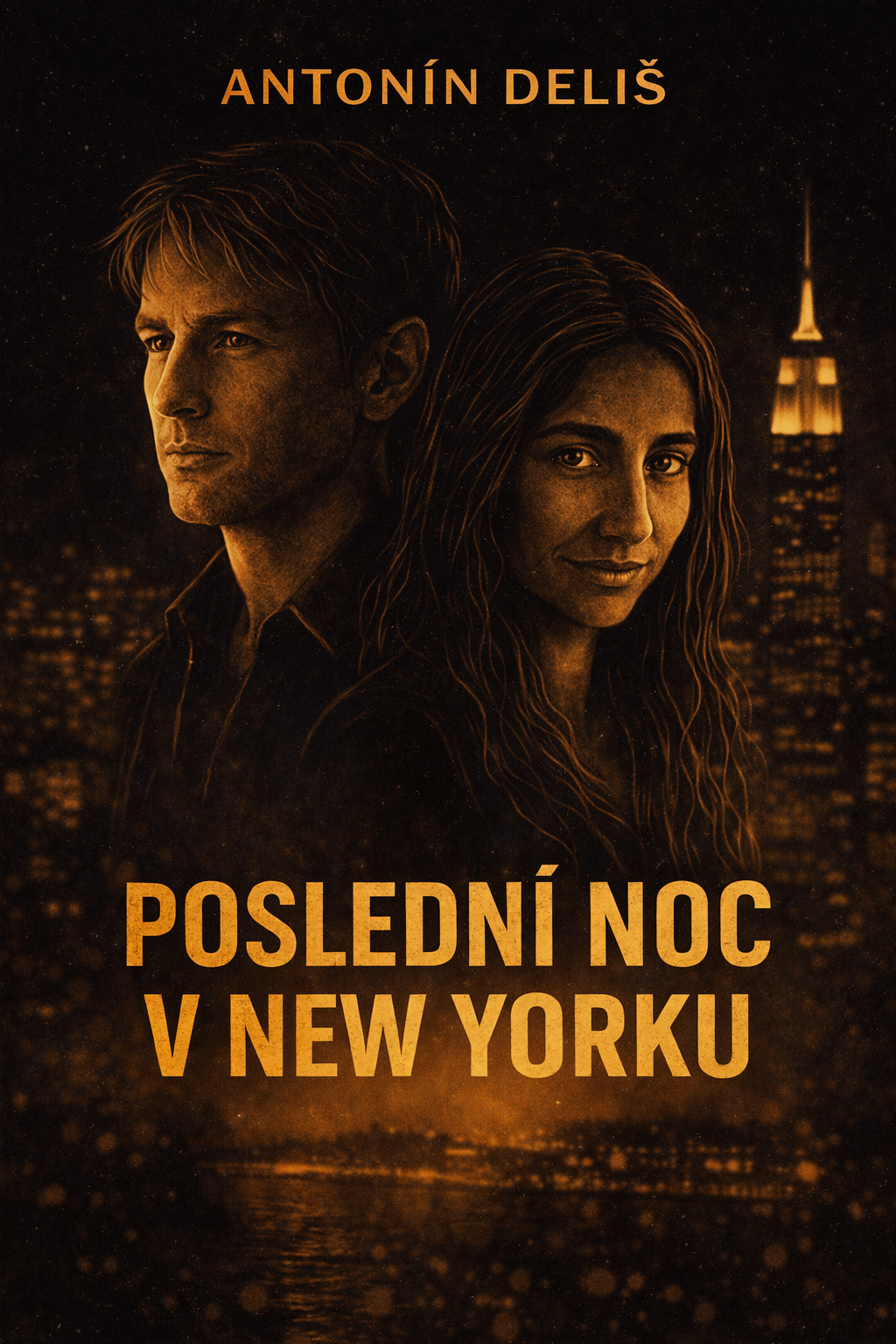
I want to send you a glimpse into the workshop, not a message like "I'm done, start applauding." More like something in between: a record of the last few days when one is no longer writing further chapters, but holding the whole by the shoulders so it doesn't spin out of control. Poslední noc v New Yorku is finished. The entire novel cycle is done. And just as finished are the Original Book Soundtracks for all three parts. That sentence is easy to write, but a person only believes it the moment they see it sitting on the screen and nothing else can be hidden behind it.
To be completely honest: this story didn't start stirring inside me "last year" or "a few months ago." It started somewhere around 2002. Back then I had no idea it would grow into the form of a modern novel, let alone a trilogy. Back then it was one night, one pressure, one network of images and sounds that I tried to keep afloat. Only in hindsight did I realize it wasn't just a cry — it was the beginning of something that assembled itself under my hands for years, without me knowing it at the time.
Perhaps the whole thing started even earlier than I admitted to myself. To this day I remember one ordinary accident that behaves like sound in the body: a tray of drinks fell, glass broke, and a silence spread among the people that was disproportionate to the smallness of it. As if something deeper than an evening on the terrace had shifted. I lay in my room afterwards and still heard that sound — and instead of letting it fade, I opened a notebook and began to write. Not out of calculation. Out of intuition. Out of need.
Time then did what time does: it showed the connection. Besame mucho and New Jeff Buckley was born were created several years apart. And Přízraky v Umagu complemented them many years later. When I look back at it, it doesn't feel like "long work on a single book." It feels like a life that gradually kept pulling me back to one set of destinies until I finished telling them. Some projects you "do." And some rather slowly catch up with you.
What I've just finished is both an end and a comparison. The book has grown and deepened in the meantime. Originally it was 224 pages. Now it's a three-part cycle: 144, 161, and 89 pages. A total of 394 — 170 pages more than originally. I'm not saying this to wave numbers around, rather because numbers are sometimes the only thing holding reality together at night. All three parts have illustrations. And each part has its own soundtrack. A total of 71 songs. When I look at it from a distance, it looks like a map of a city I originally intended to walk through one street at a time — and then discovered there was another floor underneath that city.
At a certain point, you realize that finishing is not a final period, but a change in the kind of work. Like when shooting stops and editing begins. You are no longer adding scenes, you are just looking for the right place for the light. You are looking for what holds the tone. And you find that the most sensitive thing is often what no one names aloud — because it is "just" the rhythm of a sentence, "just" continuity, "just" the order. Yet that very "just" is the difference between a world that breathes and a world that poses as a decoration.
That is why I returned to the texts in 2026. Not for a "new edition" project, but because of the spirit level. I felt the need for all three parts to share a common plane — to carry the same key, the same breath, the same discipline of silence. So that the image would not have to rely on over-explanation. So that the dialogue could carry the subtext. So that the transitions between scenes would not be a spasm, but a current. Revision for me was not "rewriting for correctness." It was the work of an editor trying to make the current flow in a single riverbed.
I kept returning to the revised edition and comparing the text "into a single line." I monitored the temporal continuity of the characters — those things that the reader often does not feel as conscious information, but recognizes the moment they are wrong. In some chapters, it is about fragile trust: who already knows whom, who cannot yet appear, what would already be false if it pretended it hadn't happened. And when I am not sure about the "specific difference," I prefer to name it as a type of change — rhythm, structure, tone — rather than inventing details that would feel convincing but wouldn't be true.
I reached into specific scenes like returning to places you know by heart, but want to see one more time before you leave them. The studio with the winter garden — glass as both a luxury and an excuse. The smoke that makes the space something between a refuge and a laboratory. Flowerpots labeled "Eva 1, Eva 2, Eva 3" — the motif of repetition, the motif of an experiment that pretends to be science, yet is just the human need to give chaos a name.
Then "FONTÁNA", Central Park, under the bridge. There I looked for the balance between liberation and sorrow. I don't want it to be uniformly dark, because that would be a comfortable pose. True sorrow has within it a strange clarity as well, sometimes even the relief that one no longer has to put on a front. And sometimes the most depressing thing is precisely what pretends to be a "nice scene." So I polished it so that it was neither pleasing nor suffocating.
"ZÓNA" and Sheep Meadow were about rigor for me. When a scene is straddled between the calm of the grass and the tension beneath the surface, the logic must not fall apart. I made sure the narrator knew precisely what they needed to know, and nothing extra. Not for the sake of rules, but for the sake of trust. And "HYDRARGYRUM" — the apartment, the bamboo screen, the photograph that Pavel guiltily hides in his pocket — that was working with a small gesture that carries weight: where is the boundary between tenderness and what is already almost appropriation.
Meanwhile, the quietest work was running: language. Sentence reformulation, rhythm, precision. Not "sparkling for effect." Rather a sentence that can carry a mood without embellishing it. Sometimes it is enough to remove one adjective and the scene suddenly feels more mature, firmer. Sometimes it is enough to change the word order so that a sentence becomes music — the kind that doesn't show off that it's music, it just is.
Interwoven with this was the visual aspect, because the image in this project is just as important as the voice. My writing has always had a tendency toward the craft of a screenwriter: interior/exterior, time of day, location — this skeleton helps me monitor continuity. And at the same time I had to learn the opposite: to let things go and wait until they speak up again on their own. Sometimes it is a paradox: a person works hard, but the most important decisions only come when they stop pushing.
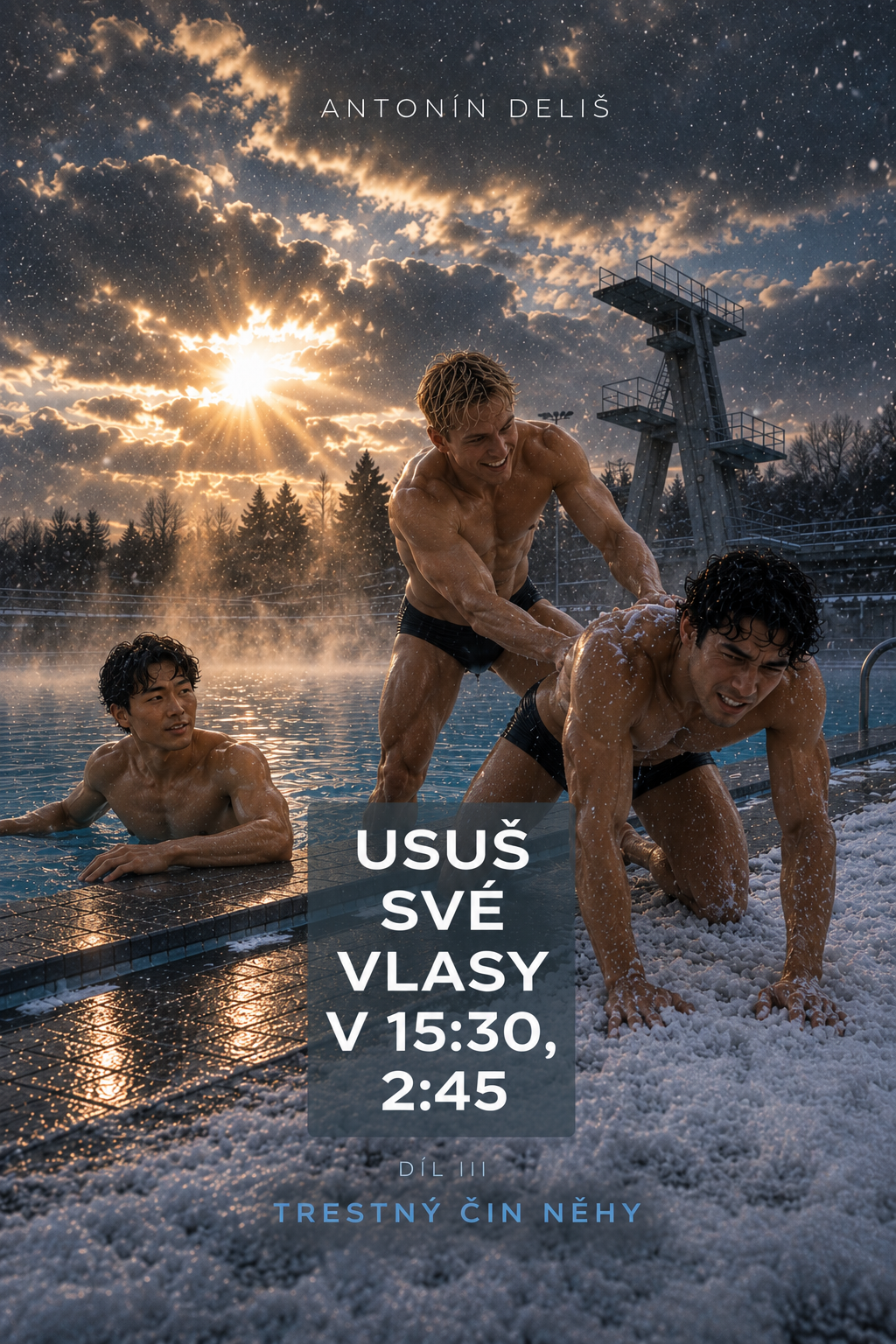
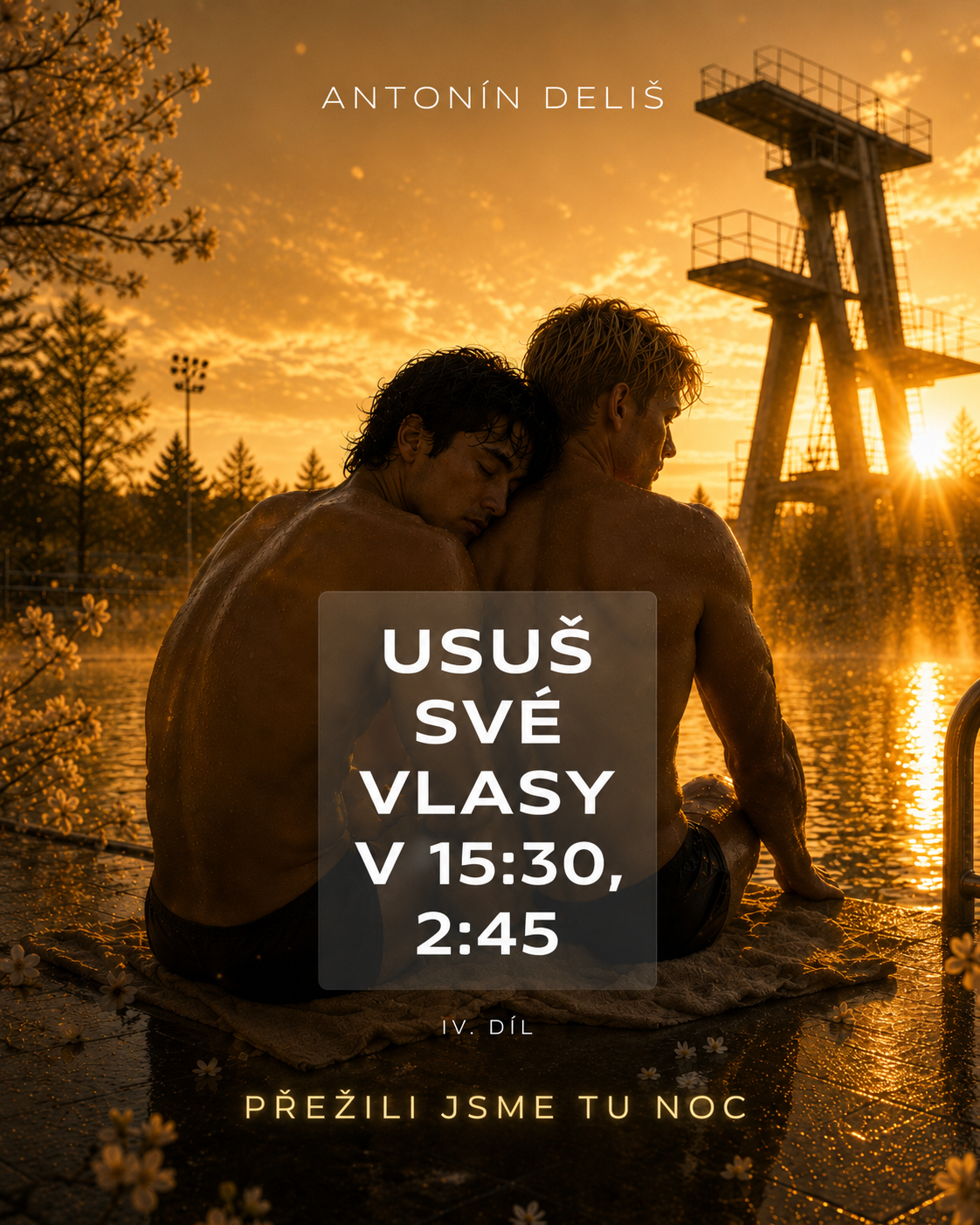
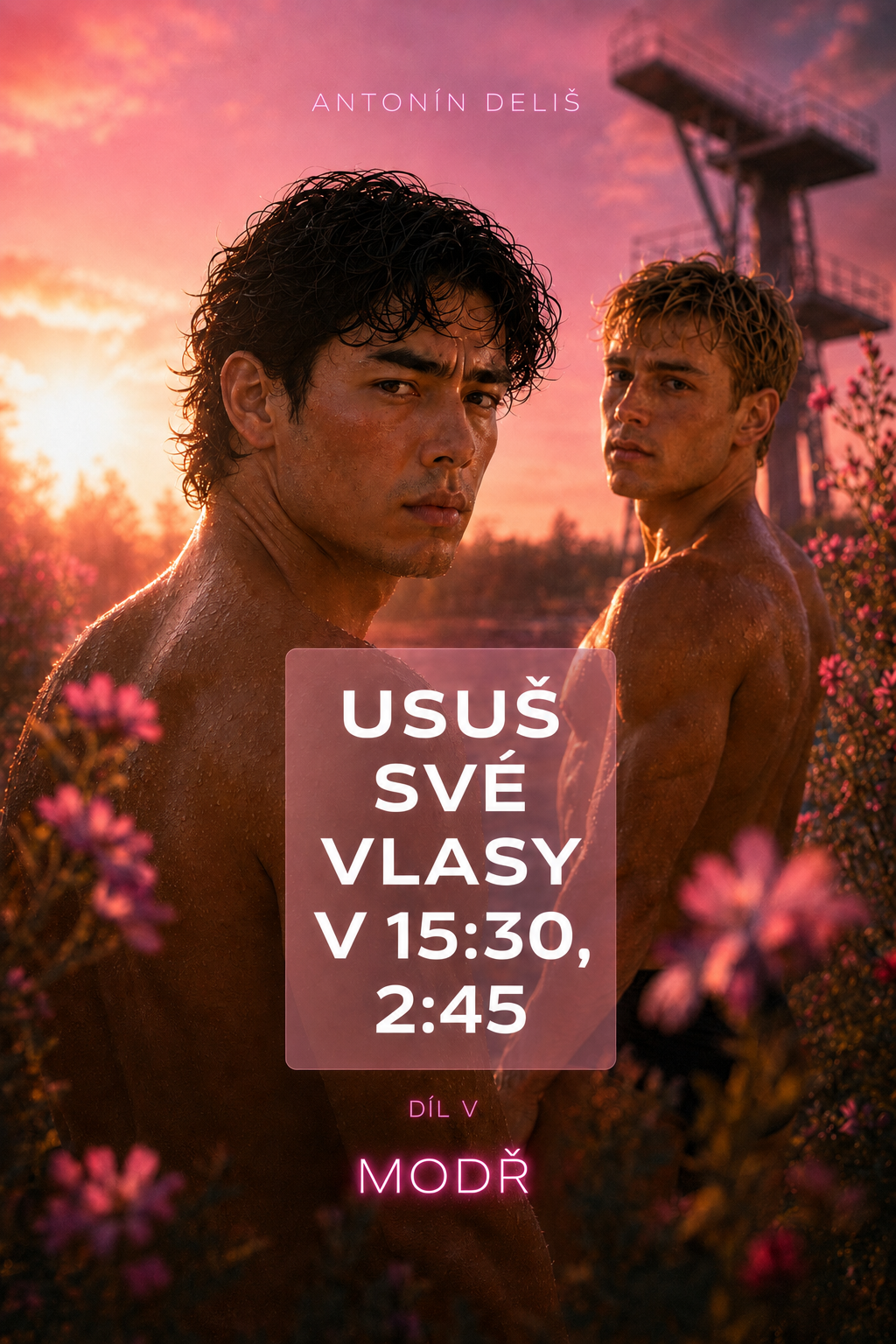
In PNVNY – Přízraky v Umagu, this tension between intuition and craft showed itself the most. I wrote that third part very intuitively, yet paradoxically with the most craftsmanship of all three. I kept an author's journal much more extensively than before — because it contains a lot of topographical terms, maps, routes, houses, and alleys. If you were to follow the heroes' path, you would certainly find most of the places I write about, even though I changed established names here and there to better suit the spirit of the story. Some places have real-life prototypes, while others I had to invent precisely so they could carry the spirit of the city, where destinies intersect so closely that the place itself becomes a phantom.
And there are also strange, delayed coincidences that ruin one's illusion of having things under control. There is a "Murine" street whose name is derived from nearby Murine, and yet the character of Stan Murin came to life much longer before I visited Umag myself. Life creates art — and sometimes reality begins to approach you belatedly, as if it were catching up with you.
The foundational part of Přízraky began to take shape during my spiritual journey through India. I bought the journal in Varanasi, and it became an invaluable assistant. On a hotel terrace near the Manikarnika Ghat, the final part began to come together — in a peculiar way: through small maps, early character sketches, an extensive synopsis, and notes that look technical but maintain emotional continuity. I always sketch out key moments. I need to see the dynamics of relationships from a bird's-eye view — I often perceive it clearly only on paper when I map out the figures in space. It's not just about "what happens," but how the characters relate to one another: who is standing closer, who is running away, who is silent, who is looking elsewhere.
In India, I also encountered the necessity of letting things rest. There are so many impressions there that a person realizes how little they actually remember of the details — even though they were there. And this exact experience is imprinted in the final part: memory is selective, truth is full of holes, and you have to accept that some things cannot be told "completely." Sometimes they can only be told through a detour. And sometimes they must remain unsaid to have power.
This, by the way, is also one of the reasons why Přízraky v Umagu gradually deviated from my original intention. Originally, it was supposed to be a detective novel. But the detective story fell apart under my hands — not in the sense that the mystery disappeared, but in the sense that I cared more about the internal investigation than the genre resolution. About what a person hides from themselves. About what can be borne only as a shadow, not as a police statement.
And because in this world music has belonged to words from the beginning, music albums were created for all three stories as another layer. The soundtrack is not a literal retelling of the plot. It is chapters in music, not plot. For the first part, it is a double album with two planes: one sharper, urban, nervous; the other slower, lost, epistolary. For the third part, it is a "soundtrack show": a cabaret layer of characters on top, dark cinematic cue compositions underneath, and the leitmotif of Úsvitu / Dawn, which returns in several forms as the final note you don't want to let go of.
The second part of the trilogy also has its own nerve. While in the first part New York is born as a desire — as a horizon onto which a person projects a better version of themselves — in the second part New York already stands before you as a place. Not as a metaphor, but as a reality with its own price. And the price is precisely the main nerve of the second part for me: it shows that even what looks like fulfillment from a distance can actually be a form of loss. That the roles that save a person can simultaneously trap them.
And now, one thing that I consider important on a human level as well: I am not a chronicler of reality. Real situations turn into motifs in my books. Some scenes have their roots in real experience, while others originated as a place in the mind to carry the spirit of a city, a house, a relationship. And wherever reality leans against a specific clue in the story, I try to ensure it is not for effect, but as an imprint: something a person carries in silence when talking about art, about loss, and about what can no longer be undone.
Moreover, beneath the surface of Přízraky, there is another layer most people don't expect: tarot. I laid out cards for the settings, for individual days, for plotlines ranging from exposition to catharsis. And then I took a pencil and drew in what was missing from the story I had pieced together. One drawing forced me to leave a lot of things unsaid—and to let go of some magical scenes, even though I loved them. It's part of the discipline of the final installment: letting the story resonate even through what it leaves unsaid.
Perhaps that's why, for me, the third installment is simultaneously a story and a record of the process. A map of how it all came together. Of how impulses from India, Istria, Venice, and Budapest mingled. Of how certain things inscribed themselves into the text like a ghost. And how, at the very end, despite all the phantoms, hope returns—not as a cliché, but more like a final note. Not by closing a door, but by turning on a light in a room one may have already left.
And yet there is another paradox that sometimes amuses and unsettles me: I have never visited New York. Perhaps that's strange when the entire cycle is called Poslední noc v New Yorku. But maybe that's precisely why it could come into being: as a longing, as a price, as a return. And perhaps only once, when I actually walk there myself, will I discover that I had walked those streets long ago—just within sentences.
Now it really is in the stage of fine-tuning and publication: revisions, visual continuity, metadata stuff, credits, captions, cover versions, platform restrictions, exports, costs. Things that are boring until they're finished—and then no one thinks about them because "it just works." And that's exactly what I want: for it to work so smoothly that you can focus entirely on the world, not on the seams.
If you want to stay along for the ride, just a gentle nudge: listen to the soundtracks as independent worlds, follow my channels/website, and I'll soon send you links, complete tracklists, and credits in one comprehensive package. And if you're interested in a specific part of the workshop—text revision, visual continuity, or the purely technical workflow surrounding music and metadata—drop me a line. Not because I have "advice," but because sometimes all it takes is asking the right question and suddenly one knows exactly what to bring out into the light from that workshop.