

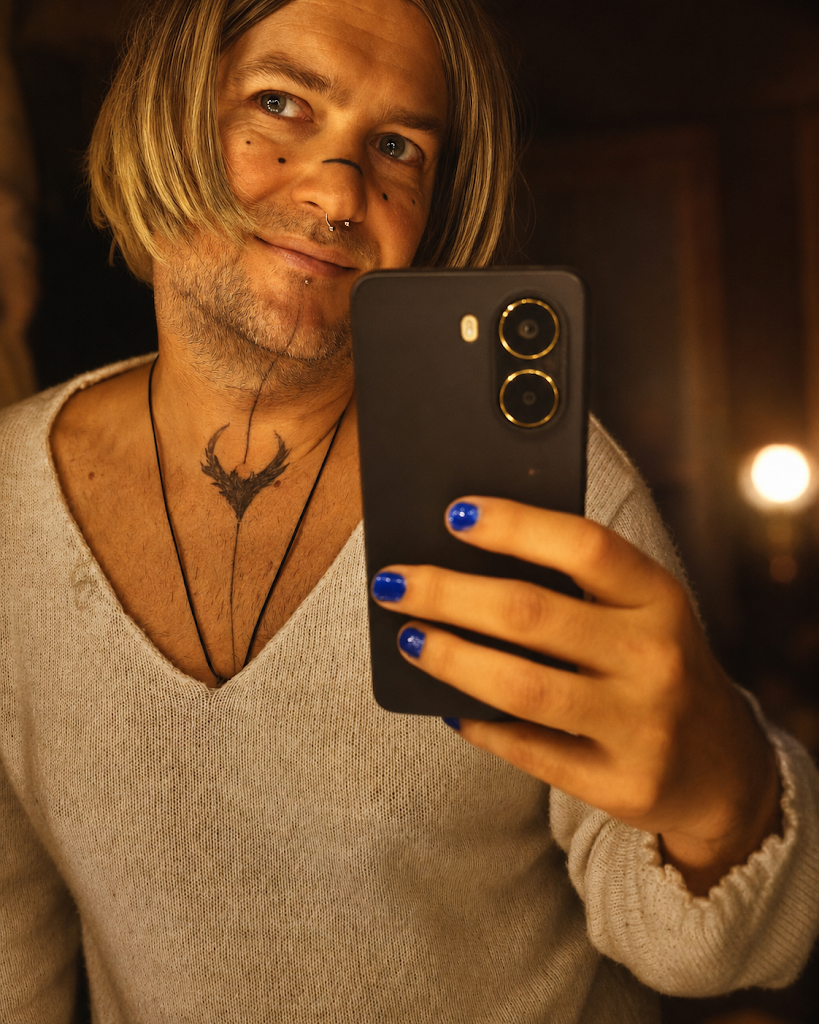




When Antonín Deliš began writing the first part of the pentalogy Dry your hair at 15:30, 2:45, he had no idea that it would fill almost the entirety of the next two years of his life. What started as an intimate gay romance set in Prague's Podolí gradually evolved into an expansive five-part novel that follows the transformation of several young people across four seasons and returns once more to the summer where it all began. We talk about the creation of the individual books, the real places that turned into fiction, the films, the music, the solitude, and why some answers only arrive after several thousand pages.
Pentalogy Dry your hair at 15:30, 2:45 was not created as a series of independent sequels. From the very beginning, it was intended as a single story divided into five books. Each of them has its own atmosphere, its own way of storytelling, and its own rhythm, yet all of them grow out of the same characters, the same environment, and the same questions.
The complete pentalogy Dry Your Hair at 15:30, 2:45
Part I – Žár pod hladinou
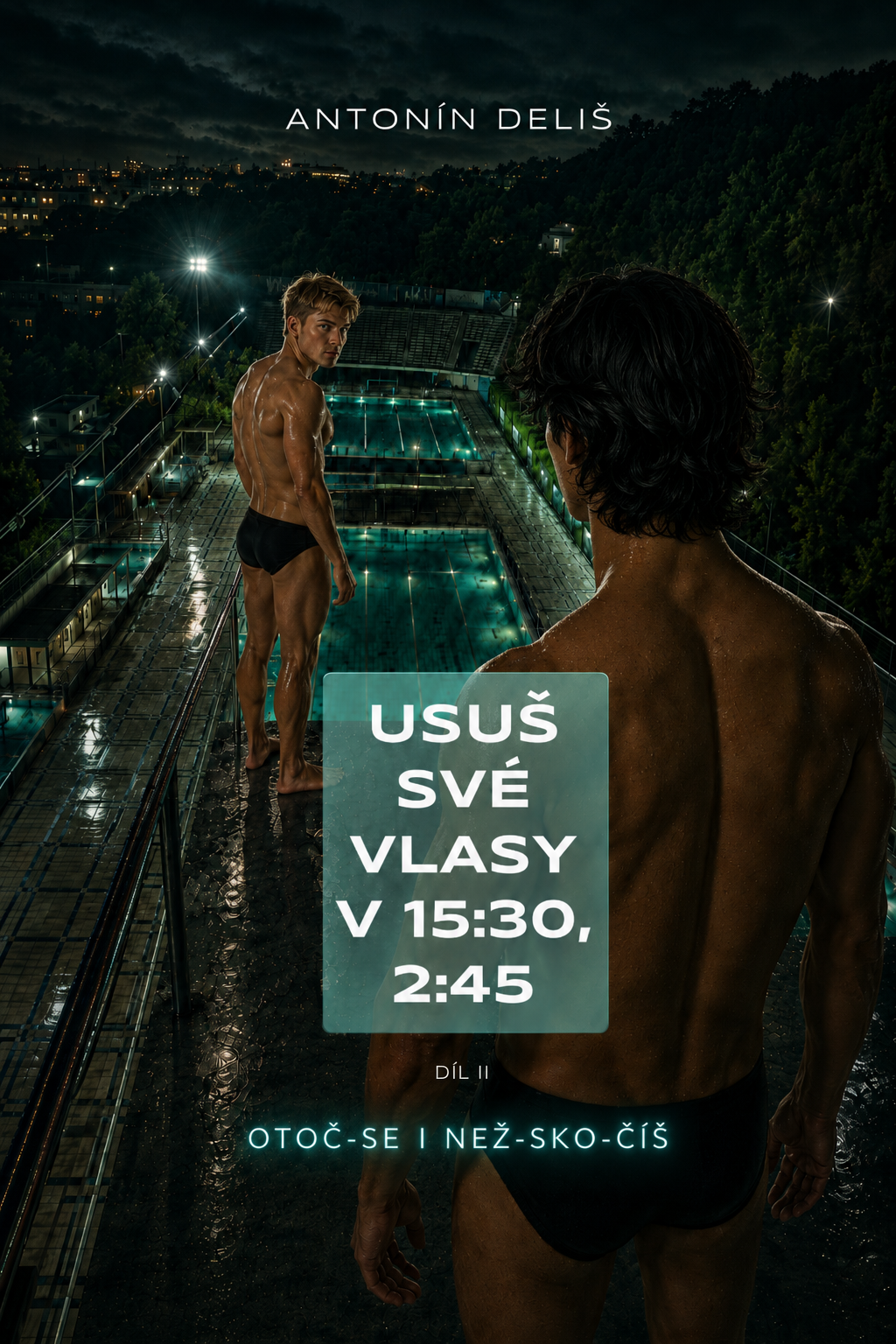
Part II – O-TOČ-SE | NEŽ-SKO-ČÍŠ
Part III – Trestný čin něhy
Part IV – Přežili jsme tu noc
Part V – Modř
The following interview was not created as promotional material for a new book. It stems from the author's extensive answers about how the pentalogy came to be, why it transformed during the writing process, and how the person writing it changed as well.
The Pentalogy in a Nutshell
Title: Dry your hair at 15:30, 2:45
Genre: Heavy Contemporary / gay romance
Setting: Prague – primarily Podolí and other real locations that transform into their own literary world during the story.
Structure: Five novels mirroring the cycle of the seasons. Summer, autumn, winter, spring, and a return to summer.
Series status: the first two installments are published, the remaining three are undergoing final editorial revisions.
"I didn't want to write five books. I wanted to tell one story."
When you started working on the pentalogy, did you know from the very beginning that there would be exactly five parts?
Yes. That decision came very early. Of course, I didn't know all the details or all the scenes yet, but I knew it wouldn't be possible to conclude the story in a single book. From the start, I felt that the individual parts had to correspond to the seasons. Summer, autumn, winter, spring, and finally a return to summer. It wasn't about a literary gimmick. It was more about the feeling that just as the world around us changes, the characters would change too. I didn't want sequels to be created just because the first installment succeeded or because I felt the need to write another book. I had a single whole in my mind. The individual parts are simply different stages of the same story.
Podolí as a place that changes along with people
The entire pentalogy is firmly connected to Podolí. Why specifically there?
I've known Podolí for many years. Not as a tourist. I used to go there long before I started writing. There are places a person returns to for so long that they stop being just places. They begin to carry time within them. I remember people I used to see there twenty years ago. Suddenly, some of them disappeared. I don't know why. Maybe they moved away. Maybe they died. Maybe they just stopped coming. A person never finds out. That is precisely what fascinated me. Podolí isn't just a swimming pool. It's a space where people briefly become part of someone else's life without knowing almost anything about each other. That's what I wanted to capture.
Real places, but not a tourist guide
Readers often recognize specific Prague locations. How closely did you stick to reality?
Real places were important to me, but I never had the ambition to create a documentary. The video rental shop is based on a real video rental shop. Some of the other environments also have a real foundation. The porn cinema is based on personal experience. Similarly, some of the apartments or routes through Prague. But the moment my characters stepped into those places, they stopped being real. I didn't want the reader to compare whether I accurately described a specific establishment or street. I wanted to create a literary space that feels believable, but already belongs to the story.
"The first part was supposed to throw readers off balance at first."
Part I – Dry your hair at 15:30, 2:45 – Žár pod hladinou
The first installment is often surprising for readers. It is much rawer than the books that follow. Was that intentional?
Yes. For example, I was sorry that my parents put the book down relatively early because of the vulgarity, and never reached the point of why it's actually there. The first part was never meant to be just about sex or provocation. It was meant to be an entry into an environment that many people judge within the first few pages. That is precisely why I wanted the reader to get to know the body first. And only then the person. If I had started with long psychological explanations, the whole principle would have vanished.
When the swimming pool becomes the whole world
What does the first part represent for you today?
It is still summer. Not just on the calendar. It is a period when the characters can still act impulsively. They can spend whole days in Podolí, ride around Prague, discover new places without being tied down by duties. It is a world that is not yet divided by school, work, or the daily rhythm. That is precisely why the first part feels the freest. It is a moment when everything is just coming into being.
Many readers asked about the meaning of the title after the first book. Why didn't you explain it?
Because I never planned to. The title existed before most of the story. I knew its meaning would be revealed gradually. It felt more interesting to me if the reader only got certain answers several books later. Life works the same way. Most of the time, we don't understand the meaning of certain moments while they are happening either.
In connection with the first installment, you often mention Korean media. How big of an influence did it have?
Big. It wasn't that I wanted to imitate anything. Rather, I was fascinated by the way Korean films and series work with the rhythm of storytelling. They aren't afraid of long, silent scenes or sudden shifts in mood or genre. Alongside that, a soundtrack was being created that I listened to during long journeys across Prague. The music gradually merged with specific streets, light, weather, and Podolí. I didn't write according to a playlist. Instead, during the writing process, it became part of that world.
When you looked back at the first installment, did it change anything about your view of the entire project?
Absolutely everything. Only when the first book was finished did I realize how many characters I had actually brought into it. Some just flashed by. Others I knew much better than I realized at the time. And most importantly, I understood that the entire pentalogy could not be told in a single style. Each subsequent book would start demanding its own way of storytelling. And that was precisely when I understood for the first time that I wasn't writing a series of similar novels. I am writing a single story that will transform with each subsequent installment.
"The second installment could no longer remain in the summer."
Part II – Dry your hair at 15:30, 2:45 – O-TOČ-SE | NEŽ-SKO-ČÍŠ
After the first book, the setting changes significantly. Summer ends, school, work, and everyday life arrive. Did you know from the beginning that the second book would be an autumnal one?
Yes. From the beginning, I knew the pentalogy would go through all the seasons and finally return to summer. It wasn't just a compositional decision. It was connected to how I personally experienced Podolí. I've known that place at various times in my life. I went there twenty years ago and I go there today. Some faces I associate with it to this day. I remember, for instance, a man who regularly went to the nudist beach. He acted as though he belonged there forever. Then suddenly he disappeared. I don't know why. Maybe he died. Maybe he moved away. Maybe he just stopped going. And that is exactly what Podolí is to me. Not the pool. But a place that remembers people. That's why the second part couldn't remain in summer. In the first part, the characters could ride bikes all day, stay by the water, or visit places where people go without much of a plan. Autumn interrupted that rhythm. School, training sessions, work, and responsibilities began. Suddenly, it was no longer possible to live purely by immediate desire.
A large part of the second volume moves to the Faculty of Physical Education and Sport. Why did you choose that particular place?
From the beginning, I knew the main characters couldn't be high school students. Not only because of the environments they enter, but also because I was interested in people who already have one foot in adulthood. They are studying, working, playing sports, dealing with relationships and their own futures. FTVS allowed me to connect all these worlds. Studies. Sports. Locker rooms. Training sessions. The hierarchy between students, coaches, and teachers. All of that creates an environment that wouldn't arise at a regular school. At the same time, my own experience with the faculty was surprisingly small. I once heard about it from a female friend who perhaps studied there or worked as a masseuse. I also rode past the school on the tram. That was all. I was never inside. When I was starting to write the first part, I imagined I would arrange a meeting and let myself be shown around the school. In the end, I didn't do it. I became interested in something else. Whether I could create a believable environment using only photographs, publicly available information, and my own imagination. That is why FTVS in the novel is not an exact copy of the real school. It is my FTVS. I created some of the spaces entirely in my own way. For example, I imagined the study department almost like the antiquarian bookshop of Karel Konrád Koreandr from The NeverEnding Story, including the doors and the whole atmosphere. I wasn't after a documentary. I was after a world where my characters could truly live. Maybe I'll go take a look there now that the pentalogie is finished. It will be strange to compare the real school with the one I carried only in my head for several years.
What came first? The second part, or its title?
Definitely the title. Only after that did the story itself begin to unfold. I liked that the sentence is not written in the usual way. The division of words by dashes changes the reading rhythm. A person reads them in parts, almost like individual body movements. And the vertical bar between them reminded me of a diving platform. The first meaning of the word "to jump" was purely athletic. Only later did it begin to transfer into relationships. Just as important, however, was the motif of turning around. A person often turns around at a moment when they are doing something they are not entirely sure of. They want to know if someone is watching them. Except turning around can also mean something completely different. Admitting that someone is truly standing behind me. That I know about them. That they interest me. That I can no longer continue as if they weren't there. Originally, that motif was much more strongly connected to Veronika. Gradually, however, it was distributed among more characters. Its definitive meaning is also connected to the conclusion of the second part. But I don't want to explain that in advance.
Tony was not an afterthought
In the second book, Tony gets much more space. Did you have him planned from the beginning?
Yes. Tony wasn't created to form a love triangle. He was part of the story from the very beginning. I even knew he would be present in the very last scene of the entire pentalogy before I knew all the paths that would lead to it. His name was created after Tony Leung Ka-fai from the film Milenec based on Marguerite Duras. It was only over time that I realized how much that film influenced me. Just like The Piano by Jane Campion. Both of them work with the body in a way that is unusual for me. The body in them is not an illustration of erotica. It tells a truth that the characters cannot voice. Touch can mean desire, power, loneliness, shame, danger, and tenderness all at the same time. I think that is precisely where my own idea of a lover's relationship comes from. Not as a space outside of life. But as a place where absolutely everything enters. Family. Origin. Money. Duty. The body. And the realization that even true closeness doesn't necessarily mean a life together.
Tony is an elite cliff diver. Why?
Because I knew from the start that I needed someone among the main characters who would be the best. But it wasn't just about the sport. Tony's performance doesn't stem from talent alone. It also carries the expectations of his family. The need to hold his own. Not to disappoint. Being the best isn't just personal ambition for him. It's almost an obligation. That's precisely why his calmness doesn't mean he isn't under pressure. On the contrary. He might be the most constrained of all three main characters.
Tony comes from a Vietnamese family. What led you to that?
I didn't want to create a representative picture of the Vietnamese community. Tony was supposed to bring an experience that neither Tom nor Viktor could have. His parents work in Sapa. His family life grows out of a different cultural environment that has been transferred to Prague, yet it still carries its own expectations and its own rules. In doing so, I also drew on my long-term relationship with Asian cultures. Since childhood, I've had a close friend from Hong Kong. Later, I got to know people from Taiwan. I never had a direct Vietnamese friend, but that environment had long attracted me. And just as sincerely, I have to say one more thing. Vietnamese and other Asian men have always seemed beautiful to me. I didn't want to hide that behind more complex literary constructions. That, too, was one of the impulses for why Tony turned out just the way he did.
Besides the setting, the style of the entire series has also changed. Why?
It wasn't that the first book stopped being enough for me. It was that the way some people read it stopped being enough. I felt like some readers condemned the characters before truly getting to know them. But I never judge them. I just observe them. That's why the second book changed its rhythm. I needed to show that their lives don't end in a cruising area cabin or by the pool. They have school. Jobs. Families. Ordinary days. Only together do they form a whole. It was also while writing the second book that I began to realize each subsequent book would need its own way of telling the story. It wasn't a pre-prepared literary strategy. It arose from how the characters and time changed. And perhaps that is why the individual parts differ from one another so much.
“In the third installment, I no longer just tell the story of a few people. I tell the world in which they live.”
Part III – Dry your hair at 15:30, 2:45 – Trestný čin něhy
After two books, the pentalogy undergoes another dramatic transformation. The third installment is no longer told primarily through the eyes of a few main characters, but becomes an ensemble novel. When did you decide to do that?
Already after finishing the first installment. That was when I realized the world of the book contained many more characters than I actually had time to develop. Some just flashed by. Others I introduced, but I knew their stories would never unfold unless I changed the way of storytelling. And that was precisely when the decision was made that the third part would be ensemble-based. It wasn't an experiment. It was the only way to give the individual characters real significance.
What led you to the ensemble form?
Definitely the films of Robert Altman. This directly bled into the book itself, because Tom and Romi watch Gosford Park. I love that movie very much. Just like The Company, which tells its story in a similar way. While writing, I also realized one more thing. I actually subtly carry over into my books the period when I was studying film and working in film and television. It's not about specific memories. More like a certain kind of nostalgia. It's a world I once knew very well and haven't lived in for a long time. Perhaps that's precisely why I keep returning to it in my books somehow.
Why was it important for you to give space to secondary characters as well?
Because they are part of the truth of that story. I'm not just interested in one person. I'm interested in the environment they live in. Only the secondary characters show why it's sometimes so hard to find closeness or a relationship. Every community has its own dynamics. Sometimes it's created by one person. Other times by an entire place. Or an app. Like Grindr. In the book, it's not just a prop. It's an environment that influences the way people think. What they are looking for. How they communicate with each other. What ideas they have about relationships. That's precisely why Tom and Viktor later switch to KakaoTalk. It's not a technical detail. It's a change in the space where they can be together.
Who took up more space during the writing than you originally planned?
First Veronika. Then Růženka. Gradually Pavel. And finally Tony. That's exactly what I love most about writing. I don't feel like the characters start doing something different from what I planned. Rather, I gradually discover that there was much more in them from the beginning than I realized.
You mentioned Pavel. How did he surprise you in particular?
Already while writing the first installment, I knew he would be important. I also knew that his fate would affect the entire pentalogy. But I didn't know how. That only took shape during the writing itself. It wasn't about a carefully drawn-out outline. It was more about gradual discovery.
Why did you decide that the third installment would be the most extensive and most branched out?
Because I'm not just telling individual books. I'm telling one pentalogy. And the third installment is its dramatic climax. To borrow from Aristotle's poetics, this is precisely where the individual lines must meet. It's not just another sequel. It's the center of the entire structure.
Because of the third installment, you went to watch cliff diving competitions. What did you take away from them?
Originally I went there mainly to observe. I wanted to soak up the atmosphere. In the end, something completely different surprised me. Until then, I had imagined that divers were almost without exception perfectly athletic types. The reality was much more varied. At the competitions there were young and older athletes. People of various body types. Even competitors recovering from injuries. Suddenly I realized how much my original idea was simplified. Yet I didn't consciously transfer it into the novel. I wasn't writing a documentary about diving. I was writing a gay romance. And I needed a world that corresponds precisely to this type of story.
What fascinated you the most at the competitions?
Perhaps a completely ordinary thing. I was sitting on a tiled bench in front of the steam room, watching the athletes. Not as a voyeur. As an author. I listened to snatches of sentences. I watched the way they waited. How they moved. How they talked to each other. I wasn't copying their dialogues. I was rather learning the rhythm of that environment. And I was realizing a strange contrast. A person who spends all day at a computer is sitting there, and young elite athletes are walking past him. It wasn't a feeling of envy. Rather, a strange joy that I could be part of their world for a while.
Did anything else surprise you?
Yes. I thought elite athletes would have professionally managed Instagram profiles. That didn't happen. Most of them used completely ordinary personal accounts. Some were even private. That's exactly why I didn't create custom Instagram identities for my characters either. The club's account was enough for me. It felt much more authentic.
Why television cameras?
In the third part, television cameras take on a major role. Where did that idea come from?
I needed to create a situation where everyone naturally comes together in one place. Not just the main characters. Also parents. Coaches. Spectators. People who otherwise wouldn't come to a regular race. The television broadcast gave it the necessary weight. My inspiration was the Korean series Twenty-Five Twenty-One. One of the main characters works there as a television anchor, and that environment stayed with me after watching the series. To this day, I have a strange habit. Every now and then, I stream Korean television news via Google. I don't speak Korean. I don't understand most of it. I listen to it for the rhythm and atmosphere. Besides that, however, I worked in television for many years. I remember very well what crisis situations look like during a live broadcast. How quickly decisions have to be made. What tension arises in the control room. I didn't want to write a novel about television. I just wanted this experience to subtly find its way into the book as well.
In the third volume, the way you work with intimacy also changes significantly.
The first two books needed a different development. The love scenes couldn't have come any sooner. Not because I didn't want to write them. But because they wouldn't have been true. The characters first had to go through a long journey. By the time the reader already knows their fear, shame, past, and mutual relationships, the body itself ceases to be important. What is more important is what closeness means between them. That is why the third volume no longer needed the same explicitness as the first. Not because I started to feel ashamed. But because it no longer brought new information.
The title of the third book feels perhaps the most mysterious of all. How did it come about?
It appeared already during the writing of the second volume. Originally, I thought it belonged to a completely different story. Then I realized that it precisely captures the continuation of the pentalogy. I didn't want to write about forbidden love. That is not the theme of that book. I was much more interested in the fact that true tenderness never remains without consequences. That is precisely why the book is called Trestný čin něhy. The meaning of the title only becomes fully apparent while reading. I wouldn't want to explain it any further. It would be a shame to deprive readers of the opportunity to discover it for themselves.
“The fourth installment didn't arise from the need to move the plot forward. It arose from the need to understand what remains after certain events.”
Part IV – Dry your hair at 15:30, 2:45 – Přežili jsme tu noc
After a sweeping ensemble novel, you are suddenly returning to an intimate narrative. Why?
Because it matched what I was experiencing myself. I didn't want the fourth installment to continue in the same way as the third. When a person is truly grieving, the world doesn't get bigger. Quite the opposite. It shrinks. Suddenly, there are only a few closest people and everything else fades into the background. Not because it ceases to exist. It's just that one no longer has the strength for it. That is precisely why the ensemble had to step back. Not because the other characters stopped being important. But because Tom and Viktor can no longer perceive the world the way they used to.
The fourth installment feels completely different from the previous books. What is the reason for that?
Grieving changes how one experiences time. That is perhaps the most important thing. When someone experiences something like that, time stops flowing the way it used to. Some moments stretch out. Others vanish. Traditional realistic storytelling suddenly wasn't enough for me. Not because I wanted to experiment. But because it could no longer capture the way a person truly perceives the world.
Elements of magical realism appear in the fourth installment. What led you to them?
I didn't want to write fantasy. I knew that from the beginning. Fantasy often offers explanations. But I was interested in precisely the opposite. Situations where a person doesn't know what is reality, what is a memory, and what is a way their mind processes pain. For me, magical realism never meant that miracles happen. Rather, that reality transforms through human perception. If supernatural elements explained everything, they would rob human experiences of their weight. I didn't want that.
Spiritual motifs appear in your books. What role do they play right here?
I never viewed spirituality as an escape from life. Quite the contrary. I think a person has to endure absolutely everything. The body. Sexuality. Sadness. Anger. Desire. Solitude. Only then does spirituality have any meaning for me. If it became a simple explanation for everything, I would stop believing in it. That's why the fourth installment doesn't rely on the existence of a simple answer. It rather admits that some questions have no answer at all.
While writing, did you have the feeling that you were no longer just writing about characters?
Yes. Maybe more than ever before. Right from the start, I knew that through Tom and Viktor, I would have to answer a question of my own. Why am I still alone after all these years? I didn't want to answer it directly. I wasn't writing an autobiography. But I realized that I could no longer examine certain things just from the outside. I had to experience them together with the characters.
In the fourth volume, family ties, genealogy, and the motif of a name change appear more prominently. Where did that come from?
It didn't originate as a literary construct. It came from my life. I became interested in family history. I experienced family constellations. After a long time, I met up with relatives. To a certain extent, my own name change affected me too. But I didn't want to write an autobiography. These experiences turned into a question. What all does family decide for a person? What does a name mean? And how much of the past does a person carry without even knowing about it? That interested me much more than genealogy itself.
The title of the entire pentalogy contains two times—15:30 and 2:45. When did you decide what they would mean?
What is interesting about that is that the title came into being before most of the story. First there was Dry your hair at 15:30, 2:45. Only after that did the individual books begin to be born. I knew I didn't want to reveal the meaning of both times right away. They are supposed to fill with meaning gradually. At the same time, 2:45 began to appear in my own life in a strange way. I was waking up at that time. I was working at night. That time became a part of my everyday life. In the end, it made its way elsewhere too. It stopped being just the title of a book.
One of the most important scenes in the fourth volume takes place in the bathroom. Why right there?
Because in the meantime, I experienced a relationship in which ordinary moments meant the most. Not grand gestures. Not dramatic moments. But bathing. Care. Drying hair. These seemingly ordinary things became one of the most intimate experiences for me. That is precisely why after the love scene, another erotic moment does not follow. Care follows. That is much more important to me.
The fourth part takes place in spring. Most people associate spring with a new beginning. Not you.
My experience is different. Spring has never been a simple symbol of hope for me. It is a time when the organism is only just recovering after winter. A person tends to be tired. Exhausted. And it was precisely then that I also began to realize how many people pass away precisely in spring. That is why I didn't want to write a book in which everything suddenly gets better just because the trees have started to bloom. The characters are not ready for it yet. The world around them is waking up. They themselves are only just looking for a way to live again.
When someone reads your books, they might get the feeling that you spent a whole two years in Podolí. Was it like that?
Not at all. Most of the pentalogy was created at home. Of course I went to Podolí. I used to return there. Observe people. Soak up the atmosphere. But the actual writing took place mainly at the computer. Perhaps it's a paradox. The more the story grew, the less I needed to be in specific places. I already carried them in my head. Just like all the characters. And perhaps that is precisely why the fourth part could be created as the most intimate part of the entire pentalogy. It was no longer just a return to familiar places. It was a journey inward.
"The final part is not a full stop. It is a return to the place where everything began."
Part V – Dry your hair at 15:30, 2:45
After winter, spring, and all the events of the previous books, you are returning back to summer. Why was it important to conclude the pentalogy precisely there?
Because I never wanted the last book to be just an epilogue. I wanted a return. When I started thinking about the entire pentalogy, it was important to me that it had the shape of a circle. It begins with summer and it also ends with summer. Except it's no longer the same summer. The same places. The same tower. The same pool. Only the people who pass through them are no longer the same. That, in my opinion, is the biggest difference. The world hasn't changed. Those who live in it have changed.
In the previous parts, the characters deal with first loves, losses, and their own identity. What is the final book about, then?
About acceptance. That word is often used too simply, but for me it means something else. It's not about everything working out. About all relationships ending happily. About pain disappearing. Rather, one realizes that some things will never be the same again. And yet one can go on. I think that's precisely what maturity is.
It feels as though in the final installment you completely stopped caring about dramatic plot twists.
That's true. I didn't feel the need to escalate everything once more. When characters go through four books, they don't need another catastrophe just to make the story feel suspenseful. On the contrary. Ordinary moments start to become interesting. Conversations. Silence. A shared journey. The way two people look at each other. Literature sometimes creates the impression that a relationship exists only when something dramatic is happening. I believe the opposite. A true relationship begins only when the dramatic events end.
You bring the reader back to the places from the first installment. Weren't you afraid of repeating yourself?
Quite the opposite. That was precisely what interested me. When a person visits a place years later where they once lived through something, the place mostly hasn't changed. Only they have. And suddenly they see completely different things. The same bench. The same stairs. The same tower. But through different eyes. This is what I wanted to capture. Not nostalgia. The transformation of perspective.
Did you have the final scene prepared from the beginning?
Yes. Not in all details. But I knew where I was heading. It's a strange experience. For several years you write thousands of pages while still knowing that somewhere out there a single scene is waiting for you, toward which everything is directed. The journey changed during the writing. The characters surprised me. Some events arose much later. But the feeling of the ending remained the same.
How did you yourself change during the writing?
I think more than I expected. When I was starting out, I left my job at the post office. I took out a writer's loan and decided to try giving writing everything I had. I had no idea how demanding that journey would be. During that time, I lost money. I lived through a relationship and a breakup. For half a year, I barely wrote after Amálka died. Then I went back to the manuscripts and started catching up on everything I had lost. At the beginning of the pentalogy, I used to sit in Podolí or at the nudist beach and think about individual scenes. In recent months, I've barely gotten up from the computer. It was a completely different kind of writing.
What was the moment when you wrote the final sentence?
I wasn't expecting any euphoria. And indeed, none came. More like an immense silence. Suddenly, I realized that several years of my life had ended with a single sentence. That felt strange. The strongest emotion didn't come until later. The moment I realized that those five books actually exist. That it's not a plan. It's not a dream. It's not an unfinished project. It's a completed pentalogy.
"I didn't want to write five books. I wanted to create one world."
Conclusion
Viewed from the outside, it might seem that Dry your hair at 15:30, 2:45 is primarily an extensive gay romance set in the environment of Prague's Podolí. After a few hours of conversation, however, it is clear that it is something broader. It is a story about time. About how places change without altering their appearance. About how relationships transform when a person stops fighting themselves. About the memory of the body, about growing up, about mourning, about tenderness, and about the courage to stay close to another person at a time when big words are no longer enough. Five books, five seasons of one life. Summer, autumn, winter, spring, and the return to summer. The circle closes. Not because everything has ended. But because some stories can only end where they once began – by the water, beneath the diving tower, in Podolí, where one once dried their hair in 15:30 and much later understood the meaning of time as well 2:45.
About the author
Antonín Deliš is a Czech author writing in the genre heavy contemporary. In his work, he has long combined psychological prose, the realistic setting of contemporary Prague, and relational stories that focus not only on romance, but also on family, physicality, identity, memory, and human transformation over time.
Pentalogy Dry your hair at 15:30, 2:45 represents his most extensive literary project to date. Over the course of two years, five novels were created, forming a single story spread across four seasons and a return to the summer where it all began.
Where to find the books
The complete pentalogy Dry Your Hair at 15:30, 2:45
Part I – Žár pod hladinou
Part II – O-TOČ-SE | NEŽ-SKO-ČÍŠ
Part III – Trestný čin něhy
Part IV – Přežili jsme tu noc
Part V – Modř











