
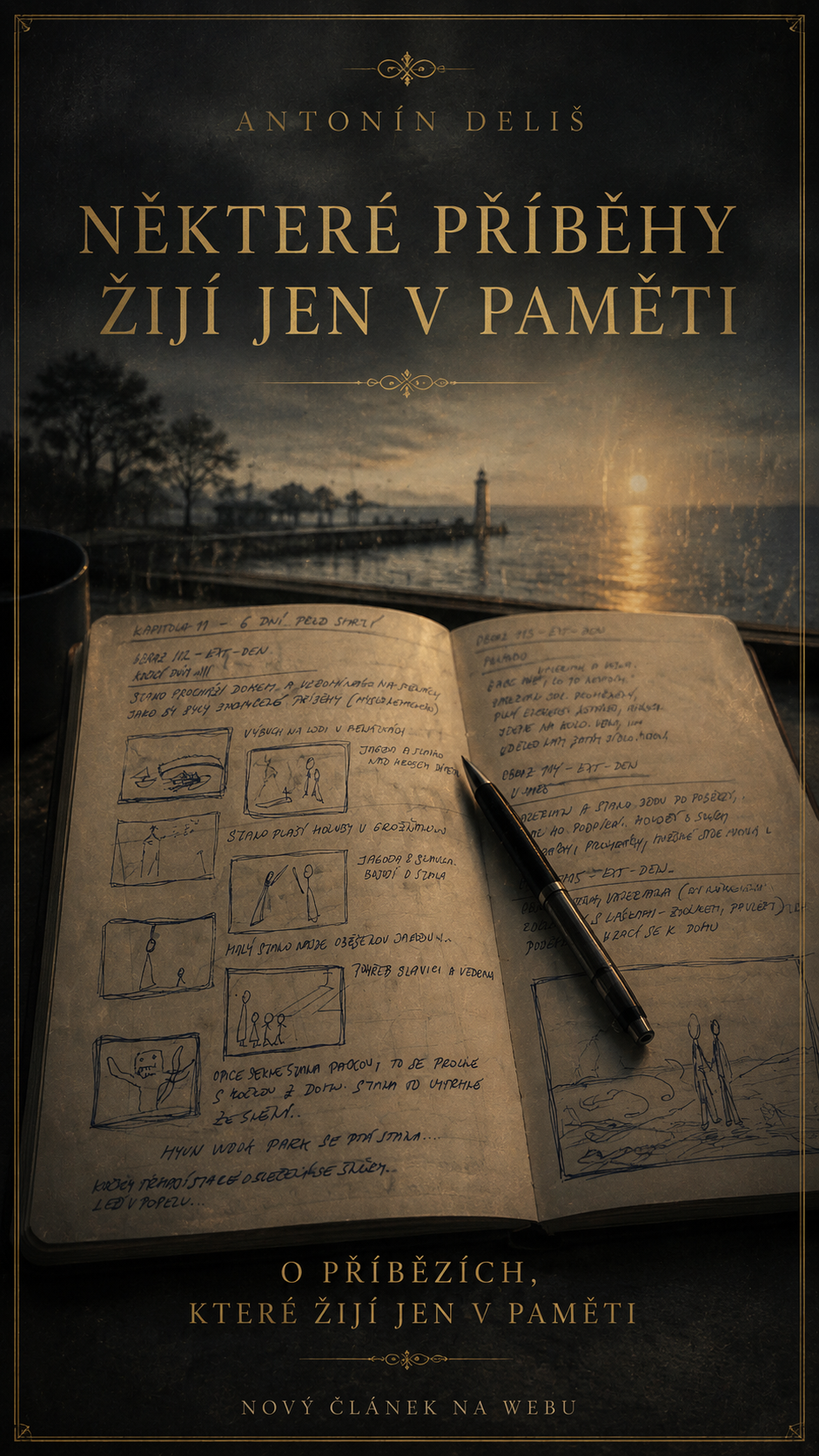
I have a red notebook from India at home.
It isn't some randomly found exercise book that I discovered after years at the bottom of a dusty box. I keep my materials. Old manuscripts, notes, sketches, story maps, screenplays, and workbooks. It just surprises me after all these years that I still have some of them. That they survived all the moving, relocations, life changes, and my own transformations.
That red notebook is from 2013.
I was born in 1981, so I was thirty-two back then. Today I am forty-five. And that very difference between my perspective then and today is strange. When I look at those old notes today, I don't just read them as an author. I read them as someone who already knows what followed. What remained. What fell apart. Who left. And which characters keep coming back to me over the years.
That notebook was created in Varanasi.
I was writing it in a hotel near Manikarnika Ghat. I sat at the table, looking out the window at the place where the dead are burned. Not as a distant metaphor. Not as an image from a book. Really. Smoke rose over the Ganges, the pyres burned, and ordinary life went on around it. People were talking, drinking tea, walking about, going about their business.
Death was not hidden there.
It was present.
And it was right there that I wrote Přízraky v Umagu.
When I open that notebook today, I see notes in it that I repressed long ago. Some of the sentences surprise me. Some thoughts I would write differently today. On the other hand, some are more precise than I would have expected. But it's not the texts that move me the most. It's the drawings that strike me the hardest.
They are quick ballpoint pen sketches.
Sometimes ridiculous. Sometimes almost childishly simple. Stick figures, rooms, stairs, coastlines, streets, a ship, an interior, a group of people at a table. At first glance, nothing much. Just a few lines meant to capture what was just then assembling in my head.
Except that for me, those drawings were not decoration.
I see stories first.
I do not begin with a sentence. I begin with an image. I see a figure in space. I see where they are standing. Who is beside them. How far apart people are. Who is looking out the window. Who is sitting at the table. Who is walking along the shore. Who can still turn around. And who has already left.
Only then do the images begin to arrange themselves into a sequence.
Perhaps that is why these notes resemble a storyboard. I see the story almost like a film. I used to sketch individual scenes so that I wouldn't get lost in them. So that I would know what follows what. So that I wouldn't lose the characters' blocking. So that I would know who is where, who is leaving whom, and who remains standing in place.
Today, those little drawings seem amusing to me.
At the same time, however, I see something very precise in them. They are not pretty. They are not artistically elaborate. Yet each of them highlights the character of the scene. It is the first shape of the story. The first attempt to capture something that did not yet have a language.
And among those drawings and notes, names appear.
Stano.
Gloria.
Valerian.
Three characters who had real-life models. Three real people. I don't want to turn them into tabloid secrets or a literary riddle. What's important to me isn't who they were exactly. What's important is that they left a mark on me.
I suppose in a way I secretly fell in love with them.
Maybe not always romantically. Sometimes maybe yes. With certain people, it's impossible to name it precisely. You feel a strange fondness for them that's one-sided, unsolicited, inexplicable. Someone walks through your life and doesn't actually do anything grand. And yet they stay inside you.
I don't really write about people I don't like.
For someone to make it into my story, they have to strike me in some way. They have to stay in me. I have to have a bond with them, even if only internal. Even if that person never returns it. Even if they have no idea at all.
The character who then lives inside me is sometimes like love across oceans of years.
That's a peculiar kind of relationship. Maybe you don't see each other anymore. Maybe you don't know anything about each other anymore. Maybe your paths parted long ago. But they still exist in the story. Not as an exact copy of a real person. More like their imprint. Like light that fell on paper for a moment and stayed there.
He thus found his way into many of my works.
He is not only in Přízraky v Umagu. He returns elsewhere, too. He appears in poems, for instance in the collection Boy of cum, where the collection's protagonist, Pan, resorts to him. Sometimes he is prominent. Sometimes he is merely a shadow. Sometimes it might not even be possible to tell that it is still him. But I know.
And perhaps that is precisely the most important thing.
Sometimes the author knows things that the reader is never explicitly told. They know who loved whom. They know who slept with whom. They know who left pregnant. They know who will die soon. They know what happens after the last page. And yet they don't have to write it directly.
In Přízraky v Umagu there are things that remained only in my head.
Take Gloria, for instance. She secretly loved Stan. Stan loves Pavel. Valerian is her brother. Stan and Valerian might be drawn to each other, but there is a blood tie between them. And somewhere deep in my head, there is also a scene that isn't in the book: Stan sleeps with Gloria in Venice. She then leaves on an ocean liner. Stan thinks she will never be happy. And I know she's pregnant.
It's not on paper.
And yet it exists for me.
Similarly with Stan's final scene. It isn't stated outright that he's going to die soon. But I knew it while writing. I felt it strongly inside me. I just didn't want to spell it out. I wanted to fade it away into nothingness. Right into nothingness.
Because there is sometimes greater power in the unspoken.
The reader doesn't need to know everything. They don't need an explanation for every pain. Some things are best left in the space. In the silence. In a glance. In a final departure. In an unfinished sentence.
I have always been interested in finality.
Poslední noc v New Yorku is about finality in many ways. A lot of characters in it disappear, die, dissolve, go out of reach. It is an encounter with mortality. Not just with death as an event, but with one's own finality. With the awareness that everything we love is temporary.
People sometimes leave dramatically.
At other times completely silently.
They stop writing. They stop calling. They get lost in another city, another country, another life. Sometimes you have an argument. Sometimes nothing happens at all. You just turn around one day and realize that person is no longer in your life.
I am forty-five.
I have a few good friends around me for whom I am grateful. But when I look back, I also see many inspiring people toward whom I felt an affection and who are gone. Whatever the reason might have been. Some have vanished from life. Some perhaps from the world. Some have remained only as an old name in a notebook.
And perhaps that is precisely why I write.
Not to take revenge on people.
This is important for me to say. Perhaps many people who have somehow reflected themselves in my stories think that they made me angry with something. That I am taking revenge on them by letting them leave the story. By letting them vanish. By letting them die.
But I am not taking revenge on people.
I write out of love.
Perhaps sometimes out of pain.
Perhaps from the pain of losses, departures, and finality. But still from love. Stories are my way of keeping certain people in my life. Not as they truly were. Not accurate. Not fair. Not complete. But as a trace.
As an image.
As a voice.
As a name that reappears on the page after years.
When I open the red notebook from India today, I don't just see working material for a novel. I see a thirty-two-year-old person sitting by the window in Varanasi, looking at Manikarnika Ghat and writing about people he doesn't want to lose.
Perhaps he didn't know yet that that was what he was doing.
Perhaps he thought he was planning a novel.
That he was drawing a storyboard.
That he was only writing down a sequence of scenes.
But today it seems to me that he was doing something else as well.
He was placing people into the story.
And perhaps that is precisely why the old notebooks are not just an archive of work for me. They are an archive of emotions. An archive of encounters. An archive of departures. An archive of those who once touched me and whom I could not let vanish completely.
Some people stay in our lives only for a while.
But in a story, they can stay much longer.
Perhaps not forever.
Yet long enough for a person to be able to return to them years later.
Open the notebook.
Read their name.
And remember once again that they existed.















