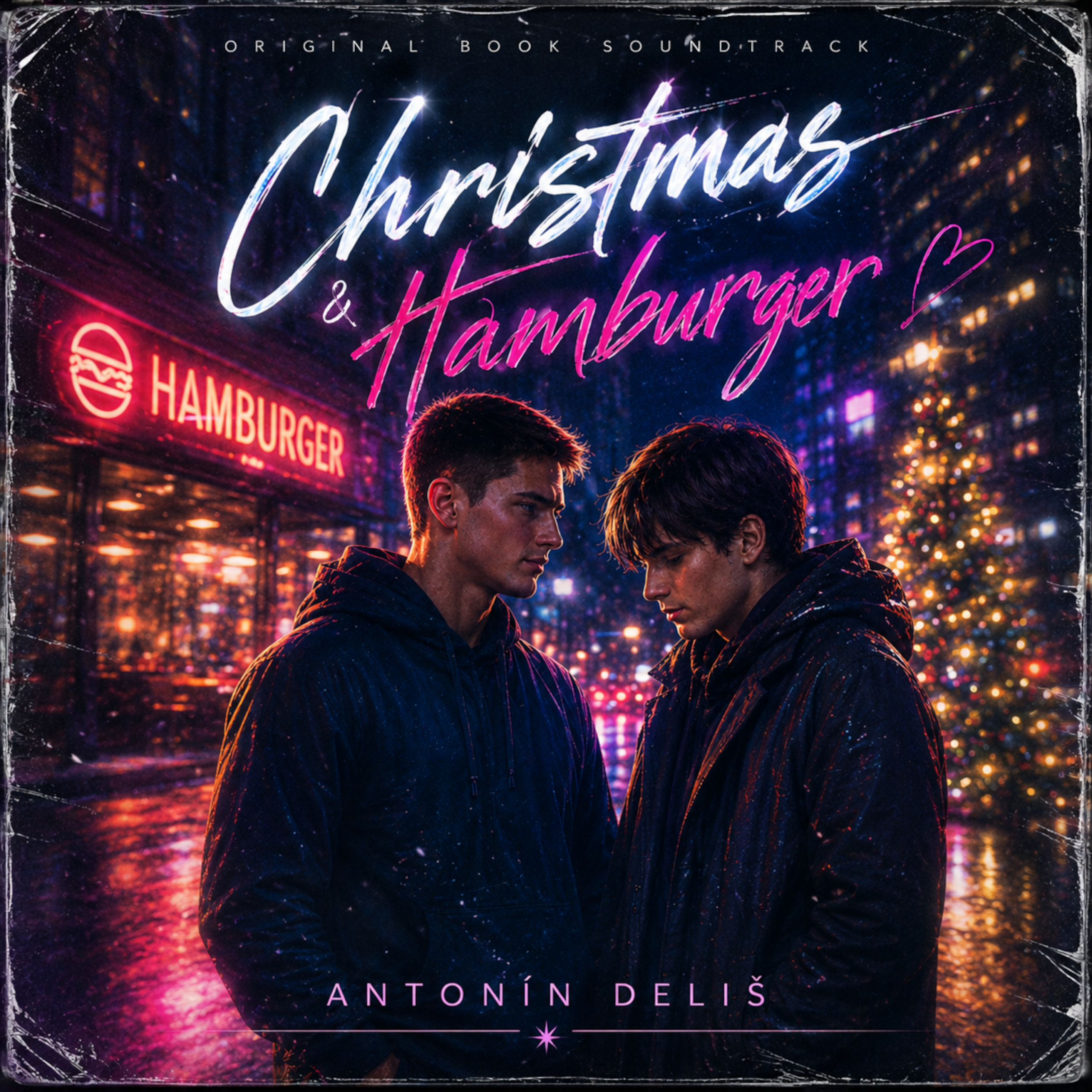
Christmas a Hamburger was born from several seemingly unrelated things that gradually began to fit together into a single story: winter Prague, Hamburg, a soundtrack, Chinese, movies, a language barrier, and the question of whether I could write a young adult novel that would entertain not only readers, but myself as well. At the very beginning was this question: whether it is possible to write a relationship-driven, fragile, almost Christmas-like story for younger readers without having to betray my own way of writing. I didn't want to write a standard romance. I wanted to write something where my melancholy, music, weirdness, city, body, language, and silence would remain. One of the first impulses was a report about a person who woke up after an injury and started speaking a different language. I began looking for other similar cases and was fascinated by how little we actually know about everything the human brain can do with speech. That's where Christmas came from — a person who understands Czech, but out of whose mouth Chinese suddenly comes. Not as a trick. Rather as a new language that has to fit his life. But films and faces that I kept returning to while thinking about the book also found their way into it. Wings of Desire was important to me for its urban melancholy, silence, observation of people, and the strange feeling that a city can be an almost spiritual space. Connected with this was also Peter Falk — his down-to-earth humanity in the middle of a poetic world, an ordinariness that is not ordinary. And for Christmas's appearance, fragility, and quiet intensity, I kept thinking of Zhang Ziyi. Hamburger came from Hamburg: from the black-and-gold apartment, from Dominique's room, from the feeling that someone loved the atmosphere more than the person. From that arose the composition and the chapter Too Dark For You — a sentence that for Hamburger is not self-pity, but a diagnosis. He was too dark for Dominique. Too real behind an image that looked beautiful. Prague was just as important: the Prague of wet sidewalks, display windows, lights, translation on a mobile phone, fast food, bad weather, and accidental movements in which two people can meet without knowing that a story is just beginning. And then the soundtrack. Christmas & Hamburger was not an appendix to the book for me, but one of the ways the book came into being. The individual tracks — ZAARE, Too Dark For You, Pretty Boy, Snow in Your Hair, Something Happened to My Words, Say It Softly, Christmas and Hamburger, ZAARE Lullaby — helped me find the chapters, the mood, and the inner rhythm of the story. In the end, it is entirely a book about language. About how sometimes it is not enough to understand someone through a dictionary. That love can begin not by forcing the other person to return to the old language, but by trying to step into the new one. Even if it were to start only through a mobile phone, a translator, a mispronounced word, tea, a star, and a single Chinese liú.


 ForendorsČÍST · AKTIVNÍ
 WattpadČÍST · AKTIVNÍ
 SpotifySOUNDTRACK · AKTIVNÍ
 Kniha u partneraTIŠTĚNÁ KNIHA · AKTIVNÍ
 Databáze knihKARTA KNIHY · AKTIVNÍ
 Google PlayE-KNIHA · KOUPIT
 VinylVINYL · AKTIVNÍ
 AudioknihaPŘIPRAVUJE SE