
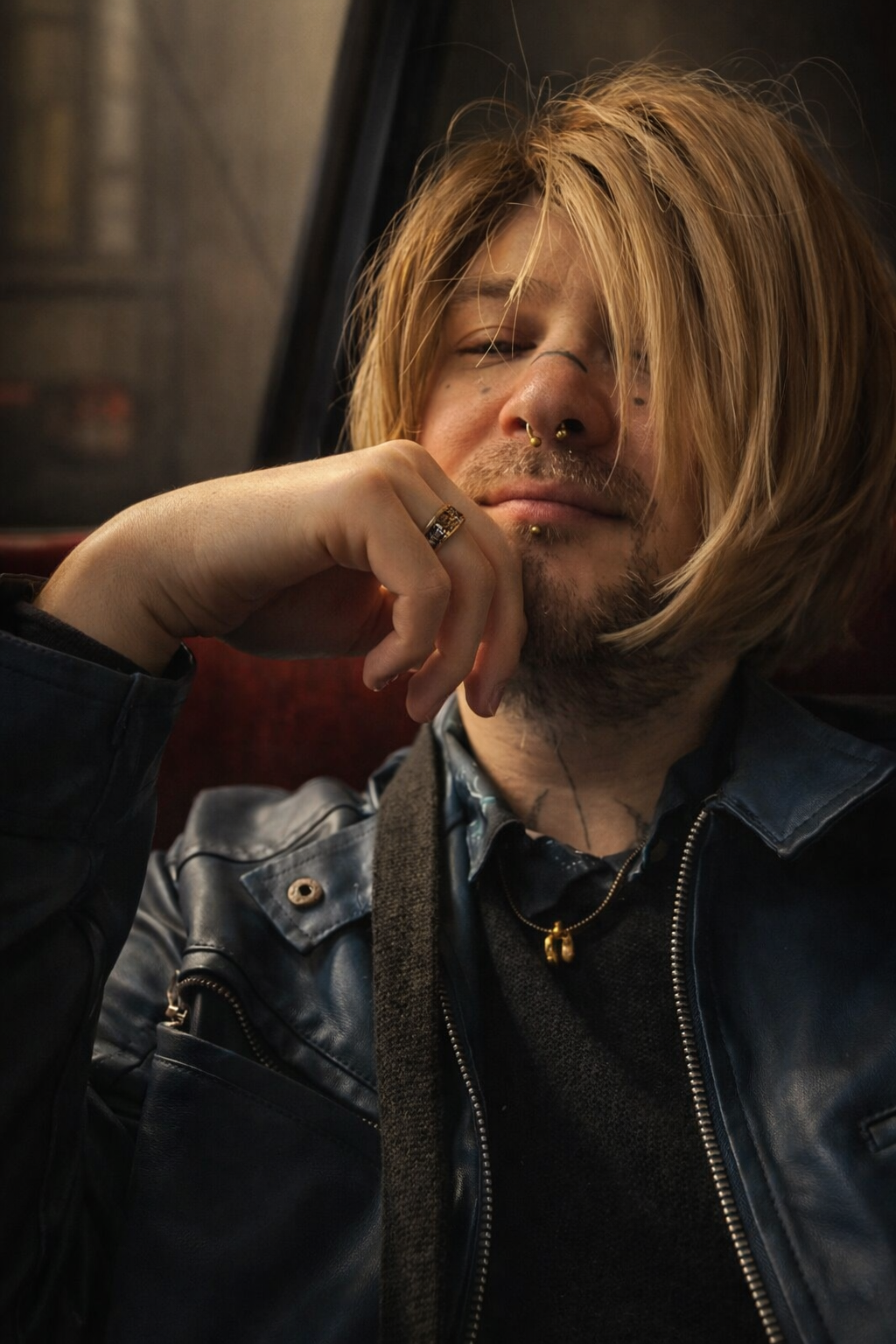
Antonín Deliš talks about the countryside, work, illness, being late, a gay experience, a porn cinema, cards, television, literary debts, a mother who still holds onto him, and why a person sometimes comes to themselves late. This is not an interview about a victorious trajectory. It is an interview about the price of not wanting to lie about what you grew up from and what still shapes you today.
Who is Antonín Deliš today?
A man who no longer wants to pretend to lead a more polished life than the one he actually lives. I don't want to make myself out to be either a cool fringe author or a cleansed cultural version of myself. I don't want to be a caricature. Neither someone else's nor my own.
My life was not composed neatly. It included the countryside, work, family routines, illness, delays, various jobs, various attempts, various identities, various forms of public life, shame, desire, sexuality, spirituality, writing, images, cards, videos, fatigue, and stubbornness. Today I write. That is probably the most accurate description. Not because I have elegantly become a "writer", but because writing is one of the few things that truly keeps me afloat.
"I don't want to invent a polished biography. I want it to be seen that even a life with cracks can have a voice, a meaning, and its own truth."
What kind of world do you actually come from?
From a very specific one. Not from a literary café, not from an environment where knowledgeable conversations about culture were held since childhood. In our family, there was a farm, work, fields, a cow, a bull, goats, rabbits, hay, beets, walnuts. My grandfather made nails, he was a metal engraver, working from morning till night. That was a world where value meant something tangible. Something that is grown, transported, sold, made with your own hands.
Perhaps that is why the tension between what is acceptable and visible, and what takes place inside a person, remains so strong for me to this day. Alongside this world of work and land was me—someone who scribbled, made things up, wanted to go into film, into another space. Right from the beginning, I lived between two currents.
Was there room for art in that world?
Yes and no. The name of Josef Drahoňovský kept coming up in the family. That sort of thing: we have someone here who achieved something. A professor, a glyptic artist, buried at Vyšehrad. A real name, a real result, a real trace. And alongside that was me, drawing, writing, making things, but without a stamp, without confirmation, without a finished form. So art was present there, but more as a yardstick than as a safe space for exploration.
That is an important distinction. When a child grows up next to something that is already finished and recognized, they can feel both inspired and out of place. I probably carried both for a long time.
Did you have anyone in your childhood who shaped your sense for story and depth?
Yes, for instance, my grandmother Ludmila. She preferred the original Cinderella to the one with Libuška Šafránková. She also liked Radúz and Mahulena. She was drawn to darker shades, psychological depth, something I didn't understand as a child, but do now. Perhaps that is also where my feeling for stories that aren't just pretty, but carry a shadow within them, remained inside me.
Did you want to write from the very beginning?
Not just write. I wanted to go into film, to the image, to the theatre, to another space. Except a person can want something very strongly and still have no real way of actually getting to it for a long time.
I remember hearing "film club in Turnov" and it sounded almost like entering another world. But the reality was much smaller. Someone stood in front of the screen, said a few words, played a movie, and everyone went home. No one to actually talk to. No one to guide you anywhere. That's actually a pattern that repeated itself quite often in my life: the desire was alive, but access to it was delayed, imprecise, or interrupted.
Dad shot on an 8mm camera. Grandpa developed photos. Images were all around me, but there was no real transmission. The material was close; the path to it wasn't.
"The most painful part wasn't that I didn't want anything. The most painful part was wanting something very intensely and for a long time having no real way to reach it."
Yet your parents did lead you toward various forms of art as well.
Yes, but not always in a way that felt like mine. I went to solo singing, choir singing, saxophone, orchestra. I had to play the saxophone because of my breathing and also because the orchestra needed a saxophonist. That's exactly it: for part of my life, I felt like I was being slotted into places. That decisions were being made around me that were supposed to be right, useful, healthy, beneficial, and I was trying to find at least a small piece of myself within all that.
What's more, I also experienced environments where supposed arts education mixed with hysteria, pressure, and the helplessness of adults who themselves didn't have the nerves for children. So art wasn't just freedom and joy for me from the start. There was discipline, someone else's idea, nervousness, imprecision, and sometimes almost absurd pressure involved.
Theater was one of the first things I insisted on for myself. And that is precisely why it meant so much to me. It had my will in it.
Did you find a home in the theater?
Not entirely. More like a passage. It was something I fought for, but even there I wasn't naturally at home. I was too uptight, too well-mannered, I didn't smoke, I didn't drink, I didn't fit in there either. And that is perhaps one of my lifelong motifs: to arrive somewhere and be neither completely on the outside nor completely on the inside.
At the same time, however, theater liberated me in a way. Petr Haken and the Turnov theater studio played an important role in that. Petr gave opportunities and also taught me something that stayed with me: when something doesn't work, it's better to let it go. That's a simple sentence, but fundamental for life.
And similarly, Modrý kocour stayed with me too. Today I enjoy it more than years ago, when I could only enjoy it to a limited extent. Perhaps also because over time a person grows into places they used to just pass by.
On top of all that, you were gay. How much did that delay you in relation to yourself?
A lot. For a long time I wasn't myself. Or more precisely: for a long time I couldn't afford to be. Until about twenty-two I was terribly blocked. And when a person cannot breathe normally even within their own identity, everything comes with a delay. Self-confidence, relationship to the body, relationship to other people, the courage to want something, the courage to show oneself.
So when I look back at forty-four and feel like I arrived late, well, that's not just a feeling. Some things really did arrive late. Not just career-wise. Existentially.
"For a long time I had the feeling that I was arriving everywhere late. Not just to the world, but to myself as well."
What role did school play in that?
It wasn't a pillar of support. More like another place where I felt I didn't belong among the properly functioning ones. I was often sick, with a lot of missed classes, sometimes even hundreds of hours per semester. To this day I don't understand how I managed to get through some things at all. I don't have an image of myself as the studious type who understands everything, remembers it, and moves with certainty through knowledge.
Quite the contrary. For a long time, I felt like someone who didn't fit the idea of an educated, confident author. Like someone who is always a bit out of it, a bit behind, a bit broken. And maybe that's why it's important for me to say that writing didn't come to me out of academic certainty. More out of an inner necessity.
Sometimes I really ask myself: how is it even possible that I learned to write? And perhaps that's part of the answer right there. When you lack self-evident competence, sometimes you start holding on to the story.
Did you ever feel stupid?
Yes, but that word is a shortcut. It's not just about a lack of knowledge. I'm not an academic, nor a particularly educated type in the classical sense. Rather, for a long time I felt like I wasn't equipped the way people expect. That I didn't know the things others were supposed to have known long ago. That I arrived late even to areas where everyone else was already speaking fluently.
And today I sometimes feel like everyone is trying to catch you out more than before — just so they don't get caught out themselves. That's a pretty exhausting game.
And now that feeling is repeating itself, for instance, with AI. Once again I have the impression that everyone already knows everything and I'm just playing catch-up again. But at the same time, I know that this feeling has accompanied me almost all my life. And that you can create things in spite of it.
Alongside writing and imagination, you also moved in completely different worlds — erotic print, porn cinemas, booths, queer intimate spaces. Why do you talk about it without shame?
Because it is neither a decoration nor a scandalous insertion. It is part of a world I know. I worked in the erotic press, moved around in the environments of porn cinemas and peep booths, exhibited paintings there, wrote about it, kept returning to it. I don't see it as a disgrace or an exotic curiosity. Those spaces were never just about sex for me. They held loneliness, awkwardness, tenderness, humor, the body, humiliation, longing, and the human comedy.
And at the same time, it wasn't just a sexual space. It was also something like my own Moulin Rouge. A place where I met people with ambitions, other writers, creative people, loners, a strange mix of the fringe, desire, art, and life. That environment was raw, sometimes ridiculous, sometimes tender, sometimes cruel, but certainly not flat.
And because I am interested in human beings precisely where society quickly writes them off or reduces them, it naturally finds its way back into my work. Not as provocation. As part of a reality I know from the inside.
That is also important because of the book Dry your hair at 15:30, 2:45. That also takes place in the settings of porn cinemas and erotic booths. Not as an attraction. But as part of a world where a person shows themselves without the veneer of society.
"I don't view these experiences as a stain, but as part of my world and my observation of people."
Some might say that sounds almost too tough-guy. Like a stylization.
Yet alongside all of that, there was also completely ordinary work. Operation. Service. Fatigue. Systems where they wanted a person to take out their piercing, make themselves smaller, look more acceptable. I have one part inside me that wants to be striking, physical, visible, authorial—and another part that had to survive in environments where a person is asked to do the exact opposite.
And there is something terribly Czech about that. That small-mindedness disguised as professionalism. Nowadays, just about everyone has a tattoo, and yet the game is still played where you have to look safe and nondescript to fit in at work. Incompetence doesn't matter, lack of backbone doesn't matter, but looking too much like your own person does. That's been bothering me for a long time.
And what bothers me even more is the way people are treated. Ghosting after interviews, no replies to emails, no respect for a person's time. In all of this, there's a lot of everyday humiliation that pretends to be a normal process.
Does that also include television, cards, and a person's public image being easily misread?
Yes. That's another layer. I used to read cards, I worked on television, I found myself in the position of someone who is visible and therefore also takes the flak for others. When sensationalism, public shorthand, front-page headlines, television, tabloids, or simply a negative image start swirling around you, you suddenly realize that you aren't just defending your work, but also your right to complexity.
I think there's still a huge need in the Czech Republic to quickly laugh at someone, shrink them down, and pigeonhole them. And with cards or esotericism, that goes double. As if some people couldn't bear the thought that someone works with something that isn't purely mechanical, sensible, rational, and ironic.
Maybe that's also why I felt good in India. Not because I found a fairy tale there, but because sacredness there wasn't automatically embarrassing. It didn't constantly have to apologize for its own existence.
Why did you eventually leave esotericism behind?
Not because it wiped me out. And not because I had to deny it. More because I reached the end of working for others on that path. I worked for others for a very long time, and it got me into a strange bubble where people brought me their sorrows. Meanwhile, happy people were somewhere around the corner, naturally, without me.
And then one day I woke up and started sawing off the business branch beneath me to free myself. Then the pandemic came. One might say bad timing. But during the pandemic I lost a lot of close people and mourned for quite a long time.
All of this changed me. Not in the direction of polish, but toward greater truthfulness about what a person can endure and what they no longer can.
What did esotericism give you and what did it take away?
It gave me a language for something that cannot be fully quantified. It gave me a sensitivity to symbols, to the invisible layers of life, to the fact that a person does not live only within what is visible. But at the same time I also know today that the complete erasure of internal friction is not the path for me.
For a long time I sought peace, reconciliation, inner peace. But over time I understood that if I smoothed everything out of myself, I might not have any friction surface left for creation. I don't know how to create from complete resolution. I create also from restlessness, from tension, from unfinishedness.
“I am not a person who creates from resolution. I create also from restlessness, from tension, from questions that cannot be completely quieted.”
When you talk about your life, money keeps coming up.
Because that is the truth of my life. I am not a writer who is set for life and just cultivates an artist image. I don't have a car, I don't own a home, I haven't been on a normal vacation in years. I returned from cities and periods that I loved often without money. And at the same time I don't want to make a martyr of myself. I just reject the lie that creation automatically means decent conditions.
In my case, creating was often secondary to surviving. Shooting thousands of videos, earning, distributing, producing, making cards, writing books, holding on. Not sitting somewhere peacefully and building a literary aura. When I then step into a space like Book World, I simultaneously realize two things: how late I am arriving there—and that I got there anyway.
How does your mother fit into this?
As both a support and an uncomfortable truth. She still supports me at forty-four. And that’s a hard thing to admit, because you want to stand on your own, you don’t want to feel like you’d fall without help. But sometimes reality isn’t elegant. Sometimes you are carried by help you wish you didn't need.
That doesn’t mean I can’t do anything or that I haven’t achieved anything. It just means that adulthood is not always a clean and triumphant discipline. Sometimes it’s also about accepting help from someone to whom you’d rather just be giving things back by now.
“Adulthood is not always elegant. Sometimes you are still accepting help from someone to whom you’d rather just be giving things back by now.”
How much did your parents' divorce and instability shape you?
A lot. And perhaps more than is visible from the outside. Divorce, uncertainty, the feeling that things can fall apart stay inside a person. Not just as pain, but also as an ability to read other people in their fragility. Perhaps that’s also why I’ve always been interested in people in transition, in collapse, in the tension between what is holding together and what is already falling apart.
To that were added other experiences—bullying, stalking, danger. Some things stay in the body for a long time. Perhaps that’s also why I’ve guarded my own voice and my own image so fiercely all my life. Not out of vanity. Out of the need not to let myself be rewritten by someone else's force again.
You changed your name. What did that mean to you?
At first, it wasn't any noble act of self-determination. It was a way to divert attention. To get people to focus on the name rather than on me. And for years, it worked quite well. The name created a layer through which one could pass more safely.
Then, however, the need to hide this way gradually disappeared. I resolved a lot of things, partly thanks to stays at the meditation center in Oslovice u Kranti, which was my master for several years. Something in me settled down, and the name settled in. It was no longer a shield in the same sense as before.
Later, a different contradiction began to emerge: in public, I was still performing under my old name, while in private, I had long been enjoying being Antonín Deliš. And as Antonín Deliš, I have been walking through the world much longer than my predecessor ever did. Yet some people, especially from my closest circles, feel the need to act as if it happened yesterday. I understand. Everyone has their own worries, and very few people want to disrupt their own peace with something that does not directly concern them. When we don't have to, we usually don't concern ourselves too much with someone else's transformation.
You write across genres. Is that freedom or distraction?
Both. I don't have a strong publisher behind me, nor a fixed institution to guide me in one direction. I've had books in POD, but no one bought them in large quantities. More like in the units. I'm still searching for my readers.
That gives me the freedom to write different things: a fairy tale, sci-fi, heavy contemporary gay romance, poetry, a shorter painful text. Each story asks me for a different shape. At the same time, that freedom isn't particularly lofty. It's not the grand sovereignty of an author for whom everything works. It's more the reality of a person who writes what they need to and hopes their readers will find their way to them.
And there is a strange human irony in it too. In your youth, you giggle that parents don't know the lyrics to songs. And when you grow up, you find that suddenly you don't have the capacity for the lyrics of your favorite songs the way you once thought you would. Similarly, one imagines how naturally they will one day read, navigate, publish, and know. And then you discover that life is full of other pressures, fatigue, and limited capacity.
At the same time, this freedom also means a great responsibility. No one decides for me what should go out now and what can wait. No one tells me: this is your main line, leave that alone. And so lying around me are not only finished pieces, but also debts I owe to my own stories. Harjin and the Star That Fell Twice. Miluj mě do krve. Older collections. Revised editions. Worlds in progress. Returns.
Sometimes it moves me to the point of pain, because I feel how much is still left inside me and at the same time how much time has already passed.
„Perhaps it is precisely conversations like this that create space in me to finish something. As if a person first has to speak things out loud in order to be able to write afterwards.“
How do you view your older work today?
Differently than before. Today I know that even what was created ten, fifteen, or twenty years ago can have its place now. I don't want to discard my older work just because it isn't new. Rather, I am learning to return to my own literary debts and give them shape today.
Perhaps I used to have a greater need to start everything from scratch. Today I know that part of growing up is also returning. Not nostalgically. Creatively. Giving an old text a new breath, a new shape, a new edition.
Why do you write sci-fi and your own worlds when you grew up in the countryside and know a specific landscape intimately?
Because sci-fi is, for me, primarily a world by my own rules, one that I understand. And also a world full of names and designations. I was always demotivated when a world was already completely described and not a piece of it was left for my own imagination.
Come on: go to the Jizera Mountains and tell me why I couldn't name Bukovec precisely Štrachlíl. The answer is simple: because nobody would know what a Štrachlíl is, it has no shared context. Except I don't relate to Bukovec. Nothing binds me to that word. Whereas Štrachlíl? That's a sound, a cluster, something that emerges from my inner self when I see that place.
Someone might say that I can just think about it that way. Only I want to hear those names and I want to use them. And precisely in that lies the problem for me of a world already described. When everything is named to the bone, there is no place left for me there. I'm not saying I don't like that world. I like the Jizera Mountains. I wrote my first poem there with a goose quill next to the Černá Desná on a wobbly little table. I lived at the Souš Mill, even though my parents called it the Cottage by the Stream, and already back then that difference hurt me almost physically. But precisely because of that, I need to name some things my own way. It's not defiance against reality. It's my way of relating to it.
"When the world is already entirely named, there is no place left in it for me."
This year you decided on a kimono for the festival. Why precisely that?
Because something truly struck me. Not as a costume, not as playing at a foreign identity, but as inspiration that I could step into for a moment and let it address me. I saw something that awakened in me admiration and a desire to plunge into a foreign world. And perhaps precisely that is what has drawn me from the beginning—the possibility of letting another universe act upon me without having to deny my own.
I don't normally wear a kimono. But for this year's festival, it suited me. Also because Asian influences have long lived in my books, especially in Poslední noc v New Yorku, even if not Japanese. It's not a disguise. It's a way of acknowledging that even a foreign world can truly speak to a person and shape their sensibility.
What do you know differently today than you did before?
That a person has to live out their dreams on their own. When you don't have children, no one will carry them forward for you, no one will realize them for you, no one will live them for you. And perhaps that is precisely why I put them first. Not out of selfishness, but out of responsibility toward my own life.
What have you stopped trying to prove?
That I have an answer to everything. For a long time, I felt I had to seem surer, smarter, and firmer than I actually felt inside. Today, I am more willing to accept that I don't know a lot of things. That I can search, verify, and learn without pretending to be someone who figured everything out long ago.
What do you no longer want to negotiate?
I no longer want to negotiate the notion that I have to be internally polished, reconciled, and calm to be okay. For a long time, I searched for the path of peace. Today I know that completely smoothing over internal friction would take away something essential from me as well. I don't know how to create from a state of total resolution. And I no longer want to pretend that I should.
What would you say to your younger self?
Maybe nothing. Maybe I would just look into his eyes so he could read what is there. I think some things cannot be explained in advance. Only endured.
And who actually is your reader?
Honestly, I don't know. And it's one of the things that sometimes unsettles me the most. I'm often standing somewhere, looking at people and thinking: does my reader look like this? Then I'm somewhere else and the same thought crosses my mind. I have no certainty of who exactly they are or could be.
I do these interviews also with the hope that they will make something resonate in someone. That something will meet and lead that person all the way to the book. That is my wish. Not to be everywhere. But to truly be with someone.
“Maybe I am not an author who knows from the beginning who he is writing for. Rather, I am writing toward an unknown person and hoping we will one day recognize each other in the text.”
When you sum it all up, what is your most accurate sentence about yourself today?
That I don't want to rewrite my life to make it look cleaner than it actually was. I don't want to turn myself into a legend. But I don't want to shrink myself either. I came from elsewhere, later, through detours, through blocks, through my own cracks. And yet I carry a voice that was born from very different worlds and that I no longer want to silence.















